
Last chance to see the rare interstellar comet 3I/ATLAS live this week

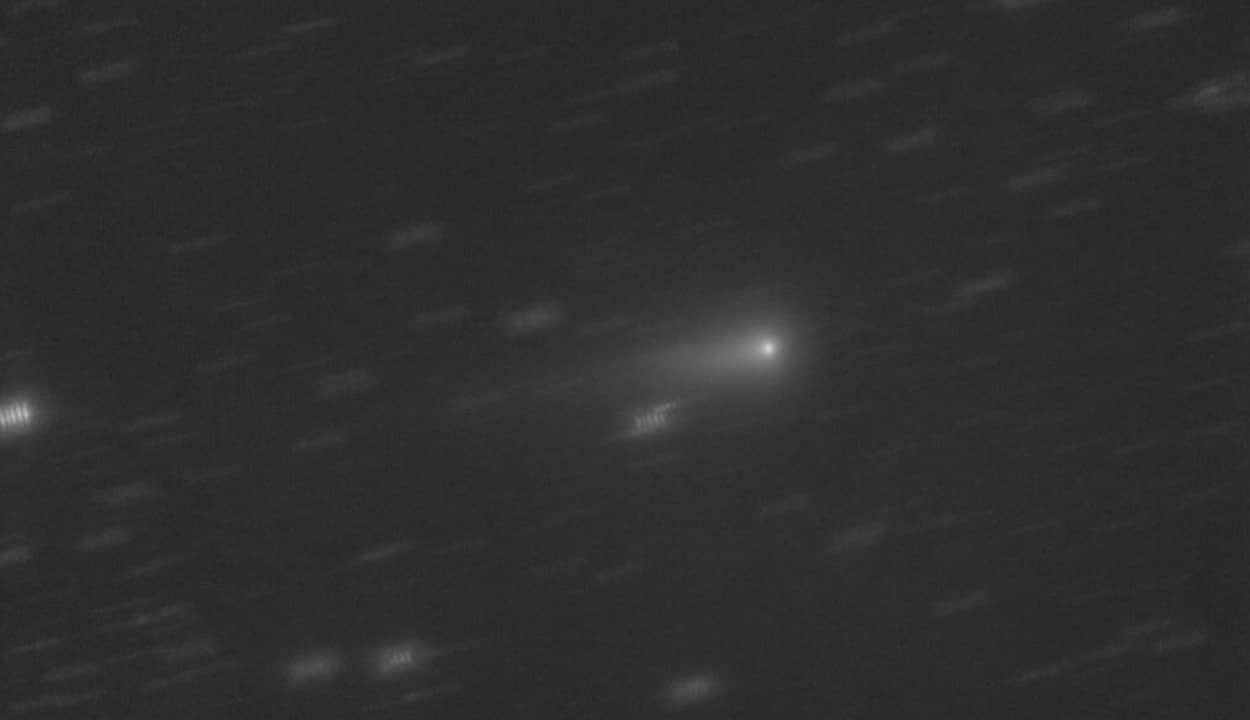
The interstellar comet 3I/ATLAS, the third confirmed object coming from outside Sistema Solar, reaches opposition this week in January 2026. Esse alignment with Sol and Terra normally increases the brightness of celestial bodies, but the visitor has already passed perihelion in October 2025 and quickly loses activity. Sua current magnitude reaches about 15, making it nearly invisible to common amateur telescopes.
Professional observers continue to record the comet with advanced equipment. Recent live Transmissões broadcasts, such as those performed by Virtual Telescope Project, have allowed the public to follow real-time footage of the object during its final visible passage. 3I/ATLAS follows a hyperbolic trajectory, confirming an origin external to our stellar system.
Discovered on July 1, 2025 by the ATLAS system in Chile, the comet sparked immediate interest from the global scientific community. Agências as NASA and ESA mobilized ground- and space-based telescopes to collect data on its composition and behavior over the following months.
Initial discovery and interstellar confirmation
The ATLAS system identified the object in July 2025 as a fast-moving point among the stars. Subsequent Análises orbitals revealed a speed exceeding 240,000 km/h and a trajectory not linked to Sol, characterizing it as the third known interstellar visitor after 1I/’Oumuamua and 2I/Borisov.
NASA scientists quickly confirmed the classification through additional observations. The comet had a visible tail shortly after its discovery, facilitating studies on its composition, rich in volatile gases activated by solar heat.
Trajectory through the interior of Sistema Solar
3I/ATLAS reached its closest point to Sol on October 29, 2025, at about 1.36 astronomical units. Nesse period, recorded a peak of activity with intense release of dust and gases, forming extensive tails captured by telescopes such as Hubble.
After perihelion, the object headed towards Terra, reaching minimum approach in December 2025 at approximately 270 million kilometers. Observações in this interval revealed rapid rotation of about seven hours and symmetrical jets distributed around the nucleus.
The trajectory continued to gradually move it away from Sol. Heat loss reduced the sublimation of icy materials, progressively decreasing brightness and visibility over the following weeks.

Decreased activity and current brightness
The comet has a magnitude close to 15 in January 2026, a value that requires professional instruments for clear detection. Telescópios small amateurs lose the ability to record it due to increasing distance and reduced material release.
Studies indicate that the composition of the nucleus, estimated to be a few kilometers in diameter, includes elements typical of distant comets from other systems. The activity observed during the passage provided valuable data about formation processes in different stellar environments.
- Main changes recorded:
- Drastic reduction in dust tail after November 2025;
- Weakening of previously detected gas jets;
- Stabilization of rotation without recent significant variations;
- Maintaining a predictable trajectory without unexpected deviations.
Opposition and final observation window
The opposition that occurred on January 22, 2026 positioned the comet aligned opposite Sol as seen from Terra. Esse phenomenon generally facilitates prolonged observations at night, but the low brightness has limited its practical use.
Projects like Virtual Telescope Project transmitted live images on that date, allowing remote monitoring by the public. The sessions showed the object as a diffuse point amid the stellar background, marking one of the last large visual opportunities.
Large ground-based observatories continue to collect spectroscopic data. Essas information complements previous records and helps refine models about interstellar objects.
Monitoring by space probes
Missions positioned in the outer Sistema Solar maintain monitoring of the comet on its exit route. The Juno probe, in orbit around Júpiter, has the potential to record the passage scheduled for March 16, 2026, depending on the exact alignment.
Other spacecraft, including Europa Clipper and JUICE, have captured indirect interactions with particles ejected by the comet over the past few months. Análises of this data proceeds to terrestrial laboratories to determine detailed chemical composition.
Spatial records offer unique perspective on object behavior at distances greater than Sol. Esses studies contribute to understanding physical processes in low temperature environments.
Close passage of Júpiter and gravitational effects
The approach of Júpiter in March 2026 slightly alters the comet’s trajectory due to the giant planet’s gravity. Esse encounter does not pose a risk of collision, but provides additional opportunity for observation by dedicated instruments.
Scientists hope to capture variations in the ionic tail during the gravitational interaction. Similar Dados obtained in previous passes of other comets help predict expected behaviors in this specific case.
The Jovian influence marginally accelerates 3I/ATLAS on its escape route. Esse effect contributes to your final speed by leaving the dominant influence of Sol.
Saída prolongada do Sistema Solar
The comet will take decades to cross the heliopause, the boundary region where the solar wind weakens in the face of the interstellar medium. Estimativas indicate a period similar to that observed in the Voyager probes, which took more than 30 years to reach this border.
During this extended interval, the object will remain inactive due to the extremely low temperatures. Sua hyperbolic trajectory guarantees unlikely return to internal Sistema Solar.
Long-term studies based on collected data now allow projections on the dynamics of objects ejected from other stellar systems. Essas information enriches models of planetary formation on a galactic scale.
3I/ATLAS represents a rare example of primordial material preserved from other stars from ancient times. Sua passage provided a unique set of observations that scientists continually explore to advance astronomical knowledge.
Scientific legacy of the passage
The comet’s visit stimulated international coordination between observatories and space agencies. Centenas of accumulated images and spectra form an extensive database available for future research.
Comparisons with the two previous interstellar objects highlight significant differences in shape, composition and behavior. 3I/ATLAS, as it displays classic cometary activity, offers a valuable contrast to the inactive ‘Oumuamua.
Researchers identified rare chemical elements in its tail during peak activity. Esses findings suggest distinct enrichment processes in distant stellar systems.
The accumulated experience improves preparedness for detecting future interstellar visitors. Sistemas alerts like ATLAS demonstrated effectiveness in identifying the object as soon as it enters the internal Sistema Solar.



