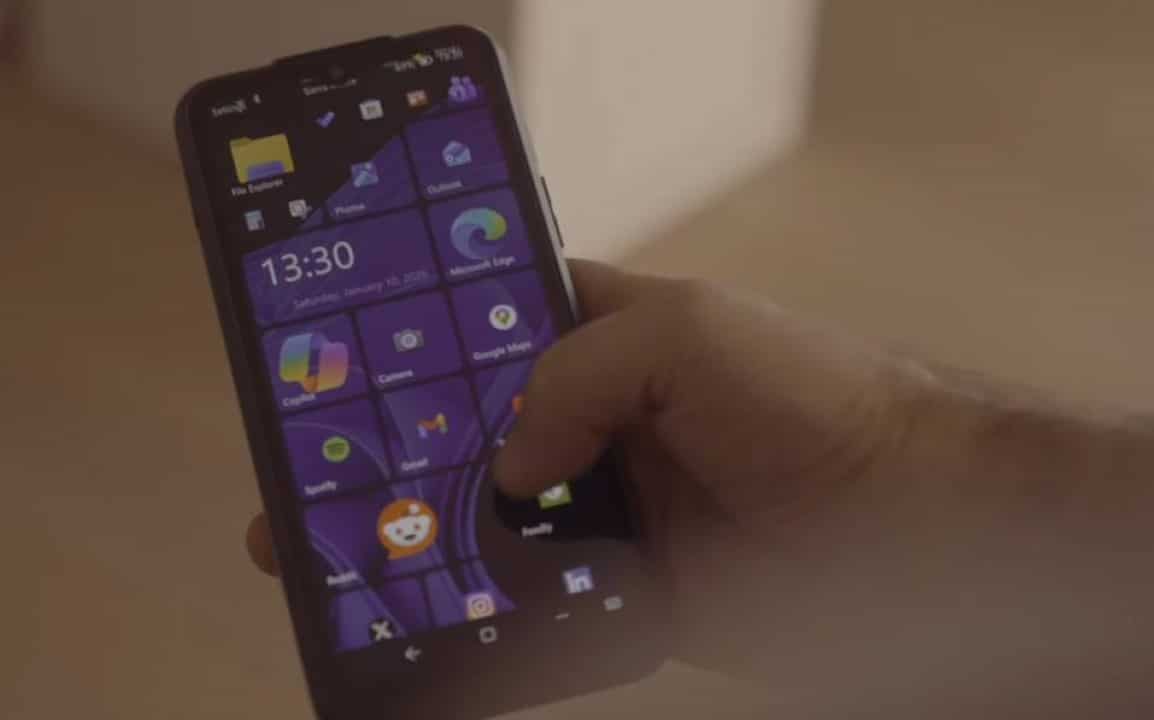
The manufacturer Nex Computer officially announced the launch of the NexPhone, a disruptive smartphone that runs the Windows 11 operating system natively, at an event held this Wednesday, January 21st. The device marks an inflection point in technological convergence by offering support for three distinct software environments on a single compact, portable hardware. With prices starting at US$549, the model seeks to serve technology enthusiasts and professionals who need extreme versatility in their productivity routines.
The announcement came after years of speculation about the viability of desktop operating systems on modern mobile architectures. The company confirmed that the project took more than a decade to be completed and commercialized with stability.
Below are the key technical highlights revealed during the launch:
- Qualcomm QCM6490 chipset with a focus on efficiency and long-term support.
- 12 GB RAM memory to ensure fluid multitasking between different systems.
- 6.58-inch screen with LCD technology and variable refresh rate of 120 Hz.
- Triple support for Android, Linux Debian and Windows 11 operating systems.
This launch places the Nex Computer in a prominent position in the hybrid device niche. The NexPhone is not just a conventional phone, but a mobile computing terminal that challenges the traditional limitations of closed smartphone ecosystems.
Commercial details and hardware availability
NexPhone enters the market with an aggressive value proposition for the niche segment it currently occupies. With the starting price set at US$549, which is equivalent to approximately 87 thousand yen at the current price mentioned in the advertisement, the product is positioned as a viable alternative for those looking for a pocket mini PC. The manufacturer opted for a direct sales strategy initially, focusing on markets that are already familiar with mobile productivity peripherals.
The device is sold with a series of optional accessories that can be purchased separately to expand the user experience. Embora the main focus is independent use, Nex Computer reinforced that integration with external monitors and keyboards is what really unlocks the potential of the Windows 11 ARM. Global distribution logistics are being organized to ensure the product reaches consumers without significant delays after the pre-sale period.
Hardware specifications were selected to optimally balance cost and performance. Confira the internal components that support this complex operational structure:
- 256 GB internal storage with fast reading technology.
- Expansion slot for microSD cards supporting up to an additional 512 GB.
- High-density battery designed to support the energy demands of the Windows 11.
- USB-C connectivity with native support for high-definition video output.
Switching between integrated operating systems
The most impressive feature of the NexPhone is its ability to switch between Android, Linux Debian and Windows 11 in its edition for ARM processors. Para change the working environment, the user needs to perform a complete restart of the device, ensuring that hardware resources are correctly allocated to the chosen system. Essa multiboot approach offers superior stability compared to virtualization or software emulation solutions found on other mobile devices.
The Windows 11 interface on the device was adapted for mobile use through a block interface, reminiscent of ergonomic concepts for smaller screens. However, the system maintains all the functionality of the standard desktop interface when connected to an external monitor, transforming the cell phone into a complete workstation. The user has the freedom to choose which system best adapts to the task at hand, be it media consumption in Android or software development in the Linux environment.
Processing and screen technical specifications
The heart of the NexPhone is the Qualcomm QCM6490 chipset, a powerful solution that shares technical similarities with high-performance Snapdragon line processors. Este component was chosen specifically for its ability to handle instructions from desktop operating systems without excessively compromising battery life. The presence of 12 GB of RAM complements the processor, allowing the Windows 11 ARM to run smoothly in office tasks and advanced web browsing.
The visual experience is guaranteed by a 6.58-inch LCD screen that offers clarity and balanced colors for different types of content. One of the biggest differences of this panel is the variable refresh rate, which varies between 60 Hz and 120 Hz depending on the needs of the system and the application in use. Essa technology allows you to save energy when reading static texts, while delivering extreme smoothness when playing games or navigating quick menus.
The device’s front design makes good use of the edges, ensuring that the device is not excessively large despite the generous screen. The display resolution has been optimized so that Windows elements, such as the taskbar and start menu, remain readable even in portable mode. The integration between the screen hardware and the Qualcomm chipset video driver ensures that there are no image distortions when switching between the native resolutions of the cell phone and external monitors.
Productivity features and USB connectivity
The USB-C port located at the base of the NexPhone serves as the main expansion hub for power users. Graças supports video output, the smartphone can be directly connected to HDMI hubs or DisplayPort monitors without the need for complex drivers. Quando system Windows 11 is active, this connection turns the device into a functional desktop computer, capable of running traditional productivity applications that are not available in mobile app stores.
The use of external peripherals such as Bluetooth or wired mice and keyboards is fully supported by the Windows 11 and Linux Debian kernel present on the device. Isso allows field professionals or frequent travelers to leave their heavy notebooks at home and rely exclusively on their smartphone for complex tasks. Nex Computer designed NexPhone to be a pocket-friendly operations center, eliminating the barriers between mobile and desktop computing.
Data transfer via the USB port also follows high-speed standards, making it easy to back up large files or connect to external storage drives. Essa versatility is essential for the company’s target audience, who generally work with large volumes of information and need quick access to editing or management tools. The engineering applied to connectivity reflects the brand’s commitment to delivering a product that goes beyond basic communication functions.
During project development, the stability of peripheral connections was extensively tested to avoid signal drops or latency. The result is a quick response system that doesn’t disappoint during presentations or work meetings where agility is essential. NexPhone thus establishes itself as a robust technical tool for those who demand the most from their mobile equipment in any geographical or professional situation.
Manufacturer’s trajectory and market vision
Emre Kosmaz, CEO of Nex Computer, expressed his personal and professional satisfaction at seeing the NexPhone finally reach consumers’ hands. In a recent publication, the executive highlighted that it took 14 years of research and development to overcome the technical obstacles that prevented the union of the Windows with the smartphone format. Essa perseverance is characteristic of the company, which is already known in the market for creating accessories that extend the useful life and usefulness of other electronic devices.
The company’s vision focuses on the user’s sovereignty over the hardware they acquire, allowing the installation of different software without the common restrictions of large corporations. By officially supporting Linux Debian, Nex Computer attracts a community of developers and open source enthusiasts who value digital freedom. The NexPhone is presented as the culmination of this philosophy, delivering powerful hardware that does not dictate how the consumer should use it on a daily basis.
Data storage and expansion capacity
Managing files on a device that supports three operating systems requires a very robust and fast internal storage structure. The NexPhone leaves the factory with 256 GB of internal memory, which provides enough space to install the Android, Windows 11 and Linux Debian partitions simultaneously. In addition, the manufacturer has included a dedicated slot for microSD cards that accepts capacities of up to 512 GB, allowing the user to store large libraries of documents, photos and desktop program installers without immediate worries. Essa flexibility is crucial, as computer operating systems tend to take up much more space than mobile versions, requiring a well-sized partition for updates and temporary files.
User interface and mobile usability
To make the Windows 11 usable on a screen just over six inches, the Nex Computer implemented a live tile-based user interface. Essa visual layer facilitates touch and navigation without the need for an extremely precise mouse pointer, adapting the classic elements of Windows for hand ergonomics. Quando the user decides they need more precision, the transition to full desktop mode is immediate when detecting an external peripheral, maintaining the visual and operational coherence of the system.
Security and support for system Linux Debian
The inclusion of Linux Debian as one of the NexPhone’s official boot options addresses a growing demand for security and privacy in mobile environments. Usuários who work with server administration or software development can count on a stable and extensively documented environment directly on their cell phone. Nex Computer guarantees that the system kernel has been optimized to recognize all sensors and hardware components of the device, avoiding common compatibility problems in generic distributions.
This openness to the Linux world also allows auditing and security tools to run natively, something that would be impossible on traditional, locked-down mobile operating systems. The manufacturer’s commitment to long-term support for these software environments reinforces the product’s reliability for the corporate sector. The NexPhone positions itself as reference hardware for those looking for a device that not only makes calls, but acts as a portable technology laboratory.
