
Subaru Telescope identifies quasar with black hole growing 13 times larger than Eddington limit in early universe

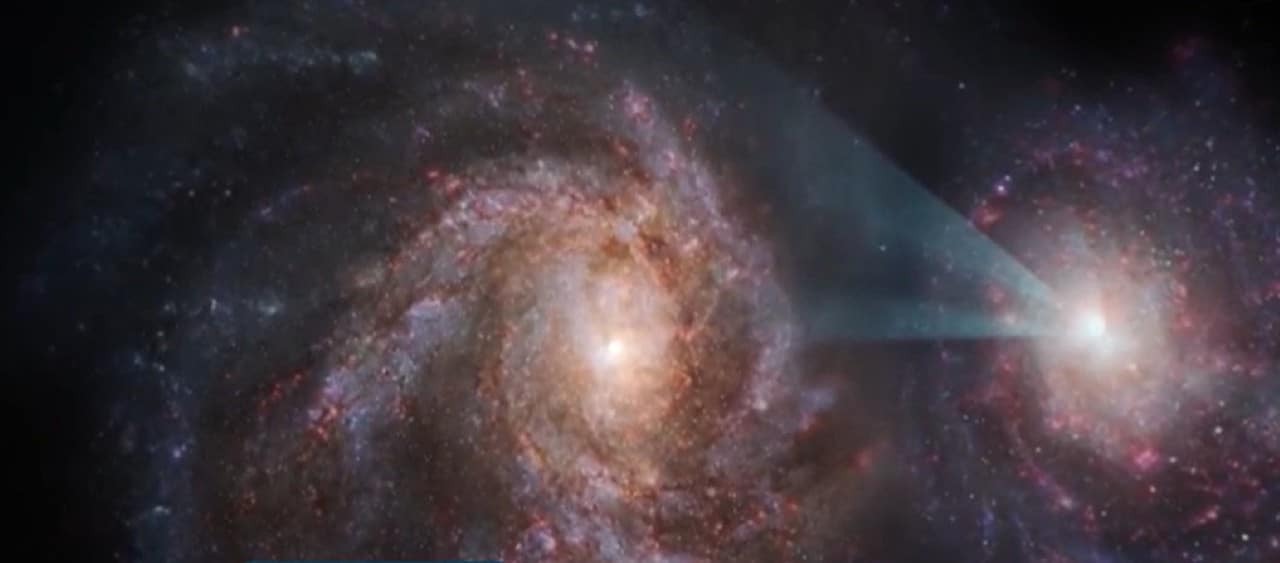
Researchers at Japanese universities have identified an exceptional quasar in the early universe, dating back to approximately 12 billion years ago. The object, known as eFEDS J084222.9+001000, hosts a supermassive black hole that is growing at a rate about 13 times the theoretical limit of Eddington. Essa discovery, carried out with observations from the Subaru telescope, reveals intense emissions in X-rays and radio waves, characteristics considered incompatible with current models of extreme accretion.
The quasar was observed at a time when the universe was less than 1.5 billion years old. Accurate measurement of the black hole’s mass, obtained using near-infrared spectroscopy, confirmed the accelerated rate of gas ingestion. Essa combination of phenomena defies theoretical predictions that expect a reduction in X-ray and radio emissions during phases of superaccretion.
The international team, led by scientists from Universidade Waseda and Universidade Tohoku, used the MOIRCS instrument on the Subaru telescope to analyze the movement of gas near the active nucleus.
Characteristics of the observed quasar
The eFEDS object J084222.9+001000 has a redshift of approximately 3.4, indicating its origin in the distant universe. The X-ray luminosity allowed us to estimate the accretion rate as 13 times the limit of Eddington. The Essa mark places the black hole among the fastest growing ever recorded for its mass range.
Multiwavelength observations highlight strong radio emissions associated with relativistic jets. Esses jets indicate enough energy to interfere with the host galaxy’s star formation. The simultaneous presence of a hot corona, responsible for the X-rays, completes the quasar’s unusual profile.
Limit context of Eddington
The limit of Eddington represents the theoretical balance between the radiation pressure generated by accretion and the gravitational force of the black hole. Quando exceeded, the system enters a superaccretion regime, allowing accelerated growth in short cosmic periods. Esse mechanism explains part of the existence of supermassive black holes in ancient times in the universe.
Conventional models predict that, during superaccretion, the structure of the internal gas flow changes in a way that reduces the production of X-rays. Da Similarly, radio jets tend to weaken due to greater radiation pressure. The discovered quasar contradicts these expectations by keeping both emissions high.
Observations with the Subaru telescope
The Subaru telescope, located atop Mauna Kea in Havaí, provided crucial spectroscopic data via the MOIRCS instrument. Essas observations made it possible to measure the width of the Mg II emission line, used to calculate the mass of the black hole with high precision. The results confirmed the extreme accretion rate inferred from X-ray data.
Combining infrared spectroscopy with multiwavelength archives revealed the object’s atypical behavior. The Subaru telescope stood out for its ability to penetrate cosmic dust and access high redshift emission lines.
Explanation proposed by the team
The researchers suggest that the quasar is in a brief transitional phase after a sudden burst of gas influx. Esse temporary event would raise the accretion rate to super-Eddington levels while corona and jet remain active. Após the peak, the system would tend to return to the standard accretion regime.
This hypothesis explains the coexistence of apparently contradictory phenomena. The flare could result from collisions with gas clouds or galactic interactions in the early dense universe.
Implications for black hole formation
The discovery provides direct observational evidence of temporal variability in the growth of supermassive black holes. Esse process helps understand how massive objects emerged so early in cosmic history. Recent Observações telescopes from the James Webb telescope have identified excessively massive black holes, reinforcing the need for rapid growth mechanisms.
The detected energetic jet suggests feedback capable of regulating star formation in the host galaxy. Essa interaction between black hole and galaxy represents a central aspect of cosmic coevolution.
Scientific publication details
The results were published in Astrophysical Journal on January 21, 2026. The paper, led by Sakiko Obuchi of Universidade Waseda, details multiwavelength analyzes of the quasar. The research received support from Japanese scientific funding agencies.
The lead author highlighted the importance of the finding in clarifying mechanisms for the rapid formation of supermassive black holes. Estudos future ones will search for similar objects in existing catalogs and investigate the physical processes responsible for the observed emissions.
Future research perspectives
Astronomers plan additional observations to monitor the quasar’s variability over time. Telescópios of a new generation will be able to detect more cases of extreme accretion in the distant universe. Esses efforts will contribute to refining theoretical models of black hole growth.
The identification of transitional phases reinforces the idea that short episodes of superaccretion played a key role in rapid mass assembly. Integração with data from other space missions will expand the understanding of primordial galactic evolution.
Main multiwavelength aspects
- Intense X-ray emissions indicate an active hot corona near the event horizon.
- Strong radio signals reveal a relativistic jet with enough power to affect the interstellar medium.
- Infrared spectroscopy allowed accurate measurement of the mass of the central black hole.
- Accretion rate estimated at 13 times the limit of Eddington places the object as a record holder in its category.
Comparison with known objects
The quasar stands out in luminosity versus mass diagrams by significantly exceeding the theoretical limit. Comparações with previous samples show that few objects combine superaccretion with elevated emissions in multiple bands. Essa rarity suggests that the observed phase lasts for a short period on the cosmic scale.
Research in large celestial surveys may reveal a similar population of transitional objects. Esses findings will improve statistics on black hole growth in the young universe.
Impact on cosmic understanding
Supermassive black holes directly influence the evolution of galaxies through energetic feedback. Jatos and winds expel gas, regulating star formation rates. The discovery connects extreme accretion to these processes in the early universe.
Numerical models will need to incorporate temporal variability to reproduce the observations. Future Simulações will test gas flare scenarios and their observational consequences.



