
Intense brightness of 3I/ATLAS reveals unprecedented details during rare solar opposition for astronomers

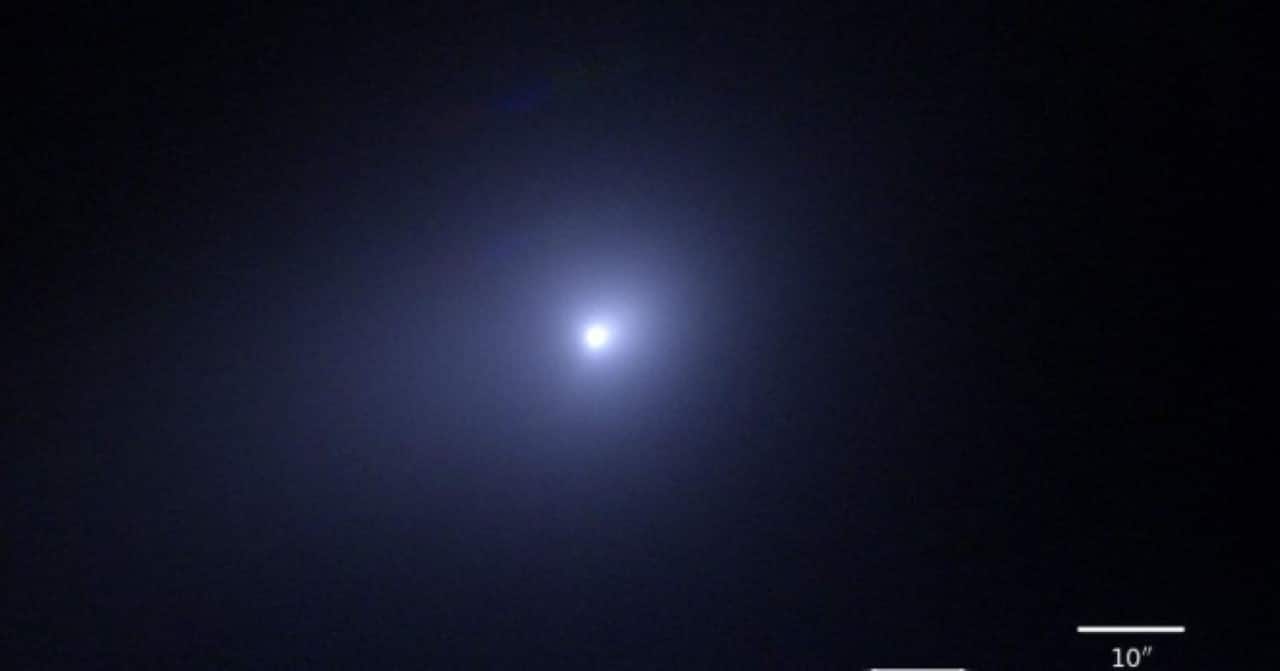
A rare astronomical alignment has placed the interstellar object 3I/ATLAS prominently in the skies, providing an unprecedented opportunity for the scientific community. On January 22, the visitor from another star system reached its solar opposition phase, an event that dramatically intensified its brightness and allowed detailed observations of its unique features.
The phenomenon occurs when a celestial body is positioned directly opposite Sol from the point of view of Terra, receiving full frontal illumination. Esse positioning, with a minimum deviation of just 0.69 degrees, turned 3I/ATLAS into a prime target for telescopes around the world, which turned to capturing the burst of luminosity predicted by recent studies.
The coordinated observation between different agencies and observatories aims to unravel the mysteries about the composition and behavior of the third interstellar object already identified. Data collected during this event is considered crucial to understanding the origin and nature of bodies traveling between stars.

What makes this lineup so special?
Solar opposition is a common event for planets and asteroids within our Sistema Solar, but extremely rare for an interstellar object. The high speed and hyperbolic trajectory of these visitors make the perfect alignment with Sol and Terra a fleeting and difficult to predict moment, making the observation of 3I/ATLAS a historic landmark.
Unlike its predecessors, 1I/’Oumuamua and 2I/Borisov, 3I/ATLAS offered astronomers plenty of time to prepare for the event. Desde its discovery, its orbit was precisely calculated, allowing the scientific community to anticipate peak brightness and plan a global observation campaign to maximize data collection.
The increase in luminosity, compared to a cosmic “full moon”, is not just for sharper images. Ele allows the application of techniques such as spectroscopy and polarimetry with greater efficiency, which can reveal the chemical composition of the gas and dust ejected by the object, in addition to the physical structure of its particles.
This detailed analysis could provide valuable clues about the conditions of the star system where 3I/ATLAS originated. Cada dust particle and each gas molecule carry a chemical signature of their birthplace, offering a glimpse of a distant planetary environment that would otherwise be impossible to study.
The visitor’s journey through our system
First identified in July 2025 by the ATLAS telescope system (Asteroid Terrestrial-impact Sua designation “3I” classifies it as the third interstellar object ever detected, and its trajectory indicated that it is not gravitationally bound to our Sol.
The object made its closest approach to Sol, known as perihelion, in October 2025, passing at a safe distance of about 1.4 astronomical units. Desde then began its outward journey, passing relatively close to the orbit of Terra in December of the same year and heading towards the confines of the system, with an approach to Júpiter scheduled for March 2026.
Anomalies and characteristics that intrigue scientists
3I/ATLAS has proven to be a much more complex and active object than initially imagined. Observações carried out by Telescópio Espacial Hubble throughout 2025 and early 2026 revealed a series of anomalous features that defy conventional comet models. Entre The most intriguing discoveries are the mini-jets of material that emerge from its core at symmetrical angles, forming a consistent pattern that has been captured in several high-resolution images. Além Furthermore, the object’s tail continued to grow in size and complexity even after perihelion, an atypical behavior for our Sistema Solar’s comets, which generally decrease their activity as they move away from the solar heat. Medições of light reflected from the object showed significantly higher levels of linear polarization than those observed in native comets, suggesting a different dust composition or surface structure. Analysis of its trajectory also detected a subtle non-gravitational acceleration, indicating that forces beyond the Sol’s gravity are altering its course, possibly due to the asymmetric ejection of gases, but with an intensity that still seeks a complete explanation.
The contribution of Avi Loeb and the academic debate
Astrophysicist Avi Loeb, of Universidade Harvard, has been a prominent figure in the study of 3I/ATLAS. In collaboration with researcher Mauro Barbieri, Loeb published analyzes that highlighted the importance of the January 22 opposition, predicting the flare and encouraging the astronomical community to focus their instruments on the object during the critical period.
The team’s work emphasizes that the opposition phase was the best opportunity to study the object’s so-called anti-tail, a dust structure that, from our point of view, appears to point toward Sol. Analysis of this structure can provide crucial information about the size and distribution of larger particles ejected by the nucleus.
Loeb has also explored alternative hypotheses to explain the observed anomalies, maintaining scientific rigor and prioritizing the evidence collected. Sua approach stimulates debate and encourages deeper investigation into the true nature of these interstellar messengers.
Post-alignment observations and next steps
With the end of the solar opposition phase, astronomers’ work is far from over. Monitoring of 3I/ATLAS continues as it moves away into interstellar space. Missões and NASA’s SPHEREx have already performed infrared captures that confirmed the object’s intense cometary activity even after its closest approach to Sol.
Data collected by ground-based and space-based telescopes will now be analyzed together to form a complete picture of the object. The expectation is that the consolidated results, to be published in the coming months, will answer some of the questions raised by its unusual characteristics and deepen our understanding of the diversity of bodies that exist in our galaxy.
The legacy for astronomy
The passage of 3I/ATLAS through our Sistema Solar leaves an important legacy for science. Ela reinforces the need to maintain and improve sky scanning systems, such as ATLAS, which are essential for detecting these rare and fleeting visitors in time to study them in detail.
Main registered characteristics
The study of 3I/ATLAS allowed the cataloging of several peculiarities that differentiate it from the comets we know. Sua hyperbolic trajectory, with a speed greater than 50 km/s in relation to Sol, is the main evidence of its extrasolar origin. The presence of a prominent anti-tail, symmetric mini-jets and a high polarization of light are features that continue to be investigated.
These attributes, added to the detected non-gravitational acceleration, make up a unique profile that fuels research into how objects form and evolve in other planetary systems. Cada new discovery about 3I/ATLAS adds a piece to the puzzle of planetary formation on a galactic scale.



