
Interstellar comet 3I/ATLAS surprises scientists with 20 times greater water emission after perihelion

A recent analysis of data from the SPHEREx space telescope revealed extraordinary behavior in the interstellar comet 3I/ATLAS, the third object confirmed to visit our Sistema Solar from another star. Liderada by astronomer Avi Loeb, from
The most impressive finding was a 20-fold increase in the rate of water vapor emission compared to measurements taken months earlier, in August 2025.
Discovered in July 2025, 3I/ATLAS follows in the footsteps of other notable interstellar visitors, ‘Oumuamua and Borisov, but exhibits unique characteristics that distinguish it from its predecessors and also from comets native to our Sistema Solar. The new observations provide an unprecedented opportunity to study the raw material of other planetary systems.
The anomaly detected after perihelion
The crucial observations occurred between December 8 and 15, 2025, when the comet was already moving away from Sol after reaching its perihelion between October 29 and 30. Data collected by SPHEREx showed that the comet’s rate of mass loss skyrocketed, with the release of water and carbon dioxide reaching an estimated 180 kilograms per second. Esse volume of ejected material is substantially greater than that recorded before the solar approach, indicating a large-scale sublimation or fragmentation event. The specific increase in water emission was what caught the most attention of the Loeb team, as it suggests the exposure of large amounts of fresh ice that were previously protected beneath the surface of the cometary nucleus.
This intensification of post-perihelion activity is not commonly observed with such magnitude in comets from our own system. Geralmente, activity peaks near perihelion and gradually decreases as the object moves away from Sol. The explosion of activity of 3I/ATLAS weeks after its closest approach raises the hypothesis that thermal stress may have caused fractures in its crust, exposing pockets of volatile materials to violent and delayed sublimation. The spectral analysis also revealed that the reflected light continuum changed from an ice domain to a low-albedo dust domain, indicating that dark grains, possibly organic-silice, began to dominate the visible surface.
Unique features in the comet’s structure
One of the most intriguing aspects revealed by SPHEREx images is the distinct morphology of the gas and dust plumes. Enquanto the gaseous plumes, composed of water, carbon dioxide and carbon monoxide, maintained an almost perfectly spherical shape, the dust cloud presented an elongated structure, similar to a pear, in the opposite direction to the Sol.
This dichotomy suggests that the gases and dust are being released from different sources or mechanisms in the comet’s nucleus. The spherical symmetry of the gas plumes indicates a source of uniform emission in all directions, possibly from icy fragments that have detached from the main body and sublimated in a homogeneous manner.
On the other hand, the shape of the dust cloud indicates a more directional release. The absence of very fine dust particles, less than a micron in diameter, explains why 3I/ATLAS did not develop a classic dust tail, shaped by solar radiation pressure.
Essa lack of fine particles suggests that the ejecta consists of larger fragments, which are not easily pushed away by sunlight. This characteristic differentiates it markedly from most known comets, whose tails are one of their most defining features.
The SPHEREx mission and spectral analysis
Detailed detection of these anomalies was only possible thanks to the advanced capabilities of the SPHEREx mission (Spectro-Photometer for the History of the Universe, Epoch of Reionization, and Ices Explorer), a NASA space observatory launched in 2025. heated, like those found in comets. Operando in wavelength ranges from 0.75 to 5.0 microns, SPHEREx was able to decompose the light coming from the comet and identify the composition of its plumes with high precision. Foram recorded six distinct gaseous plumes, each corresponding to a specific molecular species. Entre the compounds identified were cyanide (CN), water (H2O), organic compounds rich in carbon-hydrogen (C-H), carbon dioxide (CO2) and carbon monoxide (CO). Cada one of these molecules emits light at characteristic infrared wavelengths, allowing scientists to not only confirm their presence but also estimate their relative abundances and production rates. Essa análise espectral detalhada é fundamental para desvendar a composição primordial do cometa e, por extensão, as condições químicas do sistema estelar onde ele se formou.



Trajectory and discovery of 3I/ATLAS
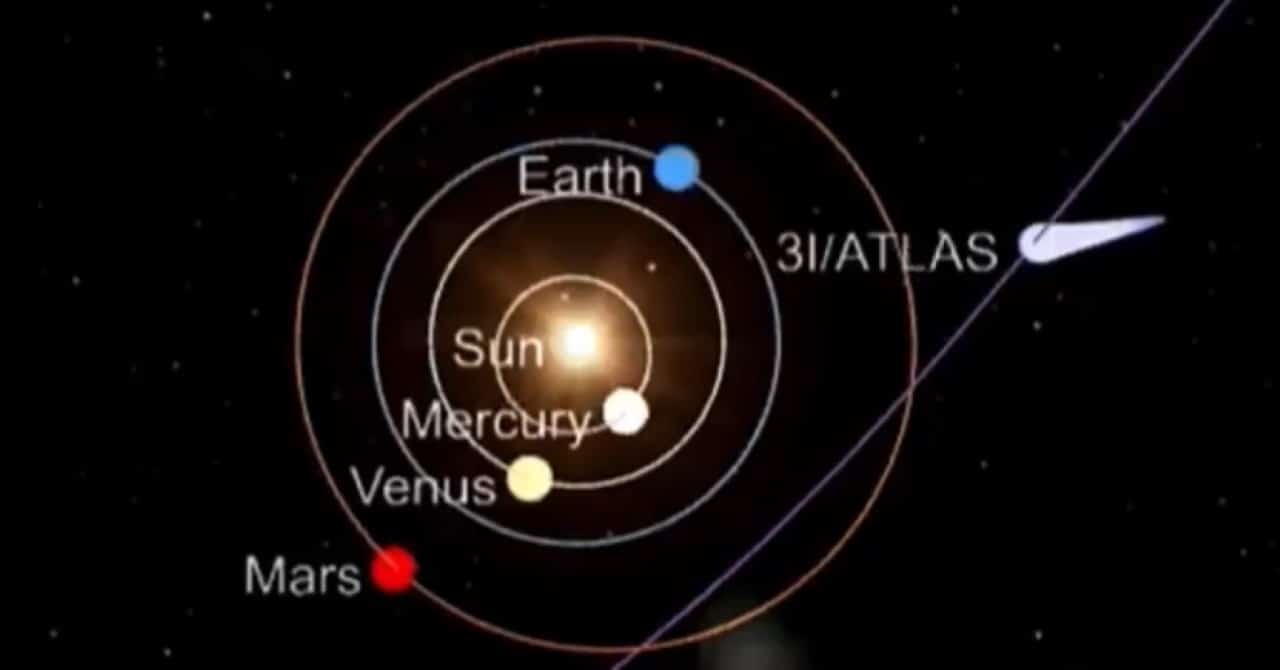
The interstellar comet 3I/ATLAS was identified for the first time on July 1, 2025, by telescopes from the ATLAS program (Asteroid Terrestrial-impact Last Alert System), located in Chile. Observações monitoring carried out by observatories around the world quickly confirmed its extrasolar nature by calculating its trajectory, which turned out to be a sharp hyperbolic orbit.
A hyperbolic orbit means that the object has too much speed to be captured by the gravity of the Sol, indicating that it is not a permanent member of the Sistema Solar and is just passing through. The comet made its closest approach to Sol, perihelion, between October 29 and 30, 2025, at a distance of approximately 1.4 astronomical units (about 210 million kilometers), before beginning its journey back to interstellar space. The minimum distance to Terra was around 1.8 astronomical units, posing no risk of collision.
Composition and the fragmentation hypothesis
In-depth spectrophotometric analysis suggests that the origin of the different materials is segmented. Cyanide and organic compounds appear to derive mainly from ejected dust particles, while water, carbon dioxide and carbon monoxide emanate from symmetrical regions, probably from the nucleus itself or from large icy fragments.
This separation between dust and gas sources implies distinct and complex sublimation processes. The vast extent of the carbon dioxide plume, which stretches for hundreds of thousands of kilometers, reinforces the idea of a massive and continuous release of volatile material.
To explain the observed brightness and the amount of dust required, scientists postulate that the comet may have undergone a significant fragmentation event during or after perihelion. Breaking the main core into smaller pieces, possibly more than 10 meters in diameter, would have exposed a much larger surface area of primordial, ice-rich material to solar heat, resulting in the burst of activity seen in December 2025.
Comparisons with ‘Oumuamua and Borisov
The behavior of 3I/ATLAS positions it as a unique object when compared to its interstellar predecessors. The first visitor, ‘Oumuamua (detected in 2017), was a rocky, elongated object that exhibited non-gravitational acceleration without a visible coma (the gaseous atmosphere), a mystery that still generates debate. Já the second, 2I/Borisov (discovered in 2019), looked much more like a typical comet than our Sistema Solar, with a composition rich in carbon monoxide and a well-defined coma and tail.
3I/ATLAS, in turn, is located at an intermediate and, at the same time, distinct point. Ele has a massive coma, but with an asymmetric gas and dust structure and without a prominent radiation tail. Além In addition, its spectrum of light reflected by the dust displays a bluish tone, different from the reddish tone common in many solar comets. Essas differences highlight the incredible diversity of small bodies that form in other star systems, each carrying clues about its original environment.
Future investigations and observations
Investigations into 3I/ATLAS continue, with other cutting-edge observatories contributing data. Imagens captured by Telescópio Espacial Hubble in January 2026, for example, revealed a peculiar geometry in the jets of material emanating from the nucleus, with some structures maintaining a surprisingly stable alignment, defying cometary rotation models. The astronomical community continues to monitor the object as it moves away, seeking to capture any final variations in its activity before it becomes too faint to observe.
Veja Tambem em News (EN)

Research reveals that parents are unaware of how their children use artificial intelligence

Samsung releases new system update with new features for Galaxy Watch 4 users

Digital retail reduces the value of the Galaxy S25 5G smartphone with bank bonuses and device exchange

Amazon’s wireless CarPlay adapter has a 50% discount and high approval ratings from drivers

Zach Cregger’s new Resident Evil ignores games and focuses on an unprecedented story with new characters

Rumor suggests that Nintendo is preparing a special edition of the Switch 2 with a remake of Ocarina of Time

Apple accelerates production of the iPhone 17e and develops new Air model with dual camera system

Epic Games platform releases twelve high-budget games at no permanent cost for PC users

PlayStation 5 Pro price drop accelerates digital retail sales and eliminates global stocks

New Galaxy Watch 9 firmware appears on server and confirms progress in software development

Apple’s commemorative project tests cell phone with 1.1 millimeter edge and curved screen for 2027
