
Interstellar visitor 3I/ATLAS will have his farewell to the Solar System broadcast live to the public

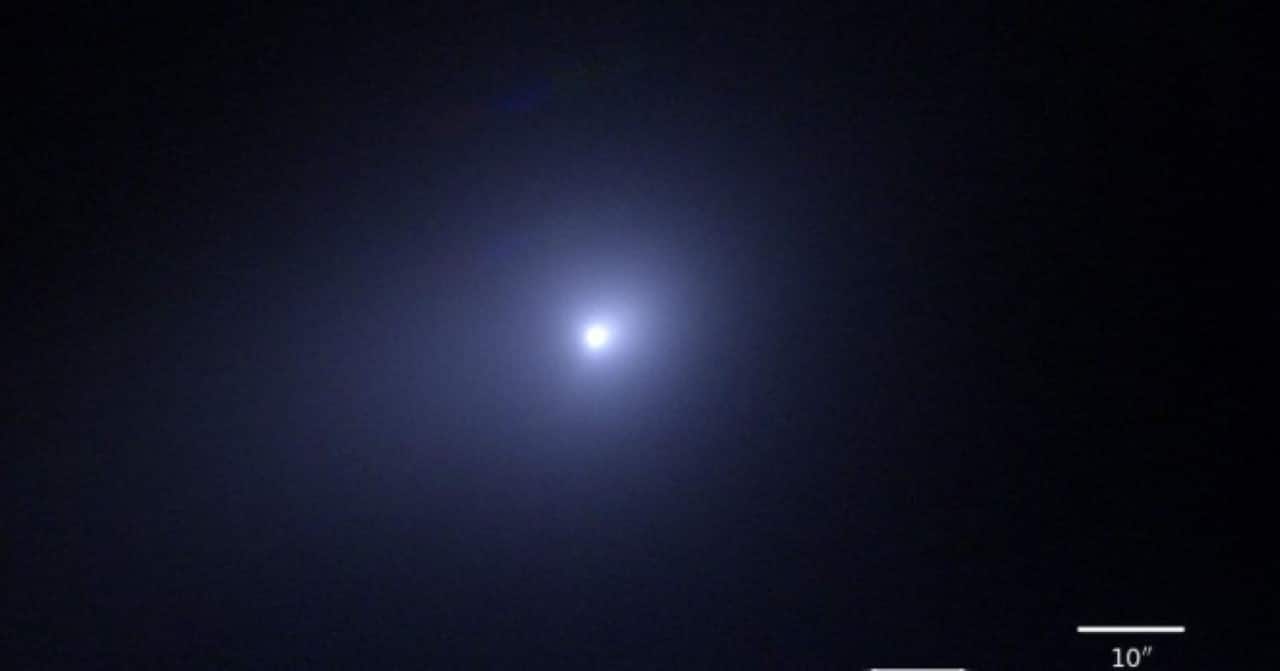
Comet 3I/ATLAS, a rare visitor from another star system, will have its final observation broadcast live around the world. The event, organized by Virtual Telescope Project, is scheduled for January 22, 2026, marking a unique opportunity for the public to say goodbye to the object before it leaves our Sistema Solar forever.
The transmission occurs at an astronomically significant time known as opposition. Nesta date, the comet will be positioned in the sky opposite to Sol, with Terra located directly between the two celestial bodies, providing the most favorable conditions for its viewing and photographic recording from our planet.
Discovered in mid-2025, 3I/ATLAS is only the third interstellar object confirmed to pass through our cosmic neighborhood. Sua hyperbolic trajectory confirms that it is not gravitationally linked to our Sol and, after its passage, it will continue its journey through interstellar space, without ever returning.
What makes the opposition an ideal event to watch
The phenomenon of opposition is one of the most awaited moments by astronomers for the observation of celestial bodies outside the orbit of Terra. Durante this geometric alignment, the object reaches its maximum brightness seen from our planet, as the face facing us is completely illuminated by the Sol, in a manner analogous to a full moon. Além from peak luminosity, the comet will be visible for most of the night, rising in the east at sunset and setting in the west at dawn. Essa long visibility window allows for extended and detailed observation sessions. The phase angle, which is the angle between the Sol, the comet and the Terra, reaches its minimum value, which highlights the details of its surface and the structure of its coma, the cloud of gas and dust that surrounds it. Para scientists, it’s their best chance to capture high-quality data about its composition and activity before it drifts away and its brightness decreases dramatically, making it inaccessible to most telescopes.
The journey of the third confirmed interstellar visitor
Comet 3I/ATLAS was first identified on July 1, 2025 by the ATLAS astronomical survey system (Asteroid Terrestrial-impact Last Alert System), at Havaí. Desde the beginning, its unusual speed and trajectory caught the attention of the scientific community. Subsequent Análises orbitals confirmed that the object followed a sharp hyperbolic path, a clear signature of an origin outside our Sistema Solar. Isso means its speed was too high to be captured by Sol’s gravity, allowing it only a single pass through our neighborhood.
After its discovery, the comet continued its approach, reaching perihelion, its closest point to Sol, in October 2025, at a distance of approximately 1.4 astronomical units (about 209 million kilometers). From then on, he began his long journey away. The relatively slow passage of 3I/ATLAS, compared to previous interstellar visitors, provided astronomers with an extended study period, allowing detailed monitoring of its evolution and behavior as it interacted with the environment of our planetary system.
Live stream details on Virtual Telescope Project
The free, public observation session is scheduled to begin at 23:00 UTC (20:00 Brasília time) on January 22nd. The event will be broadcast on the official Virtual Telescope Project YouTube channel, allowing enthusiasts from anywhere in the world to participate virtually.
The presentation will be led by Italian astrophysicist Gianluca Masi, founder of the project. Ele will provide real-time expert commentary, explaining images captured by the observatory’s robotic telescopes and answering questions from the public.
The date was meticulously chosen to coincide with the exact moment of opposition, ensuring the best possible image quality. The event represents the culmination of months of monitoring the comet by the project and offers a symbolic farewell to the cosmic traveler.
Contributions from large space and ground observatories
Since it was detected, 3I/ATLAS has become a priority target for the world’s main observatories. Telescópio Espacial Hubble was activated to capture very high-resolution images, revealing details in the structure of its coma and dust tail at different times during its passage, such as in July and November 2025.
Telescópio Espacial James Webb, with its infrared sensitivity, performed spectroscopic analyzes to decipher the chemical composition of the gases released by the comet. Esses data is fundamental to comparing the raw material of other star systems with that of ours.
Space missions en route to other destinations, such as Europa Clipper and Juice, which are heading to Júpiter, have also adjusted their instruments to observe the comet from unique perspectives, far from Terra.
On the ground, the Very Large Telescope (VLT) at Chile and other large observatories have contributed spectroscopic and photometric data, helping to build a complete profile of this rare interstellar messenger.
How to locate 3I/ATLAS in the night sky
For amateur astronomers equipped with telescopes, the comet can still be found during the month of January. Ele moves through the constellation of Câncer, a region of the sky that is relatively easy to identify during summer in the Southern Hemisphere and winter in the Northern Hemisphere.
Although its brightness is decreasing as it moves away, the object is still accessible to medium-sized instruments with apertures of at least 20 centimeters (8 inches). Para To record images that reveal its coma and faint tail, astrophotography techniques with long exposure times are recommended.
The scientific importance of studying objects outside the solar system
Studying visitors like 3I/ATLAS is of immense scientific value, as they offer a direct sample of material formed around another star. Analisar its composition, structure and orbit allow scientists to test theories about the formation of planets and comets in other systems, as well as better understand the distribution of organic and volatile matter throughout the galaxy. Cada new interstellar object detected helps build a clearer picture of the diversity of planetary systems that exist beyond our own.
Differences and similarities with ‘Oumuamua and Borisov
Comet 3I/ATLAS follows in the footsteps of 1I/’Oumuamua, detected in 2017, and 2I/Borisov, in 2019. Cada one of these objects presented distinct characteristics, revealing the complexity of interstellar visitors. ‘Oumuamua was a peculiar, elongated, rocky object that did not display a visible coma, leading to debates about its nature. Já Borisov behaved like a classic comet, with a well-defined coma and tail, and its chemical composition was surprisingly similar to that of our Sistema Solar comets.
3I/ATLAS seems to fit more closely with the profile of Borisov, exhibiting clear cometary activity. However, his trajectory allowed for a much longer and more detailed period of observation than that of his predecessors. Comparisons between the three provide crucial data so scientists can begin to understand the frequency and variety of such objects that roam Via Láctea, offering clues about the architecture of other star systems.
The future of interstellar object detection
The detection of three interstellar objects in less than a decade suggests they may be more common than previously thought. Technological advances and the entry into operation of new observatories promise to revolutionize this area of astronomy. The Observatório Vera C. Rubin, in the Chile, for example, is designed to scan the entire visible sky every few nights with unprecedented depth. Espera This survey, known as LSST (Legacy Survey of Space and Time), is expected to identify dozens or even hundreds of interstellar visitors per year. With a statistically robust sample, astronomers will finally be able to classify different types of objects, understand their most likely origins, and draw a map of the chemical composition of our galactic neighborhood. The era of interstellar exploration through these cosmic messengers is just beginning, and the legacy of 3I/ATLAS will be to have deepened the path to future discoveries.



