
Eagle Nebula is the scene of a rare encounter between comet SWAN and the famous Pillars of Creation

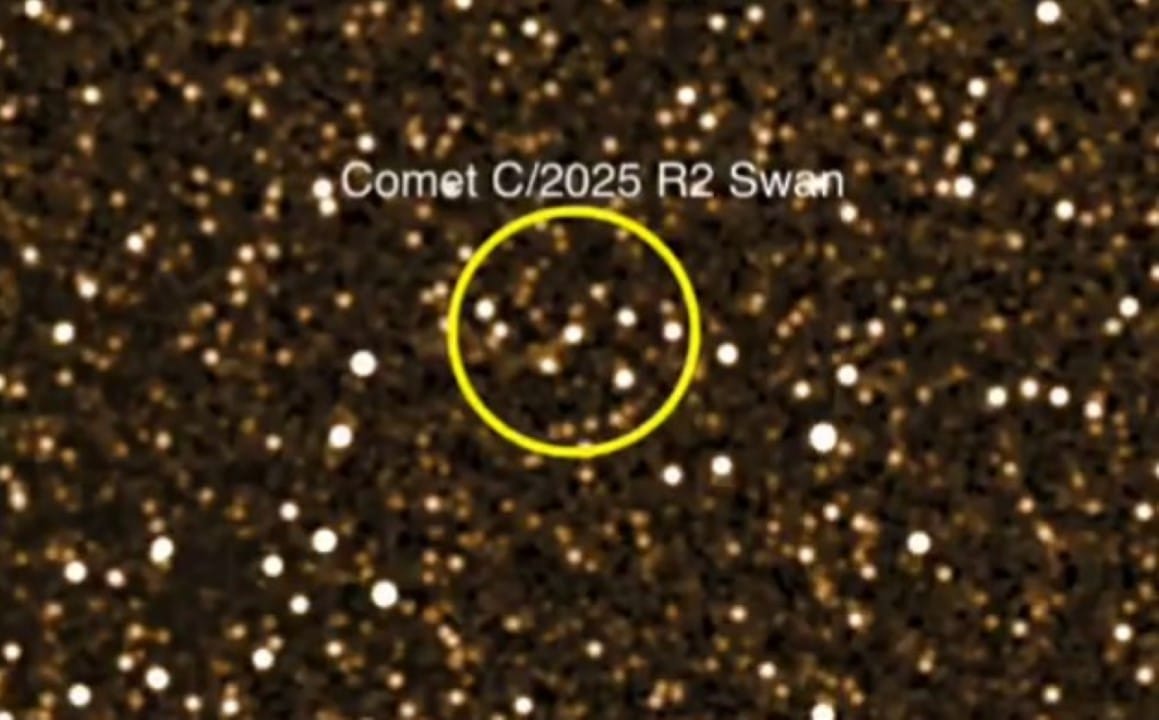
A rare cosmic alignment was recorded in the skies of Deserto, Atacama, Chile, providing an image of singular beauty for astronomy. Comet C/2025 R2 (SWAN) was photographed in a privileged position next to the iconic Pilares of Criação, one of the best-known formations within Nebulosa of Águia (M16), located in the constellation of Serpens. The spectacular record, which highlights the contrast between the comet’s greenish coma and the columns of gas and dust, was obtained on October 17, 2025.
The author of the photograph is the Italian astronomer Daniele Gasparri, who took advantage of the ideal conditions in the Chilean sky to document the event. The visual proximity between the two celestial objects occurred just over a month after the comet reached its perihelion, the point of closest approach to Sol, on September 12, 2025. During this period, the object still maintained a considerable brightness, which facilitated its capture next to the nebulous structure, which is approximately 7,000 light-years from Terra.
Composing the image required not only refined technique, but also patience and perfect atmospheric conditions. The result is a portrait that unites a transient visitor from our Sistema Solar, comet SWAN, with one of the most famous stellar nurseries in our galaxy, the Pilares of Criação. Photography quickly gained prominence in communities of amateur and professional astronomers, celebrating the beauty and dynamics of the universe.
1/4.☄️Hemos captured at Cometa C/2025 R2 (SWAN) from Observatorio to Teide.
This cosmic journey has been in orbit for 800 years, and its last visit was in the XIII era! 🤯
📷Image from October 21st, highlighting its extensive and luminous color.
Credit: D. López and A. Rosenbergpic.twitter.com/Y0ukEiq6MU
— IAC Astrofísica (@IAC_Astrofisica)November 27, 2025
The technical challenge behind the capture
Obtaining an image with such clarity and detail of two such distinct celestial objects represented a significant challenge for Daniele Gasparri. The main technical obstacle lies in the apparent movement of the bodies: while Nebulosa and Águia is a deep-sky object and remains relatively static in the telescope’s field of view during capture, comet SWAN was moving in its own orbit. Isso requires precise tracking to prevent the comet’s image from becoming blurred or the stars in the background turning into dashes. The technique involves aligning multiple short exposures, centered either on the comet or on the stars, and then combining them digitally.
For the capture, Gasparri used a Newtonian astrograph-type telescope, with 130 mm aperture and a focal length of 650 mm, equipment optimized for wide-field photography. The final composition was the result of the sum of 40 individual exposures, each 120 seconds long. In total, it took almost 1 hour and 20 minutes of integration time to accumulate enough light to reveal the subtle details of both the comet’s coma and tail and the dense gas clouds of Pilares and Criação. Further processing was crucial to balance the brightness of the different elements and enhance the colors and structures in a scientifically accurate way.
The journey of comet C/2025 R2 SWAN
Comet C/2025 R2 SWAN is a long-period object, which means that its orbit around Sol takes thousands of years to complete. Sua discovery occurred on September 10, 2025, made by Ukrainian amateur astronomer Vladimir Bezugly.
Bezugly identified the object by analyzing public images captured by the SWAN (Solar Wind Anisotropies) instrument, which operates aboard the SOHO (Solar and Heliospheric Observatory) probe, a joint NASA and ESA project.
This comet has a highly inclined orbit, approximately 90 degrees in relation to the ecliptic plane, where the planets of Sistema Solar orbit. Essa’s unusual orbital feature makes it an object of great interest to scientists studying the dynamics of the outer Sistema Solar.
After passing through perihelion in September 2025, the comet began its long journey back to the colder and more distant regions of Sistema Solar, towards Nuvem of Oort. Sua próxima visita ao interior do sistema está prevista para ocorrer somente daqui a cerca de 1.400 anos.
Pillars of Criação: An Iconic Stellar Nursery
The Pilares and Criação are undoubtedly one of the most iconic structures in modern astronomy, first immortalized in 1995 by an image of the Telescópio Espacial Hubble. Essas colossal columns of interstellar gas and dust are part of Nebulosa and Águia and function as a true nursery of stars. The structures, which span approximately 4 to 5 light-years in length, are dense enough that the gas inside them collapses under its own gravity, giving rise to protostars. Essas forming stars are hidden within the tips of the pillars, protected from intense external radiation. Recentemente, Telescópio Espacial James Webb produced new images of the region in infrared, revealing unprecedented details and showing young stars that were previously invisible. Ultraviolet radiation emitted by a cluster of young, massive stars, located outside the field of view of the classical image, is slowly eroding and sculpting the pillars. Esse process, known as photoevaporation, is responsible for the dramatic appearance of the formation and, over millions of years, will eventually completely dissipate the columns of gas and dust, revealing the stars that formed within them.
The science behind the green color
The vibrant green color surrounding Comet SWAN’s nucleus, known as its coma, is a fascinating chemical phenomenon. Essa characteristic coloring does not come from the comet’s ice or rock, but rather from specific gases that are released when the icy core is heated by solar radiation.
The main responsible for the greenish hue is diatomic carbon gas (C2). Quando sunlight hits these molecules, they are excited and emit light predominantly in the green spectrum. Outro compound, cyanogen (CN), also contributes to this emission, although to a lesser extent.
The importance of Deserto and Atacama for astronomy
The choice of Deserto over Atacama to perform high-quality astronomical observations is not a coincidence. The region, located in the north of Chile, is widely recognized as one of the best places in the world to practice astronomy, both professional and amateur.
Its geographical and climatic conditions are unique: the high altitude, which in some points exceeds 5,000 meters, places the observatories above much of the atmospheric turbulence. Além Furthermore, extreme aridity results in a very low level of humidity and an average of more than 300 nights of clear skies per year, with practically non-existent light pollution.
Repercussions in the astronomical community
The image captured by Daniele Gasparri generated an immediate wave of excitement as soon as it was released. Fóruns online, social media groups and publications specializing in astronomy highlighted the record as one of the most beautiful of the year 2025.
Astrophotographers from around the world praised the technical quality of the capture, highlighting the difficulty of balancing the exposure of a diffuse and moving object, such as a comet, with a faintly bright nebula.
The event also served as inspiration for many amateur astronomers in the southern hemisphere to point their own equipment at the region, trying to record the cosmic encounter. The visual conjunction between Comet SWAN and Pilares from Criação was a reminder of the dynamism of the night sky.
Visibility of the comet during its passage
During the month of October 2025, comet SWAN reached an apparent magnitude close to 7.5. Esse’s brightness placed it at the limit of visibility to the naked eye, making it possible to detect it only in extremely dark places free from any light pollution. Para most observers, the use of optical equipment was essential. With common binoculars, such as the 10×50 type, or small telescopes, the comet’s greenish coma became easily identifiable as a diffuse spot among the stars in the constellation Serpens.




