
Hubble reveals symmetrical jets on interstellar comet 3I/ATLAS during rare alignment with Sun

Telescópio Espacial Hubble recorded detailed images of the interstellar comet 3I/ATLAS on January 22, 2026, during a rare alignment with Sol and Terra. The captures, taken in six exposures of 170 seconds each, show a luminous halo elongated towards Sol, with a length of around 100 thousand kilometers.
This alignment, known as the quasi-opposition phase, occurred with a minimum deviation of 0.012 radians in relation to the Sol-Earth line. The setup allowed us to observe normally hidden structures, including a prominent anti-tail and three mini-jets surrounding the core.
The data was processed with a specific filter to remove the circular symmetric glow, revealing details of the material ejection. The event took place between 13:10 and 13:43 UTC time.
Structure of the observed jets
The processed images highlight four main jets emanating from the 3I/ATLAS core. The anti-tail appears directed almost exactly towards Sol and Terra, a rare feature in common comets.
Three mini-jets complement the structure, separated by angles of 120 degrees from each other. Essa angular symmetry draws the attention of astronomers, as it suggests a uniform distribution of surface activity.
One of the mini-jets has a weaker brightness, possibly due to its unfavorable orientation in relation to the terrestrial observer. The general configuration indicates periodic ejections of material.

Image processing
The Larson-Sekanina filter was applied to Hubble captures to isolate asymmetric structures. Esse method removes the circular envelope of dust and gas, detaching residue from the jets.
The results show the halo elongated towards the sun, with a length ten times greater than the diameter of Terra. The technique allowed us to visualize details that would remain invisible in standard observations.
The analysis revealed oscillations in the jets every 7.2 hours, with variations of up to 20 degrees around the axis of rotation. Esse behavior explains the difficulty in perfect anti-tail alignments.
Features of the alignment
The January 22 alignment represented a unique “full moon” observation opportunity for the comet. Nessa configuration, the object reflects maximum sunlight toward the Terra, increasing the observed brightness.
The minimum angular proximity to the Sol-Earth axis favored the recording of luminosity bursts. Esses outbreaks depend on the composition of the particles ejected by the nucleus.
- Halo extension: around 100 thousand kilometers
- Angular deviation: 0.012 radians
- Exposure duration: 170 seconds each
- Jet oscillation period: 7.2 hours
The configuration prevented the anti-tail from being completely embedded in the symmetric nuclear glow.
Context of the interstellar object
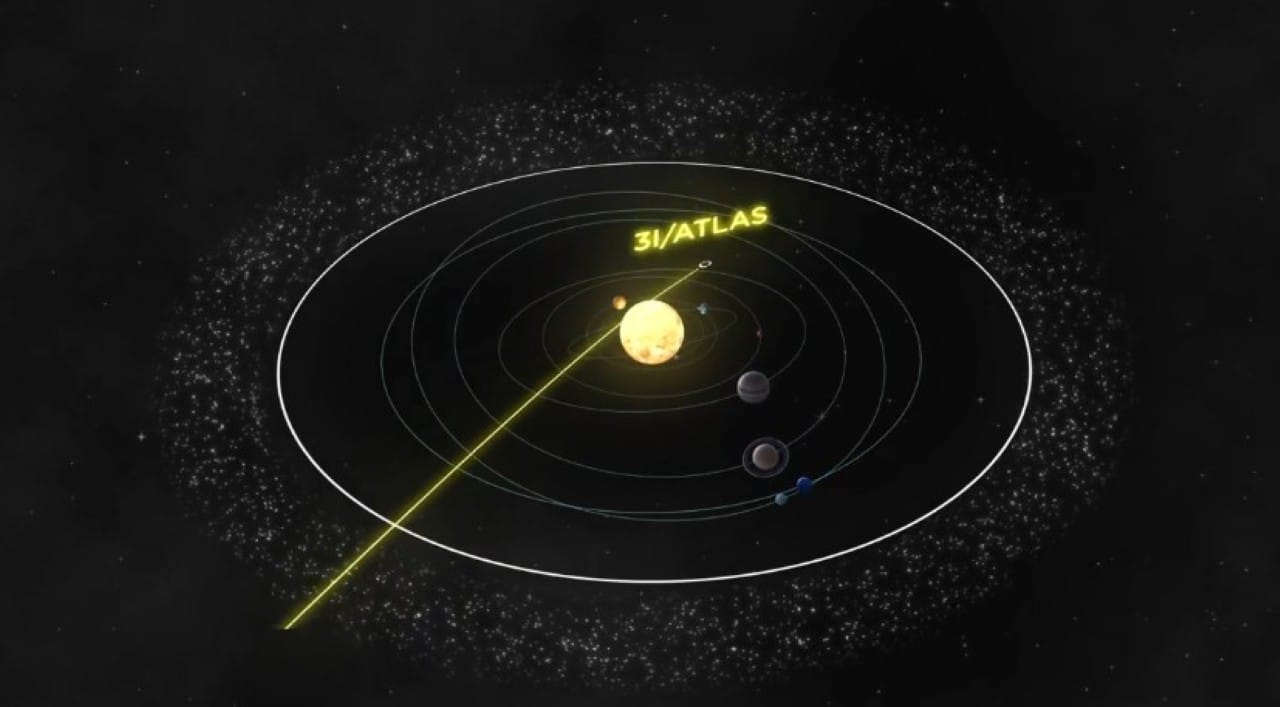
3I/ATLAS is the third confirmed object of origin outside of Sistema Solar, after 1I/’Oumuamua and 2I/Borisov. Descoberto in 2025, it follows a hyperbolic trajectory, confirming its interstellar nature.
The comet passed perihelion in October 2025, about 1.4 astronomical units from Sol. Desde then gradually moves away from the internal Sistema Solar.
Previous observations of Hubble, carried out in November and December 2025, already indicated coma and tail activity. The January images add details about the rotational dynamics.
The object maintains active ejections even at greater distances, unlike typical solar comets. Essa persistence suggests significant reserve of volatiles in the core.
Registered anomalies
Among the unusual features of 3I/ATLAS is the resistance of the anti-tail to the solar wind. Normalmente, cometary tails are deflected away from Sol, but this structure penetrates hundreds of thousands of kilometers in the opposite direction.
Possible compositions include ice fragments, large dust grains or denser particles. The symmetry of mini-jets raises questions about uniform sublimation processes.
The unstable rotation of the core contributes to the observed variation in the jets. Estudos indicate that the 7.2 hour period causes the detected wobbling.
These anomalies add to a list of 18 peculiarities identified since the discovery.
Importance of observations
The January images provide crucial data for understanding the composition of interstellar objects. The rare configuration allowed it to measure ejection rates and material distribution with greater precision.
The Hubble remains essential for monitoring distant objects, even with current operational limitations. The captures complement ground-based observations and observations from other missions.
Researchers highlight that events like this rarely occur when interstellar visitors pass through. The opportunity helped refine models of cometary behavior outside of Sistema Solar.
Future analyzes may clarify the origin and evolution of 3I/ATLAS in its galactic journey.
Technical details of the captures
The six exposures were obtained with the WFC3 UVIS camera on the F350LP filter. Esse instrument is optimized for ultraviolet and visible observations of faint objects.
The processing revealed a false-color brightness map, highlighting contrasts in the coma. The application of the graduated rotational filter isolated the linear features of the jets.
The exact date of maximum alignment occurred at 13:00 UTC on January 22nd. At Nesse moment, the object showed maximum elongation towards Sol seen from Terra.
Study perspectives
The symmetrical structure of mini-jets offers material for investigations into rotation and sublimation. The 120 degree separation suggests equatorial distribution of active sources in the core.
The resistant anti-tail maintains interest by challenging standard models of solar wind interaction. Composições alternatives continue to be evaluated by specialized teams.
The gradual withdrawal of 3I/ATLAS will reduce future opportunities for detailed observation. The current data will serve as a reference for future interstellar visitors.



