
James Webb reveals hidden structures in the Helix Nebula and stellar fate of the Sun


Telescópio Espacial James Webb recorded high-resolution images of a portion of Nebulosa and Hélice, located approximately 650 light-years from Terra in the constellation Aquário. Essas observations highlight thousands of cometary knots and intense stellar winds that shape the gas expelled by a star in the final stages of evolution. The structure, popularly known as Olho from Sauron, serves as a model to understand the process that Sol will undergo in billions of years.
Nebulosa of Hélice represents a planetary nebula formed by material ejected from a star similar to Sol. The James Webb, operating in infrared, penetrates layers of dust that optical telescopes like the Hubble cannot reveal with the same clarity. Essas new captures show dramatic transitions in the gas and dust around the dying central star.
Astronomers use these observations to refine models of stellar evolution in medium-mass stars. The observed phenomenon occurs when the star exhausts its nuclear fuel and begins to expel its outer layers, creating visible structures in the cosmos.
Details revealed in new observations
James Webb focused on a specific region of the nebula where high-speed stellar winds push expelled material. Esses winds create complex patterns in the ionized gas, visible thanks to the telescope’s infrared sensitivity. The image highlights contrasts between dense and rarefied areas.
Denser regions resist radiation pressure and form the characteristic cometary knots. The Cada structure features a bright head facing the central star and an elongated tail extending in the opposite direction. Esses elements appear in greater number and definition than in previous records.
We featured comedians
Cometary nodes dominate the new image of James Webb in Nebulosa in Hélice. Estima It is believed that the nebula contains around 40 thousand of these formations. Cada node has larger dimensions than Sistema Solar up to the orbit of Plutão.
The head of each node receives intense ultraviolet radiation from the central star, which ionizes the gas and generates an intense glow. The tail, in turn, consists of less energized material that stretches due to stellar winds. Essas structures arise in turbulent environments typical of nearby planetary nebulae.
Astronomers identify similar patterns in other nebulae, but the proximity of Hélice allows for detailed observations. Knots indicate how the material resists expansion and preserves density amid chaos.
Comparison with images from Hubble
Telescópio Hubble has captured iconic views of Nebulosa from Hélice in visible light over decades. Aquelas images showed the circular eye shape with smooth concentric rings. The Hubble highlighted the central disc and diffuse outer layers.
James Webb complements these views by revealing elements hidden by dust in the infrared. The new capture emphasizes cometary nodes that remained less visible previously. Combining data from both telescopes provides three-dimensional understanding of the structure.
This multi-mission approach makes it possible to map the dynamics of the expanding gas. Cientistas integrate observations to model the speed and direction of stellar flows.
Nebula formation process
Stars like Sol maintain stability for billions of years through nuclear fusion in their cores. Quando hydrogen runs out, the balance breaks and the star begins significant expansion. Ela transforms into a red giant and begins to lose outer layers.
The ejected material forms a gaseous envelope illuminated by radiation from the remaining star. Na Nebulosa from Hélice, this process began around 15 to 20 thousand years ago. The current structure is estimated to be between 10 and 12 thousand years old.
- Initial expansion of the outer layers
- Gas ionization by ultraviolet radiation
- Formation of dense knots resistant to winds
- Gradual dispersion of material in the interstellar medium
Future evolution of the structure
Nebulosa from Hélice will continue to expand over the next few thousand years. The gas will become progressively thinner as it moves away from the central star. Radiation decreases as the stellar core cools and becomes a white dwarf.
In approximately 50,000 years, the nebula will completely dissipate into interstellar space. The incorporated material will enrich the galaxy with heavy elements produced during the star’s life. Esses atoms will be able to integrate future generations of stars and planets.
The central star will evolve into a hot, compact white dwarf initially. Ela will only emit waste heat for billions of years without generating new energy through fusion.
Parallels with the future of Sol
Sol follows an evolutionary trajectory similar to that of the progenitor star of Nebulosa and Hélice. In about 5 billion years, it will run out of central hydrogen and begin expanding into a red giant. Planetas inmates, including possibly Terra, will face extreme conditions.
After the giant phase, Sol will eject outer layers forming a similar planetary nebula. The remaining core will contract into a white dwarf with a mass approximately half that of the current one. Essa structure will temporarily illuminate the surrounding material.
The process recycles chemical elements in the interstellar medium of Via Láctea. Hidrogênio, helium and metals produced in the stellar interior disperse and contribute to future formations.
Scientific importance of observations
Planetary nebulae represent a brief phase in stellar evolution, lasting tens of thousands of years. Elas act as laboratories to study gas dynamics under extreme conditions. The James Webb images provide data on the formation of complex structures in low-density environments.
Cometary knots reveal the material’s resistance mechanisms to radiation and winds. Esses patterns help explain morphological diversity among observed planetary nebulae. The proximity of Hélice makes it an ideal target for testing theoretical models.
Infrared observations detect complex organic molecules in gas and dust. Esses compounds indicate chemical processes that precede the formation of planetary systems. The study contributes to understanding the origin of the building blocks of life in the universe.
Context of Nebulosa of Hélice
Nebulosa of Hélice, cataloged as NGC 7293, is among the brightest and closest planetary nebulae. Sua circular appearance in optical telescopes inspires popular visual comparisons. Astrônomos amateurs often observe it with modest equipment due to its apparent brightness.
The estimated distance varies between 650 and 700 light years based on modern measurements. Ela resides in the galactic plane of Via Láctea in a region rich in interstellar gas. The complete structure covers an area equivalent to half the diameter of the full Lua in the sky.
Previous studies with ground-based and space-based telescopes have mapped its chemical composition. The expelled material contains hydrogen, helium and traces of oxygen, carbon and nitrogen.
James Webb Technological Advances
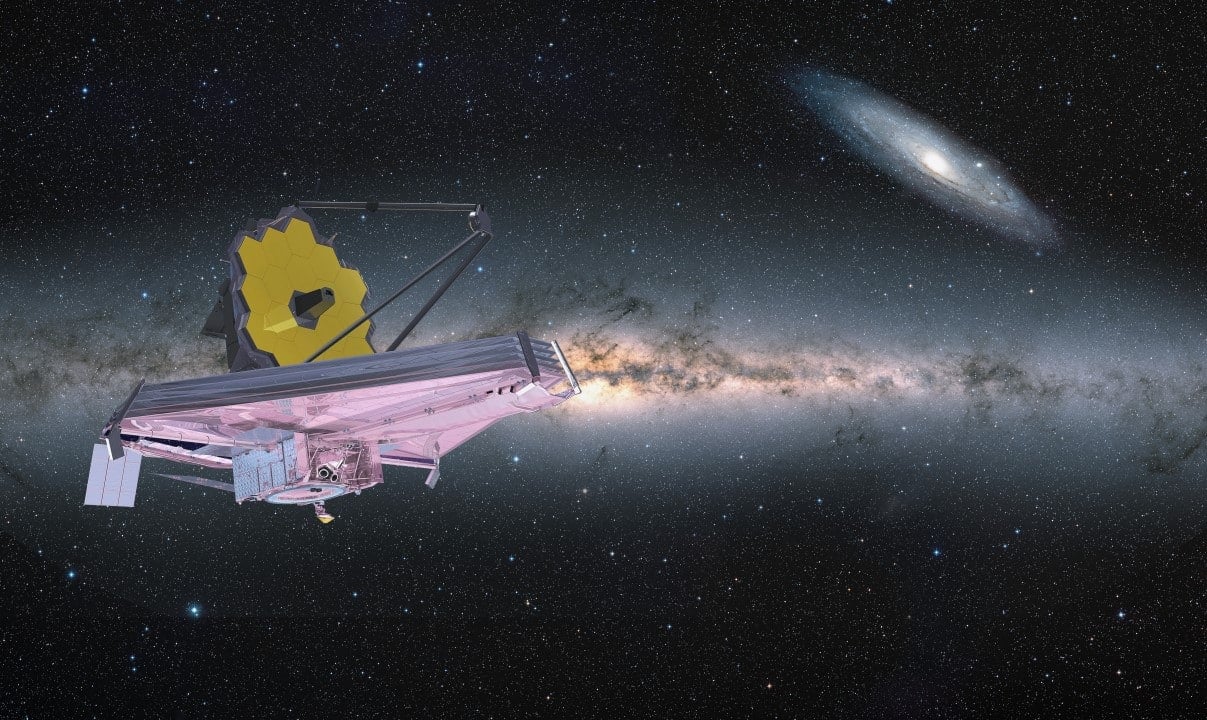
The James Webb operates with a segmented 6.5-meter primary mirror and infrared-optimized instruments. Essa setting allows you to capture light from cold, distant objects obscured by dust. The orbit at the L2 point guarantees thermal stability and continuous observations.
The NIRCam camera recorded new images of Hélice at specific wavelengths. Esses filters highlight molecular gas emissions and hot dust. The resolution achieved reveals features smaller than 1 arc second.
Combining with data from the MIRI instrument extends the spectral analysis. Cientistas extract information about the temperature, composition and movement of the material.
The Telescópio Espacial James Webb continues to provide data about objects near and far. Nebulosa’s observations of Hélice exemplify how advanced technology illuminates fundamental cosmic processes. Essas images reinforce the understanding of stellar evolution and the cycle of matter in the universe.



