
Third generation Jeep Compass adopts STLA Medium platform and has its debut confirmed for the Japanese market

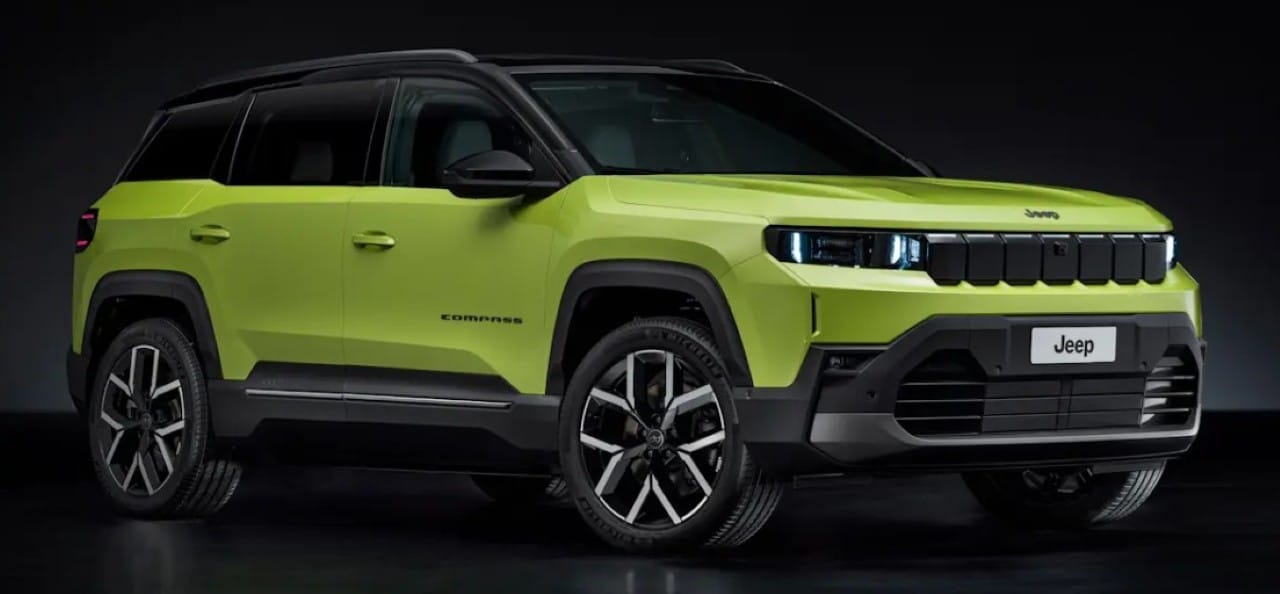
The Jeep officially announced the arrival of the third generation of the Compass, one of the brand’s most successful SUVs, which is undergoing its most significant transformation in almost a decade. The new model is built on the modern STLA Medium platform from the
The SUV maintains its robustness and off-road capability, characteristics intrinsic to the DNA of the Jeep, but now with a more contemporary and aerodynamic design. The dimensions were slightly increased, reaching 4.55 meters in length, which translates into a considerable increase in internal space, especially for rear seat passengers, and greater volume in the trunk.
The vehicle’s world premiere took place at Itália, with production centralized at the Melfi factory. Para the Japanese market, the launch is scheduled for the second half of 2026, with an initial focus on the mild-hybrid version, which combines energy efficiency with the performance expected by consumers in the region.

Modern and functional exterior design
The external appearance of the new Jeep Compass has been redesigned to convey a more imposing and sophisticated image, without abandoning the brand’s classic elements. The iconic seven-slot grille has been reinterpreted and now incorporates active shutters, which close at high speed to optimize airflow. Juntamente with a flatter floor, these innovations contribute to an aerodynamic coefficient (Cd) of just 0.29, a remarkable value for an SUV and which results in lower fuel consumption and internal noise.
Functionality has also been improved, with the parking sensors and driver assistance systems repositioned in a higher area of the bumper, protecting them from possible damage during use on rough terrain. The body now measures 4,552 mm long, 1,819 mm wide and 1,641 mm high, with a generous wheelbase of 2,795 mm. Esse growth directly reflects occupant comfort, with a 22 mm increase in legroom in the rear seat.
Spacious and technological interior
The cabin of the new Compass represents a technological leap for the model. The driver has a fully digital 10-inch instrument panel at their disposal, which is configurable and provides clear information about driving. The center console is dominated by an impressive 16-inch horizontal screen of the Uconnect infotainment system, which centralizes navigation, media and connectivity functions.
Despite digitalization, the Jeep chose to maintain physical buttons for essential controls, such as air conditioning control and audio volume. Essa decision aims to ensure safer and more intuitive operation while the vehicle is in motion, meeting demand from many consumers who prefer haptic feedback for frequently used functions.
The commitment to sustainability is also present in the interior, with the use of recycled materials in several finishing components, without compromising the perception of quality. Versatility is reinforced by the trunk, which now offers a maximum capacity of 550 liters, enough volume to meet the needs of families and travel enthusiasts.
The versatility of the STLA Medium platform
The adoption of the STLA Medium platform is the cornerstone of the evolution of the third generation of the Compass. Desenvolvida by Stellantis to be the basis for future vehicles in the C and D segments, this architecture stands out for its flexibility and efficiency. Ela was designed from the ground up to accommodate different types of propulsion, allowing the Jeep to offer the Compass in combustion engine, mild hybrid, plug-in hybrid (PHEV) and 100% electric versions. Essa modularity is crucial for the brand to adapt to different emissions regulations and consumer preferences in different markets, such as Europa, América, Norte and Ásia. Além Furthermore, the platform optimizes weight distribution and the center of gravity, improving driving dynamics both on and off asphalt. Para the electric versions, the 400V architecture allows quick recharges, recovering from 20% to 80% of the battery in approximately 30 minutes using high-power chargers, and offers a range that can exceed 600 km, depending on the battery and engine configuration.
Engine options
The range of engines in the new Compass was designed to meet a wide spectrum of needs. The mild-hybrid version (MHEV), which will be the entry point into the Japanese market, uses a 1.2 three-cylinder turbo engine.
This engine is associated with a 48V electrical system and a six-speed dual-clutch automated transmission (e-DCT6), which integrates a small electric motor. Juntos, deliver 145 horsepower.
The MHEV system allows the vehicle to move in 100% electric mode at low speeds, such as during parking maneuvers or in slow traffic, in addition to providing assistance to the combustion engine during acceleration, improving fuel efficiency.
All-electric (BEV) variants will be available with front- or all-wheel drive. The projected range in the WLTP cycle varies between 500 km and 650 km. The 4xe all-wheel drive system consists of a 132 kW (around 180 hp) electric motor positioned on the rear axle, ensuring the off-road capability expected of an Jeep.
Advanced assistance features
The new Compass raises the safety standard with the inclusion of a package from Sistemas Avançados to Motorista (ADAS) equivalent to level 2 semi-autonomous driving. As standard, the model has adaptive cruise control with stop & go function, lane keeping assistant and autonomous emergency braking.
Even in front-wheel drive versions, the Selec-Terrain system remains available. Essa technology allows the driver to electronically adjust the vehicle’s traction parameters for different road surfaces, such as sand, mud or snow, optimizing grip and control.
Main specifications
The new dimensions and technical improvements position the Compass as a highly competitive option in its segment. The key data reinforces its balanced proposal between urban use and adventure capacity.
The updated model numbers are as follows:
– Comprimento: 4,552 mm
– Largura: 1,819 mm
– Altura: 1,641 mm
– Distância between axles: 2,795 mm
– Porta-bags: up to 550 liters
– Aerodynamic Coeficiente: 0.29 Cd
Preparation for the Japanese market
The launch on Japão in the second half of 2026 will be strategic for Jeep, as it seeks to expand its presence in a competitive market. The choice of the mild-hybrid version as the initial flagship is in line with the local preference for efficient, low-emission vehicles, especially for use in large urban centers. The brand is betting that the combination of its off-road reputation with new electrification technology will be an important differentiator in attracting new customers.



