
Voyager 1 probe approaches historic landmark 25.9 billion kilometers from Earth on interstellar journey


The Voyager 1 probe, the most distant human-built object from Terra, continues its pioneering journey through the cosmos and approaches an unprecedented milestone. Lançada by NASA on September 5, 1977, the spacecraft is designed to reach a distance of one light day from our planet, the equivalent of 25.9 billion kilometers, in November 2026. Este feat will consolidate its position in the history of space exploration.
Currently traveling at a speed of over 61 thousand km/h, Voyager 1 is already more than 25 billion kilometers away. The Atingir one-light-day milestone means that a radio signal, traveling at the speed of light, will take 24 hours to get from Terra to the probe. Essa monumental distance poses significant challenges to communication and mission control.
Managed by NASA’s Jet Propulsion Laboratory (JPL) at Pasadena, Califórnia, the mission overcame countless obstacles over nearly five decades. Seus radioisotope thermoelectric generators, which provide energy through the decay of plutonium, continue to operate, albeit at a gradually reduced capacity, allowing the probe to send back valuable data from interstellar space.
Current operational challenges
Keeping a spacecraft functional after nearly 48 years in deep space presents unique technical challenges. In November 2023, Voyager 1 faced a critical failure in its flight data system (FDS), which interrupted the transmission of readable scientific information for five months. JPL’s Engenheiros managed to solve the problem in April 2024, in a complex maneuver that involved relocating software code to a functional section of the probe’s memory, restoring communication.
Communication with Voyager 1 is an exercise in patience and precision. Data arrives at an extremely low rate of 160 bits per second, a speed comparable to old dial-up internet connections. To capture this faint signal, NASA uses Deep Space Network’s giant antennas (DSN), combining the power of multiple receivers to ensure that no information is lost in the vast silence of space.
Active instruments and data collection
Despite its age and limited power, a select set of instruments aboard Voyager 1 remain active, providing crucial data about the interstellar environment. The plasma wave subsystem continues to detect the subtle interactions in the heliopause, the boundary where the influence of our star’s solar wind ends and the interstellar medium begins. Essas measurements are fundamental to understanding the dynamics between our solar system and the galaxy.
The observations revealed the existence of giant magnetic bubbles in the heliosheath, a turbulent region beyond the orbit of Plutão, and recorded variations in the solar magnetic field. Além In addition, the cosmic ray detector measures high-energy particles originating outside our solar system. The intensity of these rays increased dramatically after the probe crossed the heliopause in 2012, confirming its transition into interstellar space.
This data, transmitted to Terra via a frequency of 8.4 GHz, is essential for refining scientific models about the interaction between Sol and the rest of Via Láctea. Para save power, some instruments, such as the Cosmic Ray Subsystem, have been temporarily shut down, but the magnetometer remains a priority and remains operational to map the magnetic field of deep space.
Exploration of gas giants
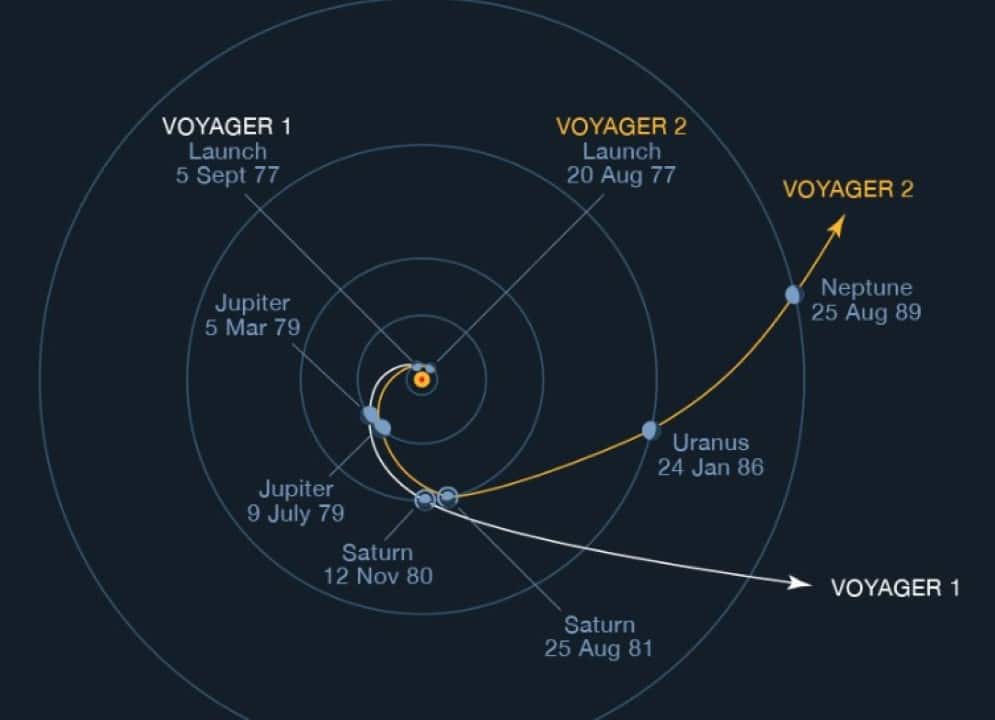
Prior to its interstellar journey, Voyager 1’s primary mission was the exploration of Júpiter and Saturno. In March 1979, the probe performed a historic flyby of Júpiter, capturing detailed images of its complex storms, including Grande Mancha Vermelha, and made one of the mission’s most important discoveries: active volcanoes on the moon Io, the first evidence of volcanism outside of Terra.
In November 1980, Voyager 1 reached Saturno, approaching 124 thousand kilometers from the planet. The images revealed the intricate structure of its rings, showing divisions and patterns that were not visible from ground-based telescopes. The probe also discovered six new moons and provided detailed data on the atmosphere of Titã.
The encounters with the gas giants were planned to use the planets’ gravitational assistance, a maneuver that accelerated the probe and placed it on the trajectory that would take it out of the solar system. Essa route was defined more than 40 years ago and has not required major course corrections since then.
The data collected from these passes has transformed our understanding of the outer planets. Atmospheric measurements in Júpiter recorded winds of up to 600 km/h, while in Saturno the famous polar hexagon was identified, a climatic structure with around 30 thousand kilometers in diameter, still the subject of study.
Limits of communication in a vacuum
The delay in communication with Voyager 1 increases every second. Atualmente, a command sent from Terra takes more than 23 hours to reach the probe, and the response takes the same time to return, totaling almost 47 hours of waiting. In 2026, when it reaches the one light day mark, this round trip time will be exactly 48 hours.
To maintain contact, the probe’s high-gain antenna, 3.7 meters in diameter, needs to be pointed with extreme precision at Terra. Pequenos trajectory correction thrusters are fired periodically to ensure correct alignment, a task that becomes increasingly critical as hydrazine fuel is depleted.
Contributions to future missions
The data collected by Voyager 1 over decades is not just historical; they are fundamental to planning future interstellar exploration missions. Projetos like Interstellar Probe, which is in the concept phase and planned to launch in the 2030s, build directly on learnings from Voyager to develop more advanced technologies capable of traveling even faster and further.
Heliopause measurements help scientists better understand interactions between our galaxy and the solar system, including phenomena such as the “hydrogen wall,” a region of interstellar hydrogen accumulation detected by the New Horizons probe. Voyager 1 validated theoretical models about the solar wind and confirmed the existence of complex magnetic structures that protect our system from galactic cosmic rays.
Preparations for the 2026 milestone
A dedicated team of engineers and scientists, including professionals who have worked on the mission since its inception in the 1970s, continues to monitor the health and operations of Voyager 1.
The milestone of a light day in November 2026 will be a moment of celebration for NASA and the global scientific community, highlighting the incredible resilience of a probe designed to last just five years. The event will be an opportunity to reflect on the mission’s legacy, which includes the iconic “Pale Blue Dot” image captured in 1990, which shows Terra as a small point of light in the vast cosmos. The mission continues to carry the “Golden Record”, a golden record with sounds and images of the



