
With 32 GB of GDDR6 memory, new Nvidia RTX 5000 Ada Lovelace appears in Russian store catalog

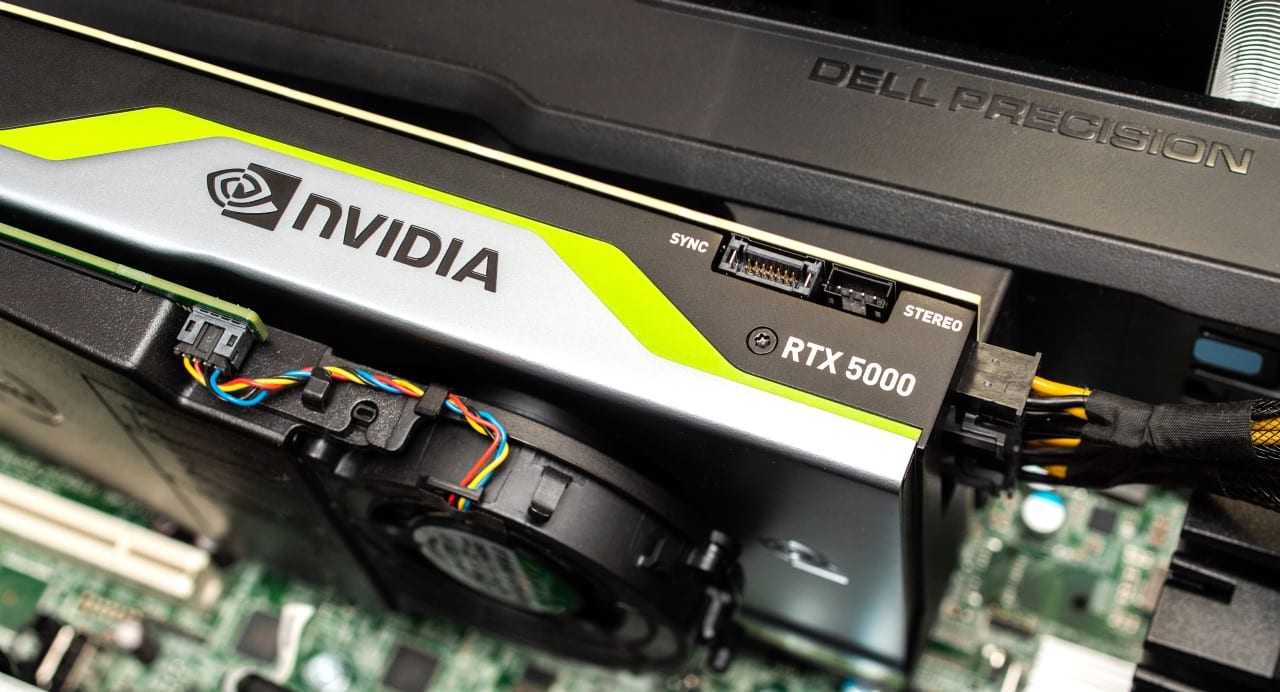
The professional hardware market welcomes a new high-performance component with the listing of the Nvidia RTX 5000 Ada Generation graphics card. The model, which features a robust 32 GB of GDDR6 memory with error correction (ECC), was added to the catalog of DNS, one of the largest electronics retail chains in Rússia, signaling its wide availability in the region.
Manufactured by PNY, a partner of Nvidia, the GPU is designed specifically for workstations and is aimed at professionals who perform intensive tasks. Suas specifications make it ideal for areas such as 3D rendering, artificial intelligence development, scientific simulations and highly complex computer graphics, offering a significant advance over previous generations.
The arrival of this model in retail expands the options for design studios, engineering companies and content creators looking to update their technological infrastructure. The card is positioned as a powerful intermediate solution in the Ada Lovelace professional line, balancing cost and processing capacity.

Performance and detailed technical specifications
The Nvidia RTX 5000 Ada Generation is built on the AD102 graphics chip, manufactured using the 5 nanometer process, which guarantees greater energy efficiency and processing power. The card has 12,800 CUDA cores, which are essential for executing parallel tasks at high speed, in addition to 400 texture units and 160 rasterization units. The listing confirms that its operating frequencies range from 1,155 MHz in base and can reach up to 2,550 MHz in boost, providing flexibility for different workloads. The 32 GB GDDR6 memory operates on a 256-bit bus, resulting in a bandwidth of 576 GB/s, essential for handling large volumes of data without bottlenecks.
In terms of consumption, the GPU has a TDP (Thermal Design Power) of 250 W, a controlled value for a component in this category, which facilitates its integration into existing systems. The manufacturer’s recommendation is to use a power supply of at least 600 W to guarantee operational stability. Power is provided by a 16-pin connector (12VHPWR), aligned with the latest ATX 3.0 standard. Esses numbers consolidate the RTX 5000 Ada as a powerful tool, capable of facing the most demanding challenges of the professional market without demanding excessive energy consumption, optimizing the total cost of ownership for companies.
The Ada Lovelace architecture and its advances
The RTX 5000’s biggest differentiator is its Ada Lovelace architecture, which introduces substantial improvements to its key components. The card is equipped with 100 third-generation RT (Ray Tracing) cores and 400 fourth-generation Tensor cores. RT cores are designed to accelerate ray tracing, a rendering technique that simulates the physical behavior of light to create photorealistic images. The third generation of these cores practically doubles performance in real-time ray tracing applications when compared to the previous Ampere architecture, directly benefiting architectural visualization, animation and product design software. Já cores specialize in matrix operations, dramatically accelerating artificial intelligence workflows such as model training and inference. Support for new data formats, such as FP8, further optimizes performance in AI tasks. The GPU uses the PCIe 4.0 x16 interface, ensuring maximum bandwidth when communicating with the most modern motherboards.
Focus on artificial intelligence and data science
400 fourth-generation Tensor cores position the RTX 5000 Ada as a powerful tool for AI and data science professionals.
These components significantly accelerate deep learning workloads, enabling applications like Stable Diffusion and other generative AI tools to operate with greater speed and efficiency.
The generous 32 GB memory with ECC support is crucial for handling massive datasets directly on the GPU, avoiding the need for paging to system storage, which reduces latency.
Integration with optimized Nvidia frameworks, such as TensorRT, maximizes performance in production environments, allowing developers to create and deploy AI applications with lower latency.
Physical design and cooling system
PNY’s design for the RTX 5000 Ada prioritizes functionality in work environments. The card uses an active cooling system with a single blower fan, which captures air from inside the case and expels it directly through the rear, preventing heat build-up in systems with multiple GPUs.
Measuring 267 mm long by 112 mm wide and occupying two expansion slots, the GPU is relatively compact, making it easy to install in a wide variety of workstations, including small-sized chassis.
Robust multi-monitor connectivity
To meet the productivity needs of professionals, the RTX 5000 Ada offers four DisplayPort 1.4a ports.
This configuration allows the simultaneous use of up to four monitors, supporting resolutions of up to 8K in specific configurations.
The board supports Nvidia Mosaic technology, which allows you to unify multiple screens into a single expansive workspace, ideal for complex data viewing and video editing.
Positioning in the professional market
The RTX 5000 Ada Generation is strategically positioned between the previous generation RTX A5000 and the more powerful RTX 6000 Ada. Ela offers a performance jump of up to two times in ray tracing tasks compared to its predecessor, while maintaining more contained power consumption than the top-of-the-line model, which has 48 GB of memory.
Applications in rendering and engineering
In animation and architecture studios, RT cores accelerate rendering in software such as Blender, V-Ray, and Autodesk Arnold. Isso allows artists and designers to visualize complex scenes with realistic lighting and shadows in real time, streamlining the creative process.
For engineers, the card accelerates simulations in CAD and CAE software, such as SolidWorks and CATIA. Memory with ECC (Error Correction Code) is a vital resource, as it prevents data corruption in critical calculations for industries such as aerospace and automotive, ensuring the accuracy and reliability of results.
The Nvidia RTX 5000 Ada Generation establishes itself as a versatile and powerful option for professionals. Sua’s combination of generous memory, improved energy efficiency and architectural advancements meets the diverse demands of today’s market, from digital content creation to scientific research and the development of artificial intelligence.



