
Astronomers warn of asteroid collision with the Moon and risk of debris reaching Earth

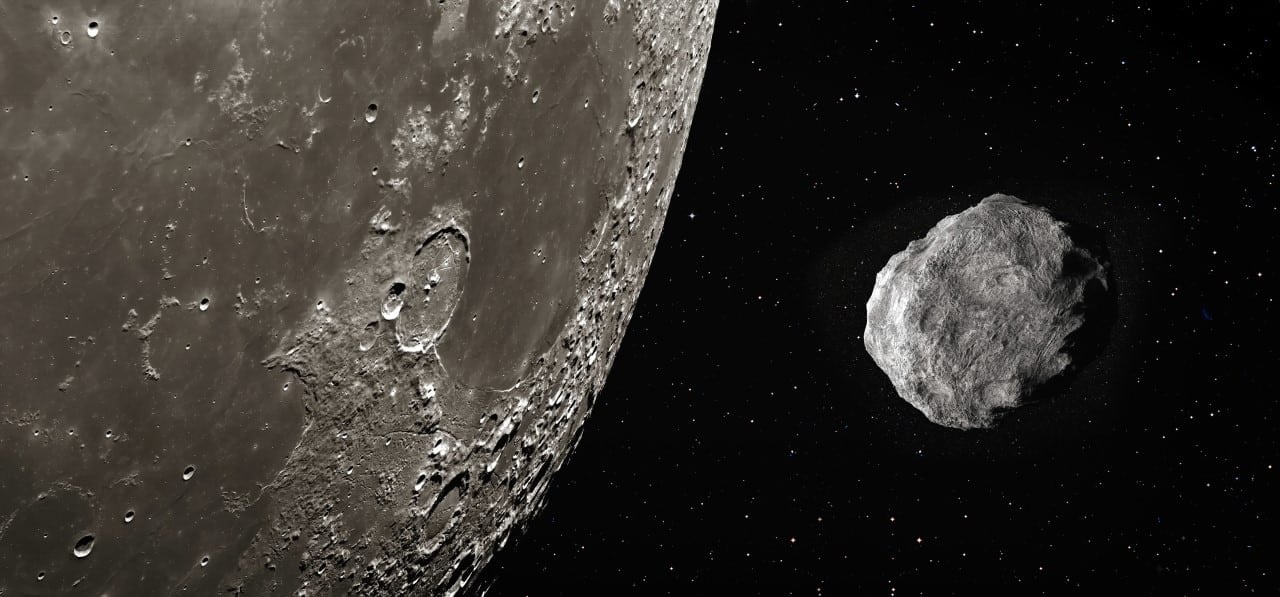
Astronomers and international space agencies have intensified monitoring of asteroid 2024 YR4, which follows a dangerous approach trajectory with the Terra-Moon system. Recent Cálculos indicate that the chances of a direct collision with the natural satellite of Terra have risen considerably, reaching the 4% mark for the event scheduled for December 2032. The object has dimensions estimated at 60 meters in diameter, which represents a significant threat to the integrity of the lunar surface and to the terrestrial technological infrastructure.
The movement of the celestial body is monitored globally due to the destructive potential of an impact of this magnitude in the vacuum of space. Pesquisadores uses advanced mathematical models to predict the asteroid’s behavior under the gravity of Terra and Lua over the next few years. The central concern lies not only in the shock itself, but in the chain reaction that lunar fragmentation can cause in the planet’s low orbit.
Increased risk: The probability of collision has quadrupled compared to the first analyzes carried out the previous year.
Expected date: Trajectory models point to a critical meeting in the last month of 2032.
Energy released: The impact would be equivalent to the detonation of a medium-sized thermonuclear bomb.
Trajectory of asteroid 2024 yr4 and the risks of lunar impact
The international scientific community directed efforts to analyze the study published by Yifana He, from Universidade Tsinghua, which details the physical consequences of a possible impact. Asteroid 2024 YR4, although initially seen as a minor threat, is now classified as an event of high relevance for planetary defense. Caso the collision is confirmed, the energy released would exceed by six orders of magnitude the last major impact recorded in Lua, which occurred in 2013.
Experts explain that the absence of atmosphere in Lua causes objects of this mass to reach the surface at full speed, without the resistance that would cause partial disintegration in Terra. The immediate result would be the formation of a vast area of molten material that would take days to cool completely under space conditions. Este phenomenon would allow unprecedented data collection on crater formation and lunar geology in real time, providing valuable information for future missions.

Crater dimensions and energy released by impact
Geological projections indicate that the asteroid impact would result in the creation of a crater approximately one kilometer wide. The depth of the hole generated could vary between 150 and 260 meters, permanently altering the topography of the region reached on the satellite. Além of the visual change, the event would trigger what scientists call a 5.0 magnitude “moonquake”, the most intense tremor ever documented by human instruments on lunar soil.
This seismic shock would be capable of displacing large volumes of regolith, the dust that covers Lua, generating a momentary cloud of debris. The force of the thermal and kinetic explosion would eject thousands of tons of rocks into space, creating a plume of fragments that would not be restricted by lunar gravity. Parte of this material would be launched on trajectories that directly cross the operating zone of artificial terrestrial satellites.
Debris rain threat and orbital safety
The real problem for humanity would occur shortly after the impact, when a cloud of lunar rocks, with individual masses reaching 400 kg, would begin to move towards Terra. Embora Most of these fragments tend to disintegrate in the atmosphere or fall into unpopulated areas, the fall routes include regions such as América of Sul and Norte of África. Existe, however, there is a real concern about the possibility of debris reaching densely populated urban areas in Península Arábica, such as the city of Dubai.
In addition to the terrestrial risk, the integrity of the global communications network would be under fire due to the density of objects in orbit. The collision of lunar rocks with GPS, internet and defense satellites could trigger the feared phenomenon known as Kessler syndrome. Esse process occurs when the destruction of an object generates new debris that, in turn, destroys other devices, creating an insurmountable cloud of space debris.
Destruction of constellations: Satélites in low and medium orbit could be pulverized by high-speed lunar fragments.
Space unfeasibility: The accumulation of rubbish could prevent the launch of new space missions for decades.
Fall in urban areas: Monitoring points to specific risks for inhabited regions on three different continents.
Constant monitoring: Agências as NASA and ESA seek alternatives to divert the asteroid’s path before 2032.
Possibility of planetary deflection and defense missions
Given this alarming scenario, governments and space agencies are already discussing the feasibility of missions to change the route of 2024 YR4 before it reaches the point of no return. The success of previous asteroid redirection test missions serves as a basis for planning direct intervention in the coming years. Current technology allows for the delivery of kinetic impact probes that could lightly push the object, ensuring it passes a safe distance from the Lua and the Terra.
The cost of such an operation is considered negligible when compared to the economic and technological damage of a satellite blackout on a global scale. Estratégias of international cooperation are being designed to ensure that monitoring is carried out 24 hours a day, using ground and space telescopes. The objective is to refine trajectory calculations to determine the exact moment when an intervention would be most effective and least costly.
Collection of scientific data during the catastrophic event
Despite the risks, the astrophysics community sees the possible impact as a unique opportunity to observe processes that normally take millions of years to occur. The formation of the crater and the subsequent cooling of the ejecta would allow calibrating crater-based dating models of planetary surfaces. If the shock is inevitable, the priority will be to position orbital sensors to record every millisecond of the explosion and dispersion of material.
Chemical analysis of the expelled rocks could also reveal deeper layers of the lunar crust that have not yet been explored by manned or robotic missions. Esses data would be fundamental for planning permanent human colonies, as it would indicate the presence of minerals or useful resources. However, the balance between scientific curiosity and the safety of terrestrial space operations remains the main point of debate among space program managers.
Immediate consequences for private space exploration
Private aerospace technology companies are following the data on asteroid 2024 YR4 with apprehension due to their investments in Earth orbit. The loss of critical infrastructure could cripple global telecommunications services and climate monitoring systems essential to the modern economy. For this reason, the private sector has been pushing for stricter regulations and more robust defense systems against objects close to Terra.
Protecting satellite fleets has become a national security priority for several world powers that depend on orbital technology for defense and logistics. Asteroid 2024 YR4 serves as a reminder of Terra’s technological vulnerability to natural and unpredictable cosmic events. Preparing for the year 2032 involves not just mathematical calculations, but a restructuring of the way humanity interacts with and protects its immediate space environment.
Global surveillance and the future of precision astronomy
The advancement of automatic detection systems allowed 2024 YR4 to be identified years in advance, providing scope for a coordinated response. Novos Deep-scanning telescopes are being finalized to increase the ability to identify even smaller objects that can cause significant damage. Transparency in sharing this data is vital so that observatories around the world can confirm orbits and reduce statistical uncertainties.
With each new observation cycle, orbital parameters are adjusted, which can increase or decrease the alert level in the coming months. Até at the moment, the tendency to increase the probability of collision keeps specialists in a state of maximum attention and technical readiness. Continued monitoring will determine whether humanity will need to take action or whether the asteroid will pass merely as an astronomical event for safe observation.



