
James Webb Telescope reveals detailed image of galaxy cluster MACS J1149 in January

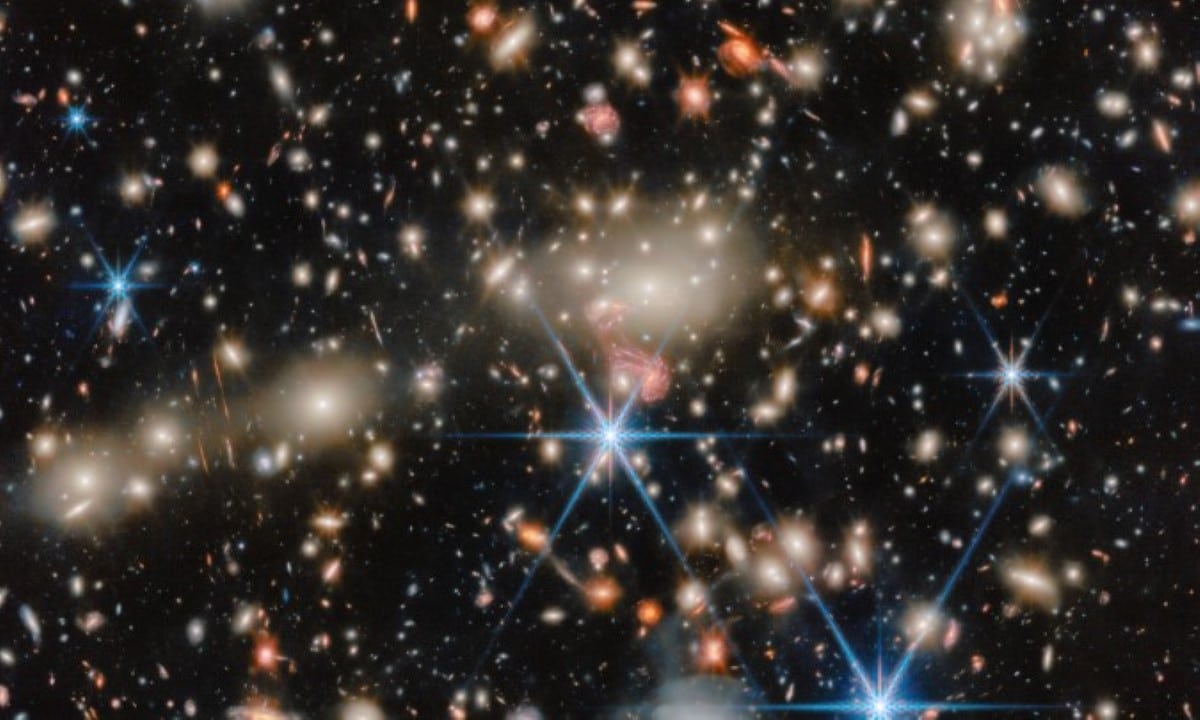
The James Webb space telescope has captured a stunning new image of the cluster of galaxies MACS J1149, located about 5 billion light-years away from Terra. The photograph was selected by space agencies as the image of the month for January 2026 due to its sharpness and scientific importance. The record details hundreds of galaxies located in the constellation Leão, offering an unprecedented look at the complexity of the deep universe.
The observation was carried out using high-tech instruments that allow us to see through cosmic dust and detect infrared light that is imperceptible to the human eye. The MACS J1149 ammasso is made up of at least 300 confirmed galaxies, housing millions of stars and an incalculable number of exoplanets in their structures. Este massive array is held together by the force of gravity, creating one of the most dynamic scenarios ever studied by modern astronomy.
- The recording was made by the NIRCam, NIRSpec and NIRISS instruments attached to the telescope.
- The distance of 5 billion light years places the object in the zodiacal constellation of Leão.
- The total mass of the ammasso acts as a natural lens that magnifies even more distant objects.
- Scientists have confirmed the presence of a supernova and a record-breaking individual star in distance.
Infrared technology highlights details of macs j1149
The use of a near-infrared camera, known as NIRCam, was essential for the researchers to be able to separate the different layers of light from the ammasso. Através of filters ranging from 0.9 to 4.44 micrometers, the image processing team assigned visible colors to the captured data, resulting in a color map that facilitates structural analysis. Essa technique makes it possible to identify the birth of new stars and the distribution of heavy chemical elements within the youngest galaxies.
The accuracy of the data collected by James Webb surpasses any observations previously made by other space-based or ground-based observatories. By applying the CAnadian NIRISS Unbiased Cluster Survey program, scientists seek to understand how low-mass galaxies have evolved since the beginning of the universe. Esse study focuses specifically on early star formation and the way gas and dust interact to shape the galaxies we currently observe in the deep sky.
A monster cluster (MACS J1149.5+2223) in the constellation Leo! 🦁⭐
— ESA Webb Telescope (@ESA_Webb)January 26, 2026
And check out more .gifs at our giphy page:https://t.co/d2sso3FRg8 pic.twitter.com/ItQTVcAfEW
Gravitational lensing phenomenon warps space time
The gigantic mass concentrated in the MACS J1149 amasso exerts a gravitational attraction so intense that it is capable of bending the fabric of space-time around it. The Esse effect, predicted by the theory of general relativity, acts as a cosmic magnifying glass, allowing galaxies located far beyond the amasso to be viewed by the Terra. Sem this natural phenomenon, many of these distant objects would remain hidden to current human technology, regardless of the power of the telescope.
In the images released, it is possible to notice several elongated and distorted shapes that look like arcs of light spread between the main galaxies. Essas distortions are actually images of background galaxies that have had their light deflected and magnified as they pass through MACS J1149’s gravitational field. Esse observation method is essential for mapping dark matter, which does not emit its own light, but reveals its presence through gravitational influence on visible light.
Pink jellyfish galaxy attracts researchers’ attention
One of the most curious points in the new image is a spiral galaxy that has acquired an appearance similar to a pinkish jellyfish in the center of the amasso. Essa visual deformation occurs because the light emission from this galaxy crossed zones of high gravitational density, being stretched and redrawn by the curvature of space. Dentro of this specific structure, astronomers had previously identified Lensed Star 1, one of the most distant individual stars ever catalogued.
In addition to the record-breaking star, the region is also home to supernova remnants that provide crucial data on the stellar life cycle in high-density galactic environments. The pink color observed is the result of the combination of specific filters that highlight ionized hydrogen and the formation of heated dust. Esses elements are indicative of frantic star-creating activity within the distorted galaxy, offering a natural laboratory for the study of astrophysics.
Exploration of the evolution of low-mass galaxies
The main focus of new scientific research is on understanding how smaller galaxies managed to grow and sustain themselves in the early universe. Através from NIRSpec spectrographic data, researchers can measure the speed of separation and chemical composition of each light point in the image. Essas information helps construct an accurate timeline of cosmic history, from the first million years after Big Bang to the current configuration observed by James Webb.
Studying low-mass galaxies is essential because they represent the majority of structures that gave rise to large stellar systems, such as Via Láctea. The international research program uses the NIRISS sensor to perform scans that do not prioritize any specific target, ensuring an unbiased sampling of all objects present in the field of view. Essa approach reveals details about cosmic dust that were previously ignored, showing that the space between galaxies is much richer in matter than previously imagined.
High-resolution images facilitate citizen science
To encourage public interest and scientific collaboration, space agencies have made high-resolution files of around 74 MB available for free download. Esses files allow enthusiasts and independent researchers to explore every detail of the MACS J1149 in detail on their own equipment. Transparency in the dissemination of this data is a hallmark of the James Webb mission, which seeks to bring society closer to the most profound discoveries about the origin of the cosmos.
The ability to process these images at home allows new details to be noticed by keen eyes, often assisting lead scientists in identifying rare phenomena. Democratized access to astronomical information strengthens the authority of the institutions involved and ensures that knowledge about the universe is shared globally. Cada image pixel represents years of engineering and decades of theories that now find visual confirmation through the lens of the space observatory.
Constant monitoring of supernovae and stars
Surveillance over the MACS J1149 ammasso is not an isolated event, but rather part of ongoing monitoring that uses multiple telescopes to validate findings. The fact that the James Webb operates in infrared complements the visible light and X-ray views captured by other equipment, creating a multispectral panorama of the object. Esse joint effort is needed to confirm whether new points of light appearing in the image are exploding supernovae or variations in the brightness of distant stars.
Identifying a supernova in such a distant galaxy allows us to more accurately calculate the expansion rate of the universe in that specific region of space. Esses data is compared with mathematical models to verify whether the laws of physics behave in the same way in different cosmic eras. The mass of galaxies therefore works like a clock and a gigantic ruler that helps calibrate our understanding of the history and future of everything that exists.



