
Rare chemical composition of 3I/ATLAS challenges scientists and suggests origin of ancient star system


A new visitor from outside our Sistema Solar is capturing the attention of the global scientific community. Identificado on July 1, 2025, object 3I/ATLAS has an unusual chemical composition that differentiates it from known comets, raising new questions about its origin in a distant star system that is possibly much older than ours.
The detection, carried out by the ATLAS telescope system at Chile, confirmed that it is the third interstellar object ever observed crossing our cosmic neighborhood. Sua hyperbolic trajectory and high speed, initially 58 km/s in relation to Sol, are unequivocal proof that it does not belong to our system and is just passing through.
Since its discovery, a vast observation campaign has been mobilized, involving some of humanity’s most powerful instruments, such as the James Webb and Hubble space telescopes. The goal is to decipher the secrets contained in this cosmic messenger, which offers a rare opportunity to directly study the matter of another star.
Chemical characteristics reveal distant origins
The 3I/ATLAS spectral analysis, led by Telescópio Espacial James Webb, revealed a composition that intrigues astronomers. The object’s coma, the cloud of gas and dust surrounding its nucleus, is dominated by carbon dioxide (CO2), in a proportion eight times greater than that of water vapor, a pattern opposite to that observed in most comets of our Sistema Solar. Além In addition, high levels of nickel were detected on its surface, along with the presence of methanol and hydrogen cyanide. Essa chemical signature suggests that 3I/ATLAS formed in an extremely cold and distant protoplanetary disk, possibly more than 7 billion years ago, even before the formation of Sol. The presence of precursor organic molecules reinforces interest in studying how the building blocks of life can be distributed across the galaxy.
A high-speed journey through our system
3I/ATLAS follows an open and extremely elongated orbit, with an eccentricity greater than 6, a value significantly greater than that of other interstellar visitors such as 1I/ʻOumuamua (1.2) and 2I/Borisov (3.4). Essa mathematical characteristic confirms that its speed is so high that the gravity of Sol is unable to capture it, guaranteeing its definitive exit from Sistema Solar. The object reached its closest point to Sol, perihelion, on October 29, 2025, at a safe distance of approximately 1.5 astronomical units (AU), without showing signs of fragmentation.
Coming from the direction of the Sagitário constellation, close to the center of Via Láctea, the object made its closest approach to Terra on December 19, 2025, passing at 270 million kilometers. Após its passage through the interior of Sistema Solar, where its speed increased to 61 km/s, it is now heading for a rendezvous with
Initial discovery by the ATLAS system
The first detection of 3I/ATLAS was made by Asteroid Terrestrial-impact Last Alert System (ATLAS), a NASA-funded network of telescopes for planetary defense. The object was spotted when it was still 670 million kilometers from Sol, in the region of Júpiter’s orbit. Inicialmente, was classified as an asteroid due to the absence of a visible coma.
However, follow-up observations taken just a day later, on July 2, revealed the development of a slight coma and the beginnings of a tail, typical features of a comet. The confirmation of its hyperbolic trajectory by Minor Planet Center (MPC) made its status official as the third interstellar object (3I), named after the system that discovered it.
The relatively early detection allowed astronomers, both professional and amateur, to track the object continuously. Registros from the Zwicky Transient Facility (ZTF) archives found images of 3I/ATLAS dated June 2025, which helped refine calculations of its orbit with high precision.
Unlike other comets that undergo explosions and fragmentations, 3I/ATLAS maintained a stable brightness throughout its solar approach, a behavior that adds yet another layer of mystery to its nature.
Observations from space missions on multiple platforms
The importance of 3I/ATLAS motivated an unprecedented observation campaign, using several space missions that were in favorable positions. The Psyche spacecraft, on its way to the asteroid belt, captured images in September 2025, as did the Lucy mission, which observed the object’s coma and tail from a distance of 386 million kilometers.
Telescópio Espacial Hubble carried out observations in July and November 2025, revealing details of its dust tail and coma morphology. The JUICE mission, from Agência Espacial Europeia (ESA), also contributed images in November, confirming the regular and symmetrical structure of the gas cloud. Esses combined data from more than 20 different instruments allowed a detailed study and ruled out any risk of collision with the Terra.
Nature debate: comet or something more?
Despite the consensus that it is a natural object, its peculiar characteristics have fueled debate. Professor Avi Loeb, of Universidade of Segundo he, the absence of detectable torques, which normally alter the rotation of an active comet, is a rare phenomenon.
Loeb argues that such characteristics deserve further investigation, positioning the object as a case of great interest within his metric for unidentified phenomena. However, the majority of the scientific community defends a purely natural origin. Pesquisadores like Jason Wright, from Penn State, attribute stability to low torque efficiency, an unusual but possible feature in comets. In an official briefing, NASA concluded that all data collected is consistent with an interstellar comet, without any evidence pointing to an artificial origin.
Implications for studying exoplanets
3I/ATLAS functions as a natural probe, bringing with it a direct sample of the chemistry of a distant star system. Seu study offers a unique window into understanding the conditions present in other protoplanetary disks where planets may be forming. The detection of organic precursors suggests that the ingredients for life may be common throughout the galaxy, carried by objects like this.
The passage of visitors like 3I/ATLAS, although rare, improves theoretical models about how planetary systems eject material into interstellar space. Futuras missions, like ESA’s Comet Interceptor, are designed specifically to intercept an object like this, allowing for even more detailed analysis and collection of physical samples in the future.
Anomalies observed in recent images
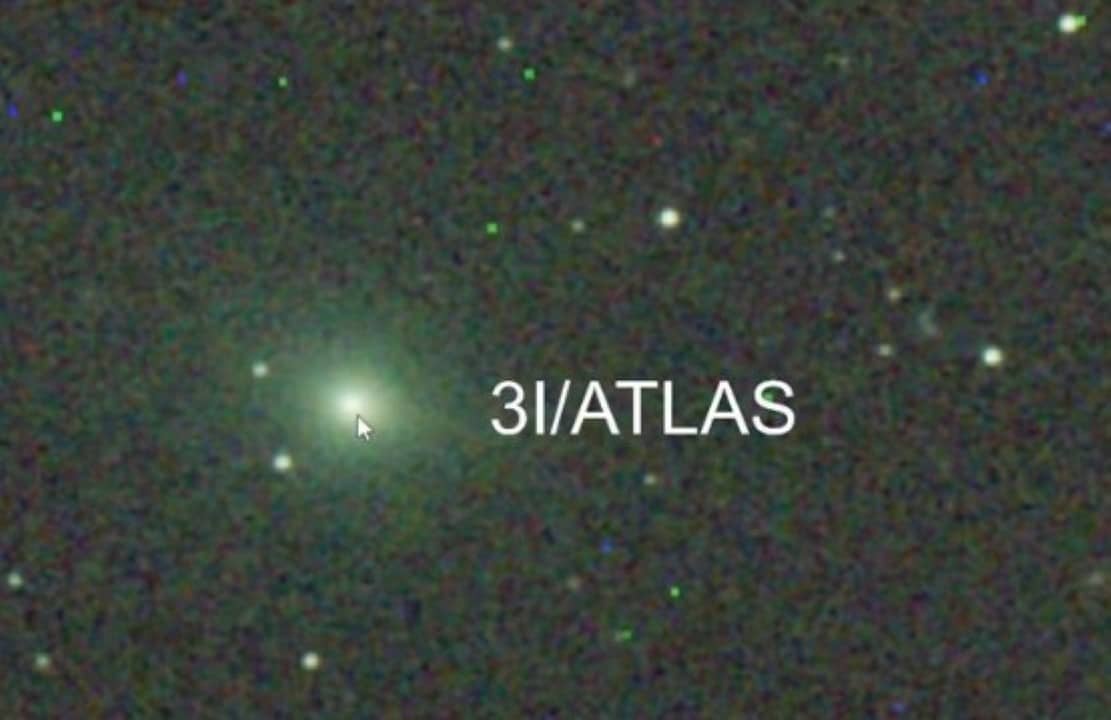
Images captured by astrophotographers in December 2025 showed a perfectly symmetrical coma and the absence of a prominent ion tail, which is common in comets. The object’s core remained pinpoint, star-like even in long exposures, indicating a very uniform and controlled source of gas. Essa’s distinctive appearance sets it apart from most long-period comets from our own Sistema Solar.
Preparations for future observations
The scientific community is now preparing for the final phase of observations, as 3I/ATLAS moves away. The Juno probe will adjust its instruments for the flyby in March 2026, with the aim of measuring any non-gravitational acceleration caused by the release of gases. On land, telescopes like the Observatório Vera C. Rubin will continue to track it until it disappears into the vastness of space, taking with it the secrets of its distant origin.



