
Unprecedented structure of ionized iron is found in the heart of the famous Ring Nebula

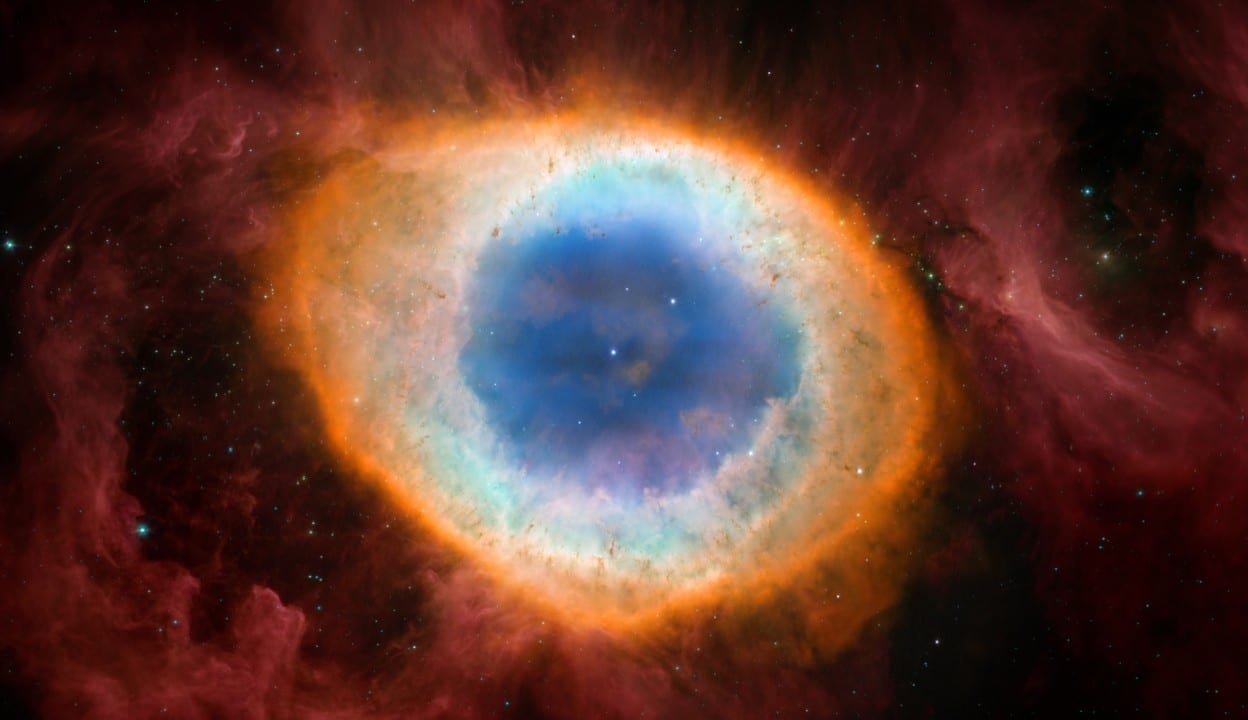
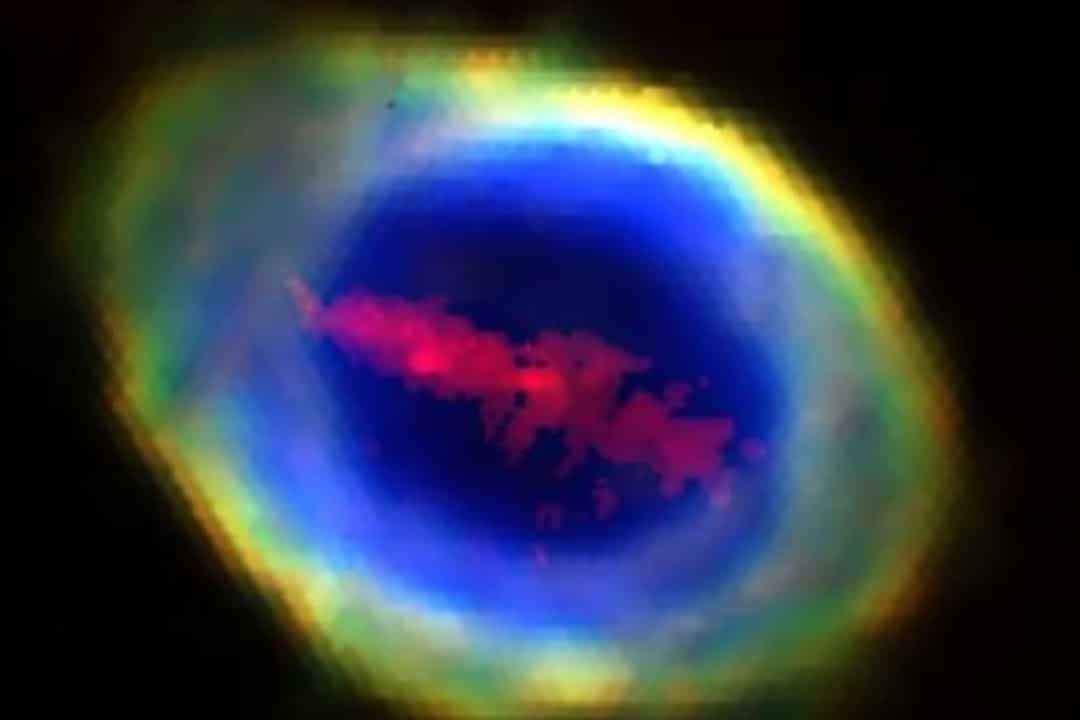
A surprising discovery has altered astronomers’ understanding of the iconic Nebulosa of Anel, also known as M57. Utilizando a state-of-the-art instrument, a team of scientists identified a linear structure, rich in highly ionized iron, that runs through the central region of the nebula. Este finding is particularly notable because iron, in such environments, usually remains trapped in cold dust grains, out of sight of spectrographs.
The observation was carried out with the WEAVE instrument, installed at Telescópio William Herschel, located at Ilhas Canárias, Espanha. The detection occurred during the equipment commissioning phase, a testing period that serves to calibrate and verify the capabilities of the new hardware. The fact that such a significant discovery was made before formal scientific operations even began underscores the power and sensitivity of WEAVE for mapping the chemical composition of celestial objects.
Located approximately 2,300 light-years from Terra, in the constellation of Lira, Nebulosa of Anel is the remnant of a star similar to Sol that exhausted its fuel and expelled its outer layers about 4,000 years ago. The presence of a hot, gaseous iron rod at its center challenges existing models about the evolution and distribution of heavy elements at the end of a star’s life.
The anomalous composition of the central structure
Detailed spectroscopic analysis revealed that the bar is predominantly composed of doubly and triply ionized iron. Isso means that the iron atoms have lost two or three of their electrons, a process that requires an enormous amount of energy, usually supplied by the intense ultraviolet radiation emitted by the white dwarf star at the center of the nebula. The temperature of the gas in this structure is therefore significantly higher than that of the surrounding material, which is mainly composed of lighter elements such as hydrogen and helium.
What makes this discovery a puzzle is the chemical selectivity and shape of the structure. Enquanto other elements such as oxygen and nitrogen are distributed more diffusely throughout the nebula, iron is confined to this narrow and well-defined band. The Este arrangement suggests that a specific, localized physical process was responsible for releasing the iron from the dust grains and keeping it concentrated in a linear formation, a phenomenon that had not previously been predicted or observed in M57 or other similar planetary nebulae.
What is Nebulosa of Anel?
Nebulosa of Anel is one of the most photographed and studied objects in the night sky since its discovery in the 18th century. Sua’s iconic ring appearance is actually a perspective effect; from Terra, we look through a structure that has a three-dimensional shape more like a cylinder or a barrel of gas and dust. At the center of this structure resides a white dwarf, the dense, hot core of the original star. It is the radiation from this white dwarf that illuminates the expelled gas, making it shine and creating the visual spectacle that we observe. Over millennia, this material enriched with heavy elements will disperse throughout the interstellar medium, contributing to the formation of new stars and planetary systems. Previous Observações, taken by telescopes such as the Hubble and, more recently, the James Webb, have revealed intricate details of filaments, knots of dense gas and concentrations of complex molecules in the nebula’s outer regions, but the central iron bar has remained hidden until now.
The technology behind the discovery
The WEAVE instrument (WHT Enhanced Area Velocity Explorer) represents a technological leap in astronomical spectroscopy. Sua’s main feature is the ability to perform full-field spectroscopy, which allows scientists to simultaneously analyze the chemical composition and velocity of thousands of distinct points within a vast area of the sky. Essa technique creates a detailed three-dimensional “map” of the observed object, revealing subtle variations that would be invisible to older instruments.
It was this comprehensive mapping capability that allowed the team to identify the specific emission from ionized iron and trace its distribution, revealing the structure’s unexpected linear shape. Previous Métodos, which typically analyzed only a narrow band or a single point at a time, would not have had the field vision needed to recognize the pattern in its entirety, highlighting how technological advances continue to drive new discoveries, even in extensively studied celestial objects.
Hypotheses about the origin of iron
The origin of this iron rod is now a topic of intense debate among astrophysicists. One of the most intriguing hypotheses suggests that the structure may be the “ghost” of rocky planets that orbited the original star. As the star expanded to become a red giant in its final stages, it would have swallowed and vaporized any nearby planets in its path.
The amount of iron detected in the bar is consistent with the mass of iron that would be found on a rocky planet like Terra. If this hypothesis is correct, the bar would be direct evidence of the destruction of a planetary system, providing a grim vision of the ultimate fate of our own solar system.
Other possibilities are being considered, although with less direct evidence. Processos internal elements in the star before the nebula’s ejection could have concentrated heavy elements in certain regions. However, current models do not easily explain how this material would be expelled in such a collimated, linear form without the presence of a strong magnetic field or interaction with a companion star, for which there is no clear evidence.
Physical details of the iron bar
The linear structure extends for a distance comparable to hundreds of astronomical units, traversing the nebula’s central cavity, a region previously believed to be relatively empty. Sua width is noticeably narrow compared to its length, accentuating its barbell appearance.
The high ionization of iron indicates that the gas is continually being bombarded by energetic radiation from the central white dwarf. Isso suggests that the structure is located deep within the nebula’s cavity, directly in the dying star’s firing line.
The distinctive linearity of the formation is perhaps its most enigmatic aspect. Tal rectilinear shape in space generally points to the influence of powerful directional forces. One possibility is that strong magnetic fields, anchored in the central star, are channeling and confining ionized gas along their field lines.
This phenomenon directly challenges the assumption that heavy elements like iron would quickly condense into dust grains in planetary nebula environments. The discovery of such a substantial amount of iron in the hot, gaseous phase forces a review of the chemistry and physics models that govern these celestial objects.
Relevance to astrophysics
This discovery in Nebulosa from Anel is not just a curiosity, but a fundamental piece that refines the understanding of the final phase of stellar evolution. Ela demonstrates that the processes that occur when stars like Sol die are much more complex and varied than previously thought, potentially involving interaction with planetary systems and the influence of magnetic fields.
Future planned investigations
Researchers are already planning the next steps to unlock the secrets of the iron bar. Observações follow-up with other high-resolution instruments will be crucial to accurately measure gas velocities throughout the structure. Esses velocity data will help determine whether material is flowing out of the star, falling toward it, or is in orbit, which would provide vital clues about its origin and dynamics.
Furthermore, a systematic search for similar features in other planetary nebulae will be initiated. Descobrir Whether the Nebulosa iron bar of Anel is a unique case or part of a common but hitherto unnoticed phenomenon in the death of stars will have profound implications for models of galaxy chemical enrichment and the ultimate fate of planetary systems.



