
Misinformation about the 3I/ATLAS object leads YouTube to remove fake channel created with artificial intelligence

The video platform YouTube took a drastic step by removing a channel entirely generated by artificial intelligence that was dedicated to spreading false information about the interstellar object 3I/ATLAS. The action was a direct response to a formal complaint made by the renowned physicist of Harvard, Avi Loeb, who had his image and voice cloned to give credibility to the misleading content.
The channel used deepfake technology to create a virtual avatar of the scientist, presenting videos with sensationalist titles and statements that directly contradicted Loeb’s official research and publications. The removal, carried out on December 8, raises a warning about the malicious use of AI to manipulate scientific debate and confuse the public on topics of great astronomical interest.
The mobilization to remove the content began weeks before, when hundreds of followers of Loeb’s work began notifying him about the existence of the videos. Eles pointed out serious inconsistencies, such as flaws in the avatar’s lip sync and factually incorrect statements, which did not match the researcher’s analysis of the enigmatic celestial body.

The scientist’s complaint and the platform’s action
Given the volume of alerts and the seriousness of the situation, Avi Loeb, who leads Projeto Galileo in Universidade of Harvard, decided to act directly. On December 8, he sent a detailed email to the YouTube support team, pointing out the clear violation of the community guidelines against impersonation and misinformation. In the statement, the physicist highlighted not only the damage to his reputation, but also the risk of polluting the scientific debate with fabricated data. The platform’s response was remarkably quick, confirming the start of an internal review and proceeding with the complete removal of the channel on the same day, which demonstrates the seriousness with which the complaint was treated.
The scientist highlighted the legal responsibility of the channel creator for defamation and the spread of false content, a growing problem in the digital age. Relatos indicate that the channel managed to accumulate a significant number of views by exploiting the public’s curiosity about 3I/ATLAS, one of the most debated topics in recent astronomy. The episode serves as an emblematic case of the fight against AI-generated disinformation, showing that direct intervention by authority figures can be decisive for quick and effective action by digital platforms.
How the fake channel operated
The channel used advanced artificial intelligence tools to clone Avi Loeb’s voice and appearance, creating a digital avatar that narrated the videos. Essa impersonation technique aimed to deceive viewers into believing that the content was produced and validated by Harvard’s own scientist. The strategy relied on deliberately sensationalist titles, such as “3I/ATLAS is a probe without a doubt”, to attract clicks and maximize reach.
The irregularities were evident to the researcher’s most attentive followers. Além In addition to visual flaws, such as artificial facial expressions and the aforementioned lip desynchronization, the content of the videos presented glaring factual contradictions. The claims made by the avatar were often the opposite of what Loeb published on his blog and in his scientific articles, where he adopts a cautious and evidence-based stance.
This disinformation tactic took advantage of the complexity of the topic to insert fictional narratives among real facts, making it more difficult for the lay public to distinguish truth from lies. The action of fans, who documented and reported these inconsistencies, was fundamental in providing Loeb with the necessary evidence to substantiate his complaint to YouTube.
The mysterious object 3I/ATLAS
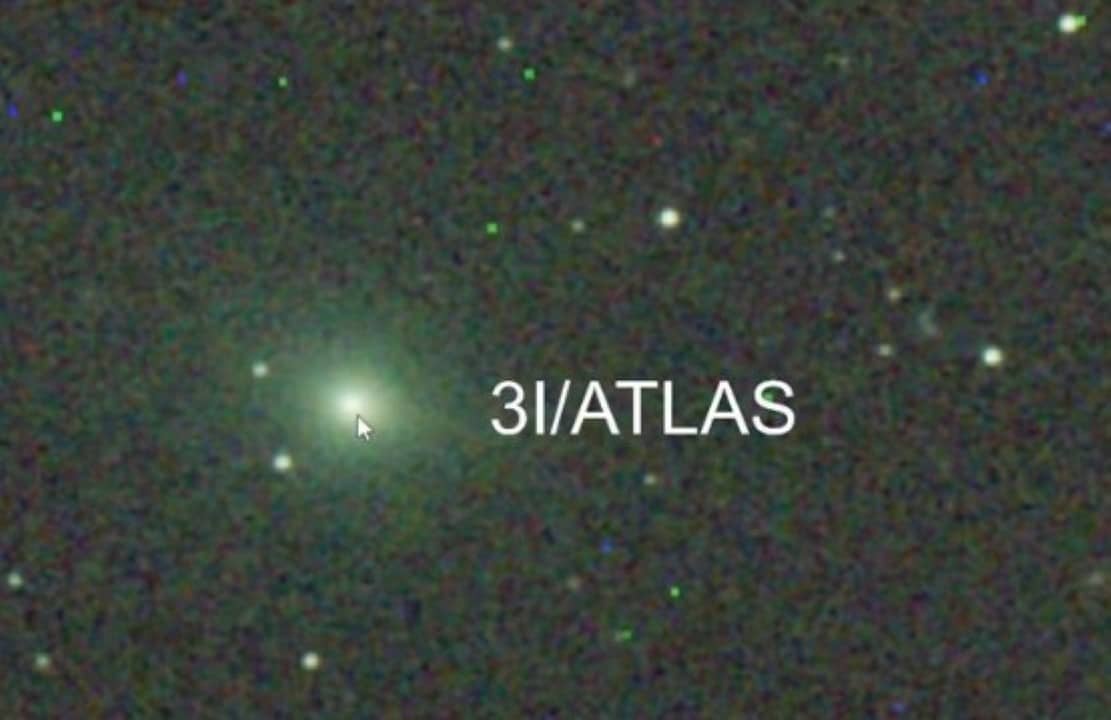
The 3I/ATLAS object, the center of the controversy, is the third interstellar body confirmed to cross our solar system. Detectado in July by the ATLAS telescope, at Chile, it immediately caught the attention of the scientific community for its anomalous behavior. Sua trajectory and acceleration could not be explained solely by the force of solar gravity, suggesting the action of other forces.
Observations carried out by observatories on Europa and África recorded regular pulses of light emitted by the object every 16.16 hours. Esse rhythmic pattern may indicate rapid rotation or the ejection of material from its surface, a phenomenon that is still under investigation. The exact nature of these pulses remains one of the main mysteries surrounding 3I/ATLAS.
Further analysis, advocated by Loeb in his essays, revealed other unusual features. The object’s composition appears to have an abundance of nickel relative to iron that differs from that expected for known comets or asteroids. Além Furthermore, it exhibits extreme negative polarization, an optical property that distinguishes it from other previously observed celestial bodies.
Adding to the enigma, images captured in November showed the presence of an “anti-tail”, a feature rarely seen in comets, which points in the direction of Sol. Todos these elements combined make 3I/ATLAS a fascinating target for studies, fueling debates about its origin, which can be both natural and technological.
Technical data and scientific observations
Research into 3I/ATLAS relies on the power of some of the most advanced instruments in the world. On November 30, Telescópio Espacial Hubble was trained on the object, capturing crucial images when it was approximately 286 million kilometers away from Terra. Esses data has allowed astronomers to obtain unprecedented details about its rotation and morphology, revealing a complex rotational gradient that is being analyzed by experts, including Italian astronomers who have processed the images to create detailed maps. NASA, based on data collected by ground and space telescopes, confirmed that the object has an estimated diameter of 20 kilometers and travels at an impressive speed of 30 kilometers per second. The space agency officially classifies it as an interstellar comet, but the observed anomalies, such as non-gravitational acceleration and peculiar chemical composition, keep the scientific debate alive. The object’s closest approach to Terra occurred on December 19, at a safe distance of 270 million kilometers, offering a unique window of opportunity for intensive observations before it continues its journey out of the solar system.
Loeb’s efforts against scientific deepfakes
Avi Loeb’s engagement in combating disinformation goes beyond the recent complaint. In November, the scientist received more than 500 emails from readers and followers commenting on his essays, which reached 5 million views, demonstrating the vast public interest in his work.
The creation of the fake channel, directly violating YouTube’s terms of service against impersonation, highlights the vulnerability of public science figures to this type of attack. The case became even more serious when a news outlet, without due verification, incorporated one of the fake videos into a report, mixing scientific facts with fiction created by AI and expanding the reach of misinformation.
Implications for digital platforms
This episode highlights a growing challenge for digital platforms: the proliferation of content manipulated by artificial intelligence. Relatórios sectors indicate that cases of AI impersonation in educational and scientific content grew by 40% in the last year alone.
In response, YouTube has strengthened its policies against synthetic manipulation, but real-time detection remains a technological barrier. Especialistas in digital ethics advocate the implementation of more robust verification systems, especially for channels that address complex scientific topics, in order to protect both researchers and the public.
Continuous monitoring of 3I/ATLAS
While the debate about disinformation takes place, scientific monitoring of 3I/ATLAS continues at full steam. Observatórios around the globe continue to track the object since its discovery, with data being constantly updated and shared by the astronomical community, under the coordination of agencies such as NASA.
The object’s approach to Sol in December was a crucial moment, as increased solar radiation could intensify any activity on its surface, such as the release of gases or dust, providing new clues about its composition. Loeb and other scientists advocate an open-minded analysis that considers all possibilities for its origin, whether natural or technological, always based on rigorous observational evidence.



