
Detection of gravitational waves validates Stephen Hawking’s prediction about black holes after 54 years


Scientists at the LIGO observatory detected in 2025 the most precise gravitational wave signal ever recorded, coming from the merger of two black holes 1.3 billion light years from Terra. The Esse event, cataloged as GW250114, made it possible to verify with high precision the area theorem proposed by Stephen Hawking in 1971. The observation confirmed that the total area of the event horizon of the resulting black hole is greater than the sum of the original areas.
The detection occurred using two interferometers in the Estados Unidos, which captured all phases of the cosmic collision. The data obtained reinforces principles of general relativity and advances understanding of the behavior of extreme objects in the universe.
- The signal showed unprecedented clarity due to improvements in detector sensitivity.
- The merger involved black holes of typical stellar masses.
- More than 300 similar events have been recorded since observations began.
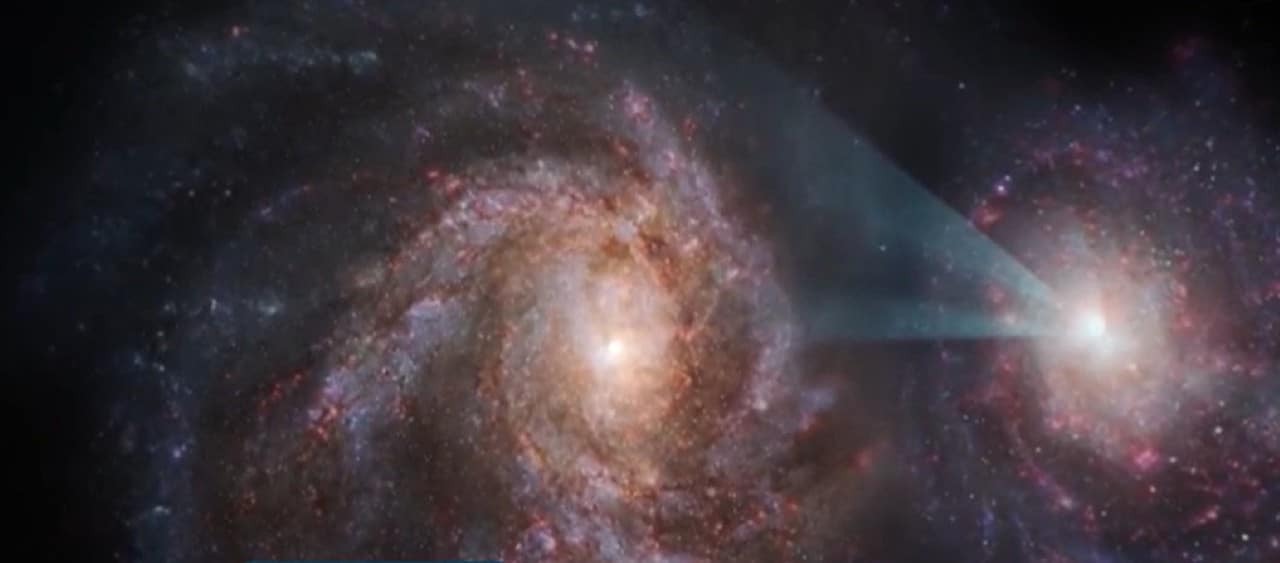
GW250114 Detection Details
Event GW250114 stood out for the quality of the signal received by LIGO’s detectors. Ripples in space-time have been measured with variations of less than a trillionth of a meter, thanks to advanced laser interferometry. Essa precision allowed tracking from the orbital approach to the final coalescence and relaxation of the resulting object.
Researchers calculated the area of the event horizon before and after the merger. The results showed an increase consistent with the theoretical prediction, validating the principle that this area never decreases in classical physical processes.
Area theorem formulated by Hawking
Stephen Hawking developed the area theorem in 1971, establishing that the event horizon of black holes behaves analogously to thermodynamic entropy. According to the model, classical interactions can only increase or maintain this total area. The proposal integrated concepts of gravitation and thermodynamics in extreme contexts.
The theorem gained relevance with the first detections of gravitational waves in 2015. Desde then, accumulated events provided data for progressively rigorous tests.
Technological advances in LIGO
LIGO operates four-kilometer-long interferometers at Hanford and Livingston. Recent Aprimoramentos have increased sensitivity, allowing more distant and detailed signals to be captured. International Colaborações with Virgo and KAGRA expand global detection network.
These developments have transformed gravitational wave astronomy into an essential tool. Observações accumulate information about black hole populations and tests of fundamental theories.
Historical context of Hawking’s contributions
Hawking published the area theorem during studies on singularities and event horizons. The work complemented previous advances in general relativity and established parallels with thermodynamic laws. Pesquisas have explored implications for information and the quantum evaporation of black holes.
The current confirmation represents a milestone after decades of observational refinement. Dados of GW250114 provided the most robust test to date.
Steps observed in the merger
The detection captured distinct phases of the collision process:
- Spiral approach, with increasing emission of gravitational waves.
- Coalescence proper, when horizons come together.
- Relaxation of the final black hole, emitting damping signals.
These steps allowed precise calculations of the areas involved. The increase observed was exactly in line with theoretical expectations.
Importance for general relativity
The result reinforces the consistency of the theory of Einstein in extreme gravity regimes. Fusões of black holes serve as natural laboratories for testing classical predictions. The absence of violations in the area theorem supports the current framework of gravitational physics.
Future observations with even more sensitive detectors promise new tests. Projetos under development aims to expand the range and precision of measurements.
Global network of observatories
Detectors such as LIGO, Virgo and KAGRA work together to triangulate signal sources. Essa collaboration improves location of sky events and extraction of physical parameters. Continuous Investimentos increases the annual detection rate.
The current network records dozens of events per year. Cada new observation contributes to population maps of black holes in the universe.
Accurate area calculations
Teams analyzed the GW250114 signal to estimate masses and spins of the initial black holes. From these parameters, they determined the areas of individual event horizons. The resulting black hole had a larger total area, as predicted.
The margin of error in measurements was below previous levels. Essa accuracy marked a significant advance over events detected in LIGO’s early years.
Evolution of observations since 2015
The first detection of gravitational waves occurred in September 2015. Desde then, the catalog grew to hundreds of confirmed events. Melhorias techniques reduced noise and expanded the observable volume of the universe.
The GW250114 represents the culmination of this technological evolution. Clearer Sinais pave the way for detailed studies of post-merger phenomena.
The field of gravitational astronomy has established itself as a mature discipline. Descobertas accumulate robust evidence for theories developed throughout the 20th century.



