
Interstellar comet 3I/ATLAS shows asymmetric jets and new chemistry after passing close to the Sun


New observations of the interstellar comet 3I/ATLAS revealed a dynamic and complex behavior after its closest approach to Sol. Dados captured by Observatório W. M.
The analysis, carried out on November 16, 2025, took place weeks after the comet reached perihelion, the point of its orbit closest to Sol, on October 29 of the same year. Naquele moment, the object was at a distance of 1.509 astronomical units (AU) from Sol and 2.089 AU from Terra. The study focused on analyzing the coma, the gaseous atmosphere around the comet’s nucleus, to map the distribution of different elements and molecules.
The findings confirm that 3I/ATLAS maintained intense chemical activity even after peak solar heating. The research details how proximity to our star changed the rates of gas production and the proportion of metals such as nickel and iron, bringing their characteristics closer to those of comets native to our Sistema Solar, a phenomenon that intrigues scientists.
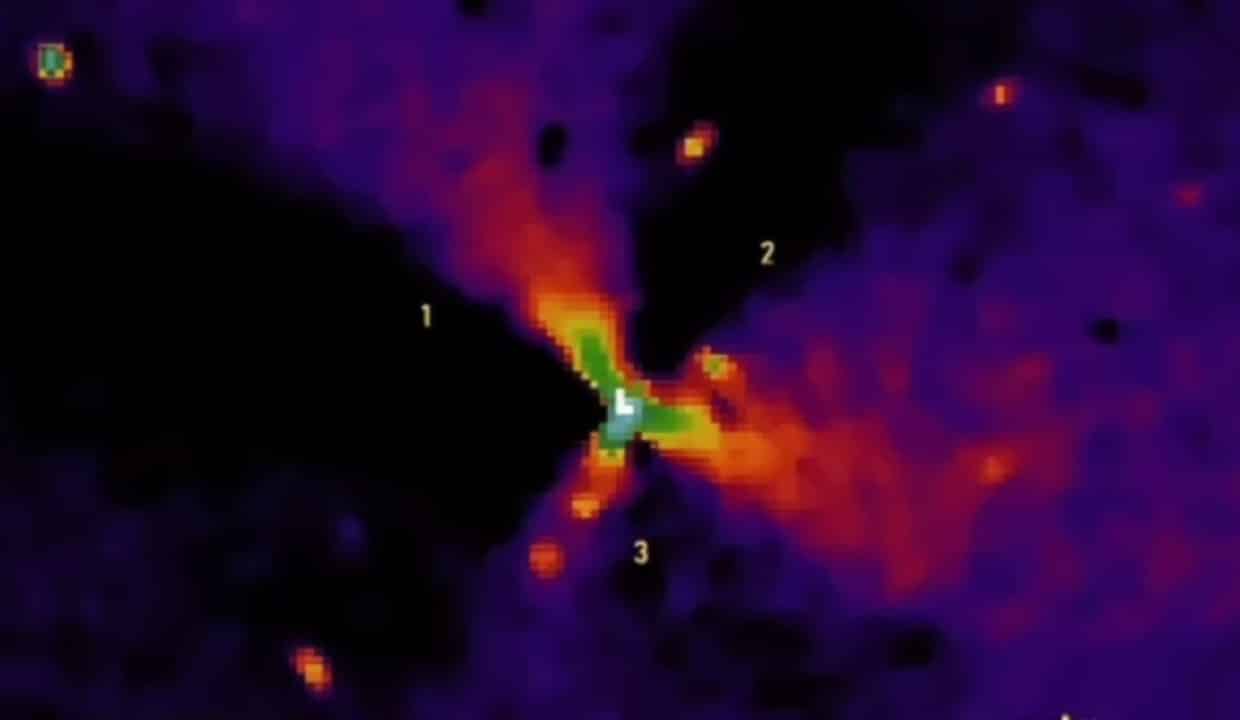
Detailed analysis of the Keck observatory
The investigation was conducted using the Keck Cosmic Web Imager (KCWI) on the Keck II telescope, one of the world’s most advanced instruments for spectroscopy. The full-field spectroscopy technique allowed astronomers to not only identify the chemical species present in the comet’s coma, but also to map their spatial distribution with high precision. By analyzing the light emitted by the gas and dust, it was possible to create a three-dimensional map of the comet’s activity. Esse method was crucial for identifying deviations from the expected circular symmetry in the coma’s brightness, revealing the presence of directed structures such as jets and tails. Excess luminous flux in specific directions, contrasting with a deficit in the direction opposite to Sol, indicated that material was not being released uniformly from the core surface, suggesting a complex topography and areas with different sublimation rates.
The surprising evolution in the proportion of metals
One of the most notable results was the drastic change in the nickel to iron (Ni/Fe) ratio after perihelion. Antes from its closest pass to Sol, when it was at distances greater than 2.5 AU, comet 3I/ATLAS exhibited extraordinary enrichment in nickel compared to iron, a value greater than that of any comet ever recorded, including the second interstellar visitor, 2I/Borisov.
This anomalous proportion decreased considerably after solar approach. The November 2025 measurements indicated that the Ni/Fe ratio approached the values typically observed in comets from our own Sistema Solar, such as those from the Júpiter family and the famous 9P/Tempel 1.
Scientists calculated production rates of approximately 9.55 × 10²⁵ atoms per second for iron (Q_Fe) and 6.61 × 10²⁵ atoms per second for nickel (Q_Ni). The logarithm of the ratio between these rates (Q_Ni/Q_Fe) registered -0.16 ± 0.03, a value much closer to the solar standard.
The hypothesis is that the intense heat of Sol vaporized the surface layers of the core, which were exceptionally rich in nickel, exposing an interior with a more common composition. Essa evolution offers a rare window into the layered structure of a body formed in another planetary system.
Asymmetric jet structures
KCWI’s spectral analysis allowed the visualization of distinct jets emanating from the comet’s nucleus. Most of the detected emissions, including those of nickel, iron, cyanogen (CN) and dicarbon (C2), were approximately aligned with the direction pointing towards Sol, an expected behavior since solar radiation is the main driver of cometary activity.
However, one anomaly caught our attention: the tricarbon jet (C3) was observed at a completely different angle, misaligned both in relation to the solar direction and the jets of other materials. Essa variation suggests that the source of C3 in the comet nucleus is located in a region with different sublimation properties or that the process of releasing this molecule is different. Tais inhomogeneities on the core surface are crucial to understanding the composition and thermal history of these traveling objects.
Differences in chemical production rates
The production rates of the various chemical species showed a strong dependence on the comet’s distance from Sol. Cyanogen (CN), for example, showed a more pronounced variation with distance than tricarbon (C3) and dicarbon (C2), indicating that its sources in the core respond differently to solar heating.
Furthermore, the species’ exponential decay radii, which measure the extent of the gas coma, increased 6.5 to 7 times compared to measurements taken before perihelion. The radius of CN’s coma reached 6,053 km, while that of nickel reached about 3,880 km.
This significant expansion of the comet’s atmosphere is a direct consequence of greater exposure to heat and solar radiation, which intensified the sublimation of ice and the release of gases trapped in the nucleus.
An extrasolar visitor in perspective
Comparison of 3I/ATLAS with other comets reinforces its extrasolar origin. Embora its nickel-iron ratio had normalized after perihelion, the initial values were unique. Essa normalization suggests that although planetary formation processes in other systems may create exotic surface compositions, the interiors of these bodies may be more similar to objects in our Sistema Solar.
The comet’s hyperbolic trajectory, which will take it out of our system never to return, is the main evidence of its interstellar origin. Studying these visitors offers an unprecedented opportunity to analyze samples of material from other “neighborhoods” of the galaxy.
The third messenger from another star system
3I/ATLAS is officially the third interstellar object detected passing through our Sistema Solar, following the discoveries of 1I/’Oumuamua in 2017 and 2I/Borisov in 2019. Cada one of these objects showed distinct characteristics, highlighting the potential diversity of smaller bodies traveling through the galaxy.
Post-perihelion observations, like those made by Keck, are especially rare and important, as they reveal how these objects respond to a stellar environment different from the one in which they formed. With the future operation of telescopes such as the Observatório Vera C. Rubin, the detection of new interstellar visitors is expected to become more frequent, opening new frontiers in astronomy.
Relevance of current measurements
These observations represent the first time that the integral-field spectroscopy technique has been used to study an interstellar comet after it has passed through perihelion. The data obtained significantly expands knowledge about the chemical evolution of bodies formed in other stellar systems and provides a comparative basis for future discoveries. The confirmed presence of heavy metals and carbon chains reinforces its cometary nature, while anomalies such as the misaligned C3 jet open new avenues for investigation into the composition and structure of cometary nuclei.



