
James Webb presents unprecedented map of dark matter that exposes invisible cosmic skeleton

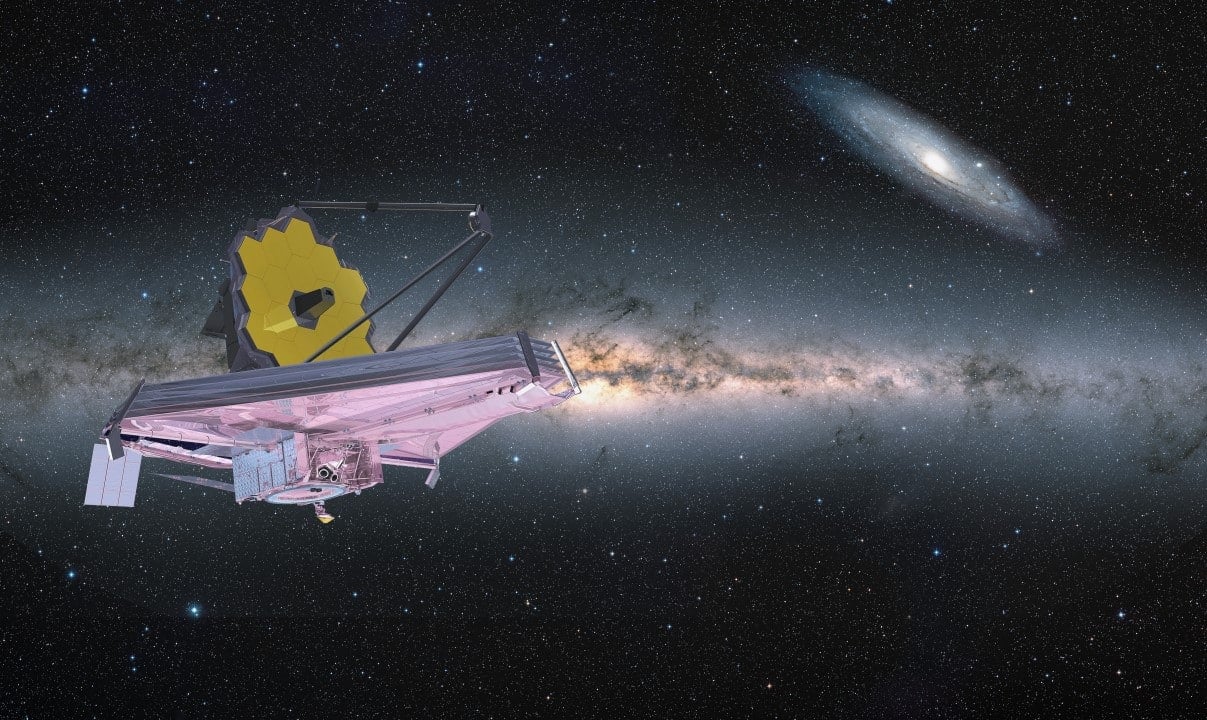
Telescópio Espacial James Webb produced the most detailed map ever recorded of the distribution of dark matter in Universo. Esse breakthrough uses data from the COSMOS-Web project and reveals the filamentary structure that acts as a gravitational scaffold for the formation of galaxies and clusters. The research, based on observations of around 800,000 distant galaxies, confirms the known proportion of matter in the cosmos, with dark matter representing approximately 85% of the total mass.
Scientists have employed the technique of weak gravitational lensing to detect distortions in light from distantly positioned objects. Essa methodology allows mapping the invisible presence of dark matter through effects on the curvature of space-time. The result highlights filaments, clusters and low-density regions that organize the common observable matter.
The analysis reinforces the standard cosmological model and demonstrates how dark matter gravity influences cosmic evolution since the beginnings of Universo.
Weak gravitational lensing technique
The weak gravitational lensing technique is based on the Relatividade Geral prediction of Einstein, which describes how masses curve spacetime. In the case of James Webb, the gravity exerted by dark matter slightly distorts the shape of galaxies in the background, creating measurable patterns of elongation.
These distortions are minimal, but statistically significant when analyzed on a large scale. Researchers measure variations in the elliptical orientation of hundreds of thousands of galaxies to reconstruct the invisible mass field.
The method requires high optical resolution, provided by the telescope’s infrared instruments. Essa capability allows it to penetrate cosmic dust and observe distant regions with greater precision than previous observatories.
COSMOS-Web project details
The COSMOS-Web project accumulates 255 hours of observation in a specific field of the sky. The Essa area covers a portion equivalent to several times the size of the full Lua, allowing us to catalog almost 800,000 galaxies.
The wide and deep coverage surpasses previous maps taken by ground-based telescopes or by Hubble. James Webb doubles the resolution compared to similar studies, revealing smaller, more detailed structures.
- Extensive filaments that connect clusters of galaxies;
- Low-density regions known as cosmic voids;
- Gravity bridges between massive clusters.
These elements form the cosmic web observed in computer simulations.
Structure of the cosmic web revealed
The cosmic web appears as a three-dimensional network of blue filaments on the map superimposed on real images of galaxies. Galaxies are concentrated along these filaments, following the gravitational pull of dark matter.
This distribution confirms theoretical predictions about the formation of large-scale structures. Dark matter acts as an initial scaffold, attracting baryonic matter to form stars and galaxies over time.
Regions of higher density correspond to clusters rich in observable galaxies. Já voids show lower concentrations of both types of matter.
Comparison with previous maps
Previous maps, obtained by Hubble or by terrestrial surveys, had limited resolution. Eles covered smaller areas or detected less accurate distortions due to atmospheric interference.
The new James Webb map offers more than double the resolution in similar regions. Essa improvement allows identification of substructures within previously indistinct filaments.
The comparison validates consistency with data from the cosmic microwave background. Complementary Observações reinforce the 85% proportion of dark matter in the total mass-energy of Universo.
Implications for current cosmology
The results align with the Lambda-CDM model, which describes the evolution of Universo with cold dark matter. The precision of the data constrains cosmological parameters more rigorously.
Scientists identify alignment between the observed distribution and numerical simulations. Essa correspondence strengthens understanding about the initial formation of structures after Big Bang.
Dark matter remains undetectable directly, interacting only via gravity. The indirect map provides robust evidence of its existence and distribution.
Key map elements
The map highlights specific components of the cosmic web at different scales.
- Massive clusters act as main nodes of the web;
- Filaments connect these nodes over distances of millions of light years;
- Voids occupy extensive volumes with low matter density;
- Smaller bridges connect substructures within larger clusters.
These features appear with unprecedented clarity in infrared images.
Telescope technological advances
James Webb operates in the infrared, allowing observations beyond interstellar dust. Seus segmented mirrors and sensitive instruments capture light from galaxies billions of light years away.
Orbital stability at the L2 point ensures long exposures without interruptions. Essa configuration enables the accumulation of data necessary for statistical analyzes of gravitational lenses.
Specific filters isolate ideal wavelengths for measuring distortions. The combination of advanced hardware increases the quality of cosmological maps.
The dark matter map represents a milestone in modern observational astronomy. Ele exposes the invisible network that underpins the large-scale organization of the cosmos and validates decades of theoretical models with high-precision empirical data.



