
Keck observations reveal chemical changes and asymmetric jets in interstellar comet 3I/ATLAS after perihelion


The interstellar comet 3I/ATLAS passed through perihelion on October 29, 2025 and was observed on November 16, 2025 by K14 Keck Cosmic Web Imager, on the Keck II telescope, on Mauna Kea, on Havaí. On the date of observation, the object was 1.509 astronomical units (AU) from Sol and 2.089 AU from Terra. The analyzes captured emissions from atomic and molecular species, identifying deviations from circular symmetry in the brightness distribution. Essas asymmetries point to the presence of jets and tails, with excess flow in specific directions and deficit in the anti-solar direction.
The spectral data show variations in the emissions of nickel (Ni), iron (Fe), cyanogen (CN), tricarbon (C3) and dicarbon (C2). The comet maintained significant chemical activity after closest approach to Sol. The research confirms an evolution in composition, with production rates changing depending on the heliocentric distance.
Observations by Keck
The Keck Cosmic Web Imager performed full-field spectroscopy on November 16, 2025. The Essa technique mapped the spatial distribution of chemical species around the nucleus.
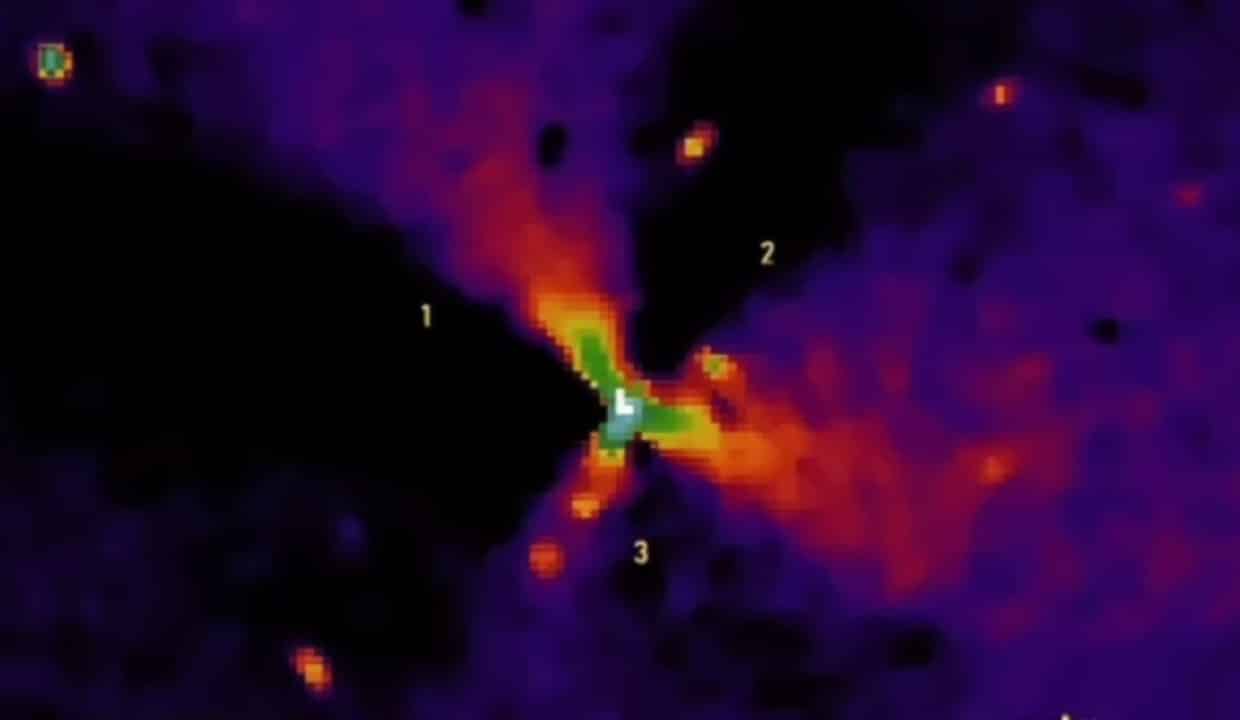
Subtracting the symmetric brightness revealed asymmetric structures. Excess flow corresponds to jets or tails, while deficit occurs in the opposite direction to Sol.
Nickel, iron, cyanogen and dicarbon species are approximately aligned with the solar direction. The tricarbon jet exhibits a different angle, misaligned in relation to the others. Essa variation suggests distinct sublimation processes in the nucleus.
Evolution in the nickel-iron ratio
The nickel-iron ratio (Ni/Fe) underwent a marked evolution after perihelion. Antes from the closest passage to Sol, the comet recorded extraordinary nickel enrichment at distances above 2.5 AU.
The data indicate variation proportional to the heliocentric distance raised to a power of 1.15 ± 0.05. Após the perihelion, the values approached those of Sistema Solar comets, such as 9P/Tempel 1.
Production rates include Q_Fe of about 9.55 × 10²⁵ atoms per second and Q_Ni of 6.61 × 10²⁵ atoms per second. The logarithm of the Q_Ni/Q_Fe ratio registered -0.16 ± 0.03. Essa normalization reflects volatilization of nickel-enriched surface layers.
Pre-perihelion observations already showed ratios higher than any recorded comet. The change reinforces the influence of solar proximity on the exposed composition.
Varying production rates
The production rates of atomic and molecular species depend on the distance to Sol. Cyanogen has a more pronounced dependence than tricarbon and dicarbon.
Exponential decay radii increased 6.5 to 7 times relative to pre-perihelion measurements. Valores reach 6,053 km for CN and around 3,880 km for nickel.
These expansions indicate a greater extent of the gas coma after exposure to solar heat. The chemical activity remains consistent with comet patterns from Sistema Solar.
Asymmetric jet structures
Spectral analysis highlights jets in specific directions. Níquel, iron, cyanogen and dicarbon align approximately with the solar direction.
The tricarbon forms a jet at a different angle, without anti-sun alignment or with other emissions. Essa anomaly suggests heterogeneities in the nucleus.
Asymmetries reflect variations in the sublimation rate of specific regions of the surface. Jatos indicate targeted release of volatile material.
Comparison with other comets
3I/ATLAS initially surpassed the Ni/Fe ratio of any observed comet, including the interstellar 2I/Borisov. Após the perihelion, the values resemble those of Jovian comets and Halley.
Dynamically new comets from Nuvem to Oort exhibit varying patterns. 3I/ATLAS follows a normalization trend with solar approach.
The comparison highlights increasing similarities with objects from Sistema Solar. Initial Diferenças reinforce the extrasolar origin.
Context of interstellar objects
3I/ATLAS is the third confirmed interstellar object, after 1I/’Oumuamua and 2I/Borisov. Sua hyperbolic trajectory confirms origin outside of Sistema Solar.
Post-perihelion observations offer rare data on the composition of bodies in other stellar systems. The presence of heavy metals and carbon chains provides clues about planetary formation.
Activity over greater distances suggests a composition rich in volatiles. Observatório Rubin will be able to detect more objects before perihelion.
Relevance of current measurements
The Keck observations represent the first post-perihelion integral-field spectroscopy of an interstellar object. The data expands knowledge about extrasolar chemical evolution.
The detection of carbon chains and heavy metals confirms the cometary nature. Anomalias and the misaligned C3 jet require additional studies.
These discoveries contribute to characterizing the diversity of interstellar bodies. The set of information helps in understanding natural origins.



