Carlos Alcaraz beats Alexander Zverev in the longest semi-final in history and goes to the final in Melbourne

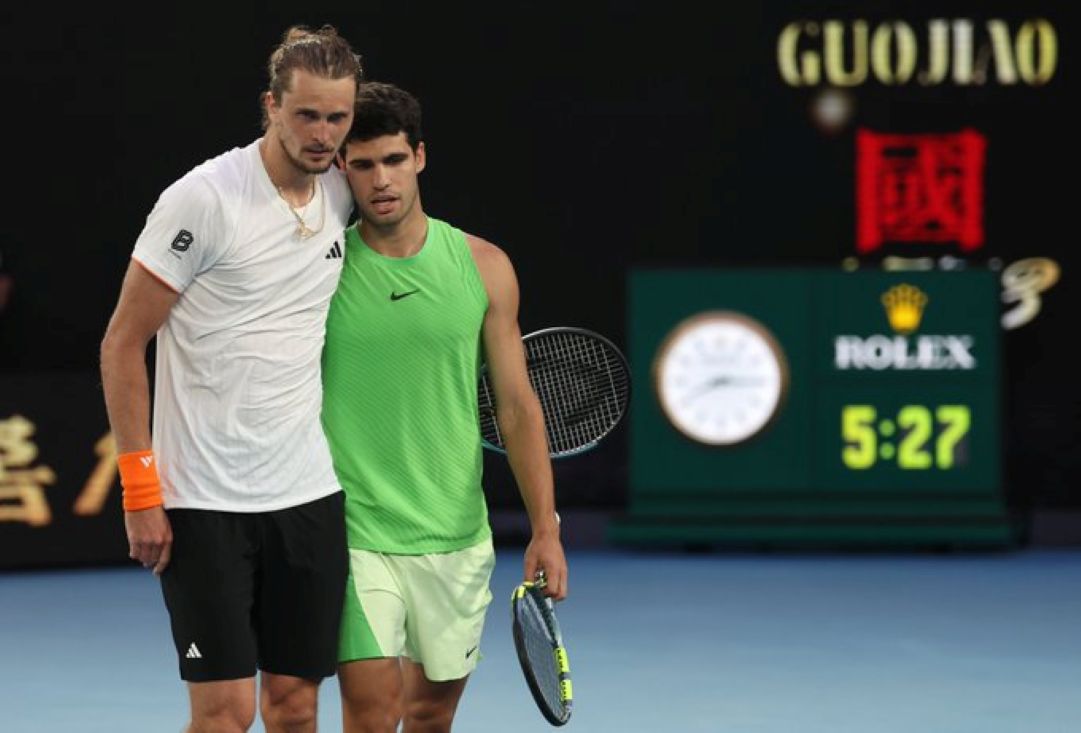
Spanish tennis player Carlos Alcaraz, current number 1 in the world rankings, secured his place in the final of Australian Open after defeating German Alexander Zverev in a historic match held this Friday, January 30, at Melbourne. The match lasted 5 hours and 27 minutes, officially becoming the longest semi-final ever at the Australian tournament, surpassing the previous record set by Rafael Nadal and Fernando Verdasco in 2009.
Alcaraz won by 3 sets to 2, with partials of 6/4, 7/6 (5), 6/7 (3), 6/7 (4) and 7/5, in a game marked by technical twists and extreme physical exhaustion of both athletes. Esta is the first time that the young Spaniard has reached the decision of the first Grand Slam of the season, reinforcing his leadership position in the professional men’s circuit.
The victory was built under adverse conditions, as the leader of the ranking had to deal with severe cramps from the third set onwards, when he was already winning by two sets to zero. Key facts from the match include:
- Breaking the record for the duration of a semi-final in Melbourne Park.
- The controversial medical care requested by the Spaniard during the fourth set.
- Alexander Zverev’s resilience in forcing the fifth set after being at a considerable disadvantage.
- Maintaining Alcaraz’s unbeaten record in Grand Slam matches after opening 2-0.
Spanish champion heritage 🇪🇸@carlosalcaraz | @alo_oficial pic.twitter.com/iTIiMOyJiW
— #AusOpen (@AustralianOpen)January 30, 2026
Historical record and physical resistance on blue clay
The semifinal in Melbourne Park went down in the history books of world tennis due to the intensity and longevity of the duel between today’s two biggest names. By surpassing the 5 hour and 14 minute mark in the 2009 semi-final, Alcaraz and Zverev demonstrated physical fitness that tested the limits of human endurance in the Australian heat. The audience present at Rod Laver Arena watched a game where technical strategy was, at times, replaced by the pure willpower of the competitors.
The Spaniard started the match with an aggressive pace, dominating the actions from the back of the court and forcing the German to make unforced errors in crucial moments of the first set. Zverev, occupying third place in the ATP rankings, tried to react in the second set, taking the decision to a tie-break, but was unable to contain the precision of Alcaraz’s right shots. The balance between the two players was constant, resulting in ball exchanges that often exceeded ten beats per point.
Medical care and on-court controversy
One of the most tense moments in the match occurred when Carlos Alcaraz had acute pain in his right thigh and requested the presence of the physiotherapist in the middle of the fourth set. Alexander Zverev expressed strong dissatisfaction with the refereeing, claiming that his rival was suffering from cramps, a condition that, according to the rules of the international federation, does not justify immediate medical attention during the game. The interruption generated a momentary atmosphere of hostility between the players’ benches and the technical team at the stadium.
Despite the visible limitations in his lateral movement, Alcaraz continued in contention, adapting his playing style to shorten points and avoid prolonged rallies. Zverev aproveitou a brecha física do adversário para vencer o terceiro e o quarto sets, ambos decididos em tie-breaks emocionantes que inflamaram a torcida local. The German showed emotional coolness so as not to disconnect from the match in the face of the physical drama experienced by the Spaniard on the other side of the net.
Mental exhaustion also played a fundamental role, as each mistake made at the end of the fourth set weighed significantly on the athletes’ confidence. Alcaraz revealed after the game that he had to find strength in his pre-season preparation to not give up in the face of the intense pain he felt. The world number 1’s ability to adapt was put to the test, requiring a more varied repertoire of moves, including the frequent use of cues to unbalance Zverev.
Overcoming in the fifth set and the path to the title
The decisive set was played at a high level of tension, with both tennis players showing clear signs of exhaustion, but maintaining technical quality in their services. Alcaraz managed a crucial break of service in the twelfth game, closing the partial at 7/5 and guaranteeing his passage to the grand final. The result confirms the Spaniard’s winning mentality, who declared that he had put his heart on the court to overcome one of the toughest challenges of his professional career.
With this triumph, Alcaraz now awaits the winner of the clash between the Italian Jannik Sinner and the Serbian Novak Djokovic to find out who they will face in the dispute for the trophy. The Spaniard is looking for his seventh Grand Slam title, which would further consolidate his name among the great icons in the history of active sport. The physical work carried out by the Alcaraz team will be intensified in the coming hours to ensure that he is recovered for the final, which takes place on Sunday.
Mental preparation and game strategy
Alcaraz’s success in long matches is attributed to his ability to maintain focus even under extreme pressure and physical pain. Durante the official interviews, the athlete highlighted that the key to victory was believing in the possibility of recovery even when the legs did not respond adequately. Ele emphasized that days of heavy training and mental suffering are made precisely for moments of crisis like those experienced in this semifinal against Zverev.
Zverev, in turn, regretted the lost opportunity to return to an Major final, but recognized the level of play presented by his opponent. The sneakers presented in Melbourne reflect the current competitiveness of the circuit, where the difference between the four best in the world is minimal and decided on details of resistance and precision. The tournament continues to attract global attention, especially due to the possibility of a new generational clash in Sunday’s grand final.
Next steps and expectations for the final
The Australian Open organizers confirmed that the final schedule will follow Melbourne local time, with a full house expected to see the 2026 champion crowned. Technical analysis indicates that the Spaniard will need an efficient serve and impeccable movement to face Sinner or Djokovic in the final.
Match statistics show that Alcaraz converted a high percentage of first serve points in the pressure moments of the fifth set. Além Furthermore, his aggressive service returns allowed him to keep Zverev on the defensive for most of the time. The statistical balance between aces and unforced errors was what allowed the game to go on for so long, with both players refusing to give up ground.