
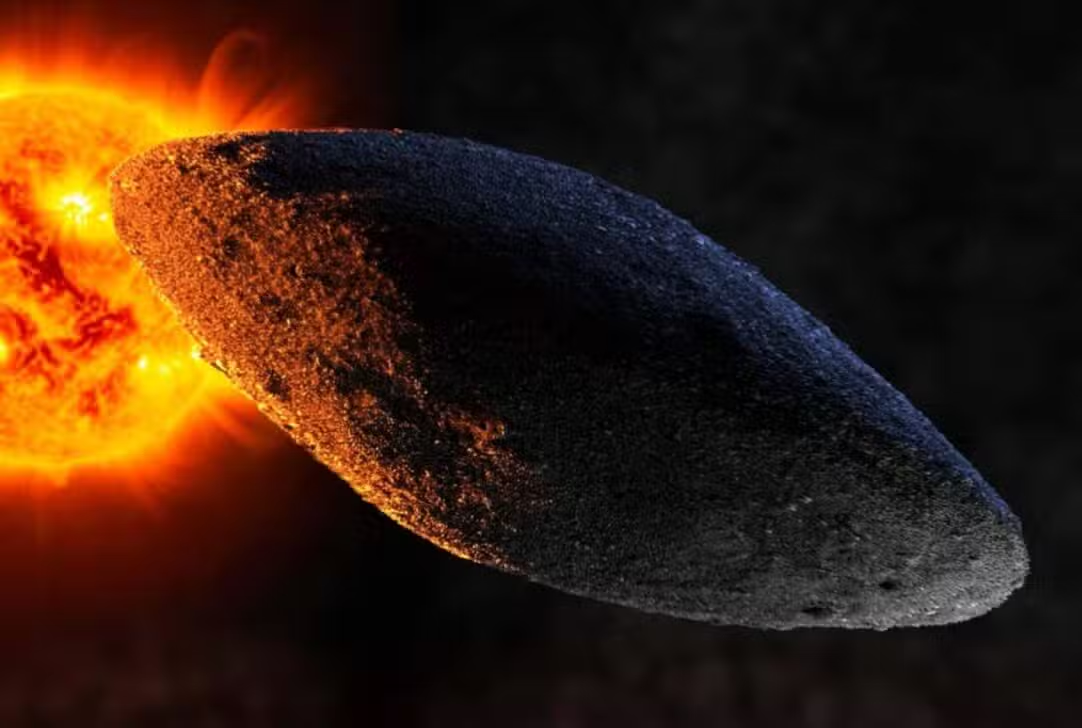
A new visitor from a distant star system is crossing our cosmic neighborhood. Astrônomos confirmed the passage of comet 3I/Atlas, the third interstellar object ever identified, which moves at an impressive speed of 57 kilometers per second. Essa’s extreme speed is key to understanding his journey, as it places him on a hyperbolic trajectory, ensuring he will not be captured by Sol’s gravity.
The recent detection places 3I/Atlas in a select group of cosmic travelers, following in the footsteps of ‘Oumuamua, identified in 2017, and 2I/Borisov, in 2019. The comet’s trajectory is an open line, not a closed ellipse like that of the planets and comets in our own system. Isso means that, after its closest approach, it will continue its journey back to deep space, never to return.
Telescopic observations are crucial for tracking its path and analyzing its composition. The object’s initial velocity already exceeds the escape velocity needed to break free from the solar attraction, making the interaction resemble a gravitational slingshot effect. Sol influences bodies up to 3.8 light years away, but this force is not enough to lock 3I/Atlas into a permanent orbit.
Origin and ejection of interstellar objects
Celestial bodies like 3I/Atlas probably orbited very distant stars before being expelled into the vast void of interstellar space. Acredita These objects are believed to be remnants of the formation of planetary systems, similar to the asteroids and comets of our Nuvem and Oort.
The ejection of these bodies from their home systems occurs due to cataclysmic gravitational events. Interações with giant planets, similar to Júpiter, or the influence of nearby stars can destabilize their orbits and launch them on journeys that last millions of years, until they eventually cross the path of another star system, like ours.
The hyperbolic trajectory in detail
A hyperbolic trajectory indicates that an object has enough kinetic energy to overcome the gravitational attraction of a central body, in this case, Sol. At each point on its journey through Sistema Solar, 3I/Atlas’ speed is greater than the local escape velocity, which prevents it from forming a closed orbit.
Solar gravity acts to change the comet’s direction, curving its route, but is unable to reduce its speed enough for capture. Assim, the comet enters Sistema Solar, makes its closest approach and then moves away in a different direction from which it arrived, continuing its journey through the galaxy.
Precise calculations make it possible to predict the point of closest approach, with the interaction lasting just a few weeks or months. Modelos Complex computational techniques are used to simulate this gravitational slingshot effect and accurately predict its exit route, providing valuable data for the study of celestial mechanics.
Comparisons with other cosmic visitors
The 3I/Atlas stands out for its speed. At 57 km/s, it is considerably faster than its interstellar predecessors. ‘Oumuamua was detected at a speed of 26 km/s, while 2I/Borisov was traveling at about 33 km/s. Essa notable difference could provide clues about the type of star system it originated from and the nature of the event that ejected it.
Each interstellar visitor presented unique characteristics. ‘Oumuamua, with its elongated shape and absence of coma (the cloud of gas and dust surrounding the nucleus), generated intense scientific debate. Sua slight non-gravitational acceleration is still a topic of study, with the leading theory pointing to the release of gases from its surface.
On the other hand, 2I/Borisov closely resembled a typical comet from our Sistema Solar, exhibiting a well-defined coma and tail. Isso allowed astronomers to analyze its composition in more detail, revealing the presence of molecules such as carbon monoxide in unusual proportions, suggesting that it formed in a very cold region of its home system.
The 3I/Atlas study will add a new piece to this puzzle. Scientists are eager to analyze its composition and behavior as it approaches Sol. How it reacts to solar heat, develops a coma or exhibits anomalous acceleration will provide essential comparative data to understand the diversity of small celestial bodies in Via Láctea.
The importance of analyzing its chemical composition
Analyzing the chemical composition of interstellar comets is one of the most fascinating areas of modern astronomy. Utilizando a technique called spectroscopy, scientists can break down the light reflected by the comet into its constituent colors, like a prism. Cada chemical element and molecule absorbs and emits light at specific wavelengths, creating a unique pattern, a kind of chemical “barcode”.
This barcode reveals the ingredients that make up the object, such as water, carbon monoxide, cyanide and silicate dust. By studying the proportions of these materials in 3I/Atlas, researchers can compare them to those of comets from our Sistema Solar. Significant Diferenças may indicate that the comet formed in an environment with distinct chemical conditions, offering direct insight into the raw material that forms planets around other stars.
Effects of gravitational interaction with Sol
The 3I/Atlas encounter with Sol is a dynamic event that offers a unique opportunity to test the laws of physics in an extreme scenario. Passage through the solar gravitational field functions as a large-scale natural experiment. Embora the comet’s kinetic energy predominates over the solar attraction, the force of the Sol is sufficient to bend its trajectory at a calculable angle. Observatórios around the world monitor this deflection in real time, refining orbital data and improving our understanding of gravity. Após leaves Sistema Solar, the object will maintain its perpetual movement through space, carrying with it the subtle marks of its brief interaction with our star, information that, in theory, could be used by a future civilization to track part of its journey through the galaxy.
The challenge of detecting these travelers
Identification of interstellar objects like 3I/Atlas is an extremely challenging task. Eles are generally small, dark and move very quickly against the background of fixed stars. Detection relies on wide-field scanning telescopes, which monitor the sky night after night for any moving points of light. Confirmation of its interstellar origin only comes after collecting enough data to calculate an unambiguously hyperbolic trajectory.
Acceleration observed in previous cases
The case of ‘Oumuamua in 2017 demonstrated an intriguing phenomenon: a slight acceleration that could not be explained by Sol’s gravity alone. Esse unexpected behavior has led to various speculations, but the most accepted scientific explanation is that of a natural process known as “outgassing” or degassing.
As the object approached Sol, heat would have heated its surface, releasing gases trapped inside, possibly molecular hydrogen. Essa release of gas acts as a subtle propellant, pushing the object and causing the observed acceleration. Hipóteses alternatives have been proposed, but so far they lack concrete evidence to support them.