
James Webb detects record-breaking MoM-z14 galaxy 280 million years from the Big Bang with high nitrogen


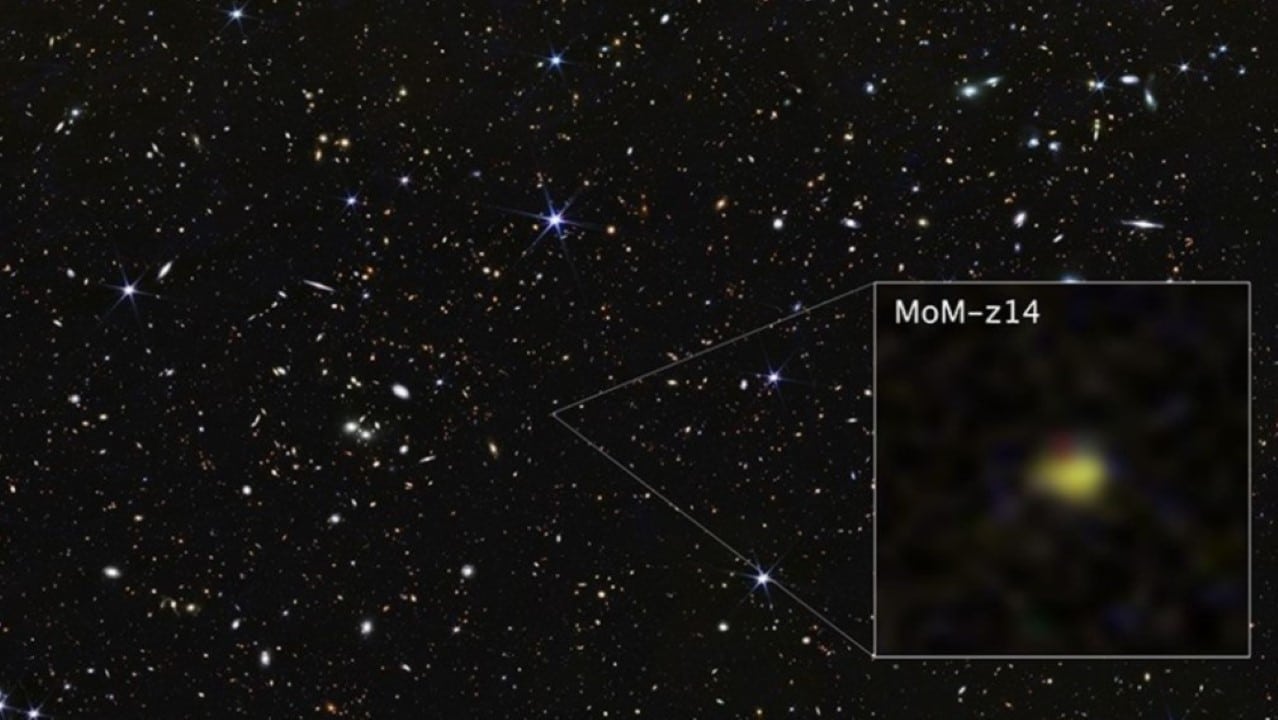
Telescópio Espacial James Webb, from Nasa, confirmed the existence of the MoM-z14 galaxy, the most distant galaxy ever observed, which existed just 280 million years after Big Bang. Essa structure presents intense brightness and high concentrations of nitrogen, characteristics that surprise astronomers by indicating accelerated processes of star formation in the early universe. The light emitted by this galaxy traveled for around 13.5 billion years until it was captured by the observatory’s instruments.
Confirmation occurred through spectroscopy performed with the NIRSpec instrument, which identified a redshift of 14.44. Esse value positions MoM-z14 as the oldest cosmological object spectroscopically validated to date. The data reinforces the role of James Webb in continually expanding the limits of the observable.
Researchers highlight that galaxies like this appear in greater numbers than cosmological models predicted before the launch of the telescope. Essa discrepancy drives revisions in theories about the early evolution of the cosmos.
Spectroscopic observation details
The NIRSpec instrument on James Webb captured ultraviolet emission lines and a characteristic absorption break in the light from MoM-z14. Esses signals confirm the galaxy’s extreme distance and reveal its detailed chemical composition. Spectral analysis is essential to differentiate distant candidates from closer objects that could simulate similar signals.
The responsible team used observations in the COSMOS Legacy field to initially identify the object by image and then validate it. The process combined NIRCam data with precise spectroscopy to eliminate ambiguities. Resultados like this demonstrate the telescope’s unique ability to probe remote epochs of the universe.
Unexpected chemical enrichment
The presence of high amounts of nitrogen in MoM-z14 draws scientists’ attention, as this element requires specific stellar cycles to be produced in abundance. In the young universe, the time available was limited for multiple generations of stars to generate such enrichment. One possible explanation involves supermassive stars that evolved rapidly and released large volumes of nitrogen.
These chemical features are reminiscent of those found in some ancient Via Láctea stars, suggesting connections between the early universe and local structures. Astronomers compare these traces to better understand nucleosynthesis processes under extreme density conditions.
Hypotheses about accelerated star formation
Scientists propose that dense environments in the early universe favored the birth of stars much larger than those today. Essas giant stars would have short life cycles and violent explosions that enriched the interstellar medium with heavy elements. The hypothesis gains strength from observations of several bright galaxies at high redshifts.
- Supermassive stars could reach hundreds of times the mass of Sol.
- Its collapse would release nitrogen in quantities incompatible with ordinary stars.
- The process would accelerate chemical evolution in short periods after Big Bang.
- Future observations could test this idea on larger samples of galaxies.
This perspective explains the excessive brightness observed in objects like MoM-z14 without resorting to exotic mechanisms.
Contribution to cosmic reionization
The MoM-z14 galaxy shows signs of dissipating the neutral hydrogen around it, contributing to the period known as reionization. Essa phase marked the transition in which light from the first stars ionized primordial gas, making the universe transparent. James Webb was designed precisely to map this critical era of cosmic history.
The object emits ionizing photons in an almost dust-free environment, facilitating the propagation of radiation. Esses data helps refine the timeline of reionization and indicates that the process began earlier than previous estimates suggested. Additional Observações in broad fields will be needed to confirm the extent of this contribution.
Comparison with previous findings
Before James Webb, Telescópio Hubble had identified the galaxy GN-z11 about 400 million years after Big Bang. Webb not only confirmed this distance but also found even older and more numerous objects. The sequence of records demonstrates the technological advancement represented by the new observatory.
Galaxies like JADES-GS-z14-0 and others with redshifts above 13 accumulate evidence of a more active early universe. Cada new detection reduces the interval between Big Bang and the first light structures. Esse consistent pattern reinforces that current observations capture a real population and not isolated anomalies.
Challenges to current theoretical models
Standard cosmological models underestimated the abundance of bright galaxies at such early times. The presence of MoM-z14 and similar ones indicates that star formation occurred more efficiently than predicted. Astrônomos adjust parameters related to star formation and supernova feedback to accommodate the new data.
The discrepancy between theory and observation grows as Webb accumulates more examples. Pesquisas future ones will need to incorporate mechanisms that allow a higher rate of galaxy formation in the young universe. Esse adjustment could involve revisions to the physics of primordial cloud collapse or the influence of dark matter.
Legacy of Telescópio James Webb
James Webb continues to fulfill its primary mission of investigating the cosmic dawn with unprecedented precision. Parcerias international agreements between Nasa, ESA and CSA enabled the development of the most advanced observatory ever launched. Instrumentos like NIRCam and NIRSpec allow you to capture infrared light from extremely distant objects.
Consecutive discoveries of record-breaking galaxies consolidate the telescope as an essential tool for modern astrophysics. Cada observation provides pieces to assemble the puzzle of early cosmic evolution. The accumulated data collection is already transforming the understanding of the first billion years of the universe.
Perspectives with future observatories
The future Telescópio Nancy Grace Roman, from Nasa, promises to complement the work of Webb by mapping larger areas of the sky in infrared. Sua combination of resolution and wide field should reveal thousands of additional early galaxies. Essa Statistically robust sample will help distinguish general patterns from individual variations.
Other projects, such as Euclid and next-generation ground-based telescopes, will contribute complementary data at different wavelengths. Integrating these observations will allow for more rigorous testing of current hypotheses about star formation and reionization. The field of observational cosmology is entering a phase of accelerated progress.
Telescópio James Webb has operated successfully since its launch and continues to produce results that redefine knowledge about the origins of the universe. Investigações ongoing explore deep fields to identify more candidates for extreme redshifts. The astronomical community closely monitors each new release of data.
Implications for cosmic understanding
Observations like that of MoM-z14 demonstrate that the early universe was more dynamic than imagined. Processos Galactic formation occurred quickly, producing complex structures in a short time. Esses findings connect the distant cosmos to present-day galaxies, including Via Láctea.
The early chemical richness suggests intense stellar cycles that shaped the interstellar medium early on. Heavy Elementos dispersed widely, setting the stage for subsequent generations of stars and planets. The continuity between remote times and the present becomes more evident with each discovery.



