James Webb Telescope reveals in detail the invisible web of dark matter in the universe
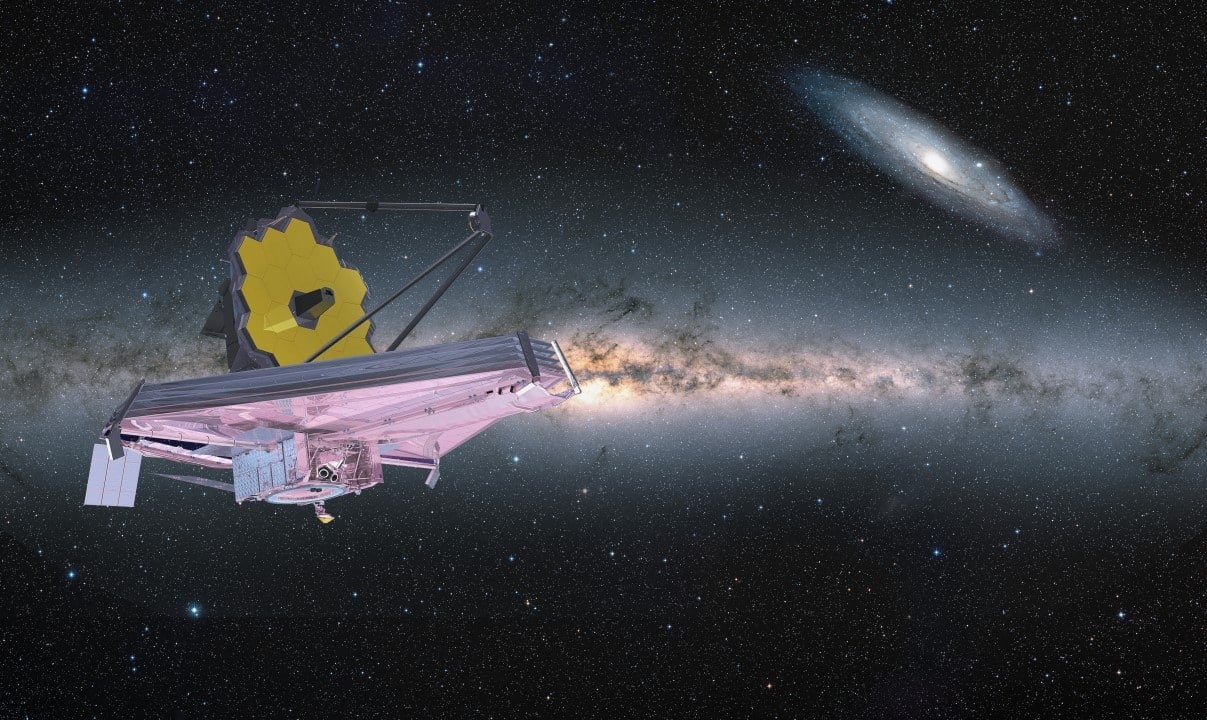
A new image of the deep universe, captured by Telescópio Espacial James Webb, offers the most detailed map ever created of dark matter, the mysterious substance that makes up about 85% of the total mass of the cosmos. The analysis, part of the ambitious COSMOS-Web project, reveals the vast and complex network of filaments that functions like an invisible skeleton, guiding the formation and distribution of galaxies and star clusters.
The research used observation data from almost 800,000 distant galaxies, allowing scientists to map the presence of dark matter through its gravitational effects. The result is an unprecedented visualization of the so-called “cosmic web”, confirming theoretical predictions about how the structure of the universe has evolved since its beginnings.
This breakthrough not only reinforces the standard cosmological model, but also demonstrates James Webb’s extraordinary ability to probe the most fundamental mysteries of the universe. By making the invisible visible, the telescope opens new frontiers for the study of cosmology and the nature of matter itself.
The weak gravitational lens technique
To map something that neither emits nor reflects light, astronomers have turned to an ingenious method known as weak gravitational lensing. The Essa technique builds on one of the pillars of Teoria, Relatividade Geral, and Albert Einstein: the idea that massive objects curve the fabric of space-time around them.
The immense mass of dark matter, although invisible, creates this curvature. Quando light from much more distant galaxies travels towards Terra, it passes through these regions and its path is slightly deflected, causing the apparent shape of these galaxies to be subtly distorted or elongated.
These distortions are tiny and imperceptible when observing a single galaxy. However, by statistically analyzing the shapes of hundreds of thousands of galaxies in the same area of the sky, scientists are able to identify a coherent pattern of alignment, which reveals the presence of a large invisible mass in the foreground.
The precision of James Webb’s instruments, especially its near-infrared camera (NIRCam), is critical to detecting these minute variations. The telescope’s high resolution allows for much more accurate measurements than previous observatories, resulting in a dark matter map with unprecedented clarity.
The scope of the COSMOS-Web project
The map was generated from data collected by COSMOS-Web, one of the largest observation programs ever carried out by James Webb. The project devoted more than 250 hours of telescope time to scanning a vast area of the sky in the constellation Sextans, covering a region several times the size of the full Lua.
This broad coverage allowed the recording of a massive catalog of galaxies, providing the statistical sample necessary for the application of the gravitational lensing technique. The depth of observation, achieved thanks to the sensitivity of the telescope, ensures that even very distant and faint galaxies are included in the analysis.
Compared to previous studies, such as those carried out by Telescópio Espacial Hubble, COSMOS-Web offers twice the resolution and a significantly larger coverage area. Isso makes it possible not only to confirm the existence of large structures, but also to reveal details such as extensive filaments, cosmic voids and gravitational bridges between massive clusters with a clarity never seen before.
The invisible architecture of the universe
The image resulting from the analysis clearly reveals the structure of the cosmic web, a concept that until now has been more prominent in computer simulations than in direct observations. The map shows long, dense filaments of dark matter stretching millions of light years, connecting massive clusters of galaxies that act as nodes in this cosmic web. Entre these filaments, there are vast regions of low density, known as cosmic voids, where matter is much scarcer. Essa distribution is not random; it is the result of the gravitational evolution of the universe over 13.8 billion years.
The importance of this structure is fundamental to understanding the formation of everything we see. Dark matter acted like a primordial gravitational scaffold. Logo after Big Bang, small density fluctuations in the dark matter began to collapse under its own gravity, forming the web filaments. Ordinary, or baryonic, matter, which forms stars, planets and ourselves, was then attracted to these regions of greater density, giving rise to the first galaxies and, later, the large clusters we observe today. The Webb map shows, empirically, that visible galaxies are in fact concentrated along these invisible filaments, exactly as predicted by theory.
A strong validation of the cosmological model
The results obtained by James Webb provide strong support for the standard cosmological model, known as Lambda-CDM (Lambda-Cold Dark Matter). The Este model describes a universe composed of dark energy (represented by the Greek letter Lambda), cold dark matter (Cold Dark Matter) and ordinary baryonic matter. The precision and detail of the new map allow us to test the model’s predictions with unprecedented rigor. The distribution, density and connectivity of the observed dark matter filaments are in remarkable agreement with predictions generated by computational simulations based on Lambda-CDM. Essa consistency strengthens our understanding of the evolution of the universe, from the initial conditions revealed by the cosmic microwave background radiation to the complex large-scale structure we see today. Além Furthermore, data analysis allows us to refine important cosmological parameters, such as the total density of matter in the universe, confirming that dark matter constitutes the overwhelming majority of cosmic mass, around 85%.
Technological capabilities that made a difference
The James Webb’s ability to operate in the infrared spectrum is one of its greatest advantages for this type of study. Light from extremely distant galaxies is stretched to longer, redder wavelengths due to the expansion of the universe, a phenomenon known as redshift. The Webb is optimized to capture this light, allowing you to see further in time and space.
Furthermore, its stable orbital position at Ponto of Lagrange 2 (L2), 1.5 million kilometers from Terra, protects it from the heat and light of our planet. Isso guarantees the thermal stability necessary for long exposures and uninterrupted observations, crucial for accumulating the amount of data needed for statistical analysis of weak gravitational lensing.
A new chapter for cosmology
While the nature of dark matter remains one of the greatest enigmas in modern physics, this map represents a monumental step toward understanding its role in the universe. Ele provides robust observational evidence of its existence and large-scale distribution, serving as a guide for future theoretical and experimental investigations.
By exposing the invisible skeleton that supports the cosmos, Telescópio Espacial James Webb not only validates decades of theory but also opens a new chapter in observational astronomy. The data will continue to be analyzed by scientists around the world, promising even more discoveries about the formation and destiny of our universe.
What the map reveals visually
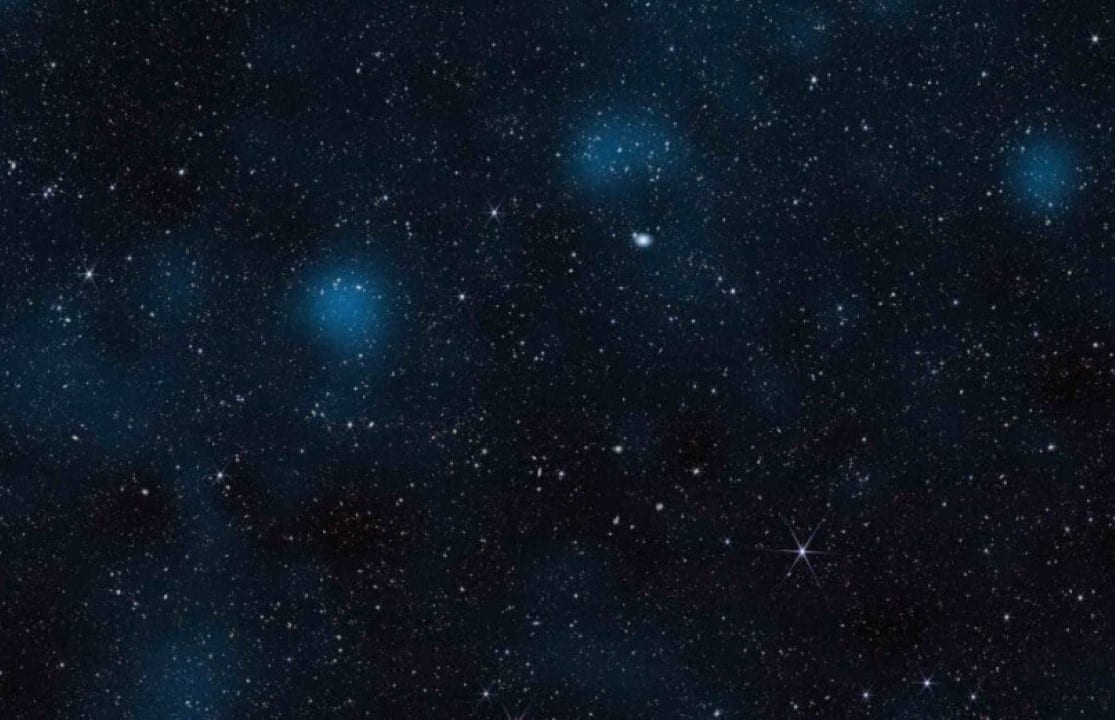
In representations released by the research team, the distribution of dark matter is often shown as a bluish overlay over the actual image of the galaxy field. Areas with more intense blue indicate greater density of dark matter, corresponding to the nodes and filaments of the cosmic web, while darker regions represent cosmic voids, where the concentration of matter is significantly lower.