
Discovery on Jupiter’s moon points to ice ladder as a path for nutrients in the subsurface ocean

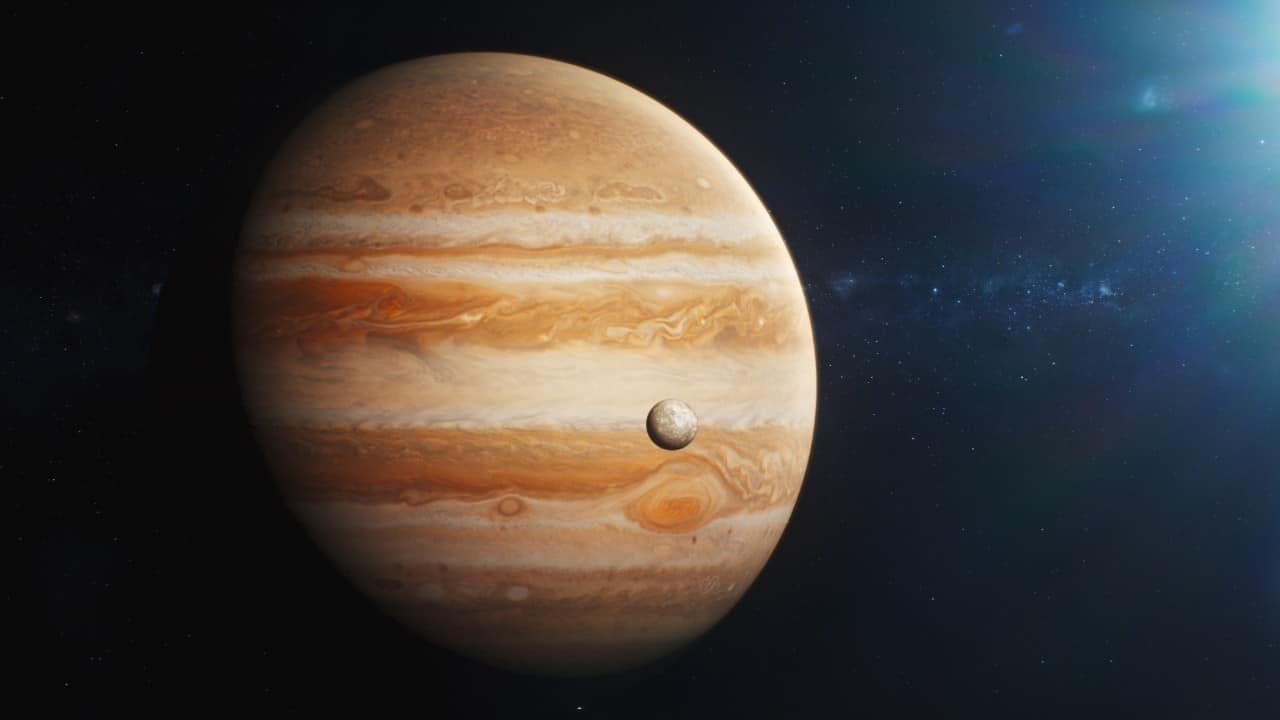
Researchers from Universidade Estadual of Washington published a study that describes an unprecedented process of material transport in the ice crust of Europa, one of the moons of The mechanism, likened to an ice ladder, allows oxygen and nutrients from the surface to reach the subsurface ocean over millions of years. Essa discovery increases the prospects for habitability on the natural satellite.
The process involves the accumulation of salt in surface ice, exposed to the giant planet’s intense radiation. Blocos of salty ice become more dense and malleable, beginning a slow drip through the crust. Modelos computational models simulate how these structures constantly renew the icy layer.
Europa maintains a global ocean of salty liquid water beneath an ice crust estimated to be between 10 and 30 kilometers thick. Observações from previous missions, such as Galileo, confirmed the presence of this ocean through magnetic measurements induced by interaction with the field of Júpiter.
Key features of the moon Europa
Europa has a diameter of approximately 3,121 kilometers, slightly smaller than that of Earth’s Lua. Sua surface displays few impact craters, indicating constant ice renewal.
- Fractal lines and regions of chaos dominate the icy terrain.
- Intense radiation from Júpiter produces oxidants such as molecular oxygen in the outer layer.
- The underground ocean can contain more than twice the volume of water on Earth combined.
- Surface temperatures reach -170°C, but internal heat keeps the water liquid.
These conditions position Europa as one of the most promising places to search for life on Sistema Solar. The combination of water, chemical elements and chemical energy sources makes the environment relevant to astrobiology.
Saline drip mechanism
The study details how concentrated salt changes the physical properties of ice. Áreas with greater salinity, they form heavier blocks that gradually sink.
This movement creates vertical channels that function as natural stairs. The process occurs on scales of tens of kilometers and takes around three million years to traverse the entire crust. Constant renewal transports oxidants generated by radiation to the ocean floor.
Researchers used computer simulations to reproduce the phenomenon. Models show that pure ice maintains structural rigidity, while salty ice facilitates controlled descent.
Implications for ocean habitability
The arrival of oxygen to the ocean represents a crucial source of chemical energy. Organismos extreme terrestrials use similar reactions to survive in environments without sunlight.
This continuous transport can support chemosynthesis-based food chains. The presence of oxidizing nutrients increases the potential for microbial metabolism on the ocean floor.
Historical context of observations
The Galileo probe, operated by NASA between 1995 and 2003, provided the first robust evidence of the subsurface ocean. Medições of the magnetic field revealed high conductivity compatible with salt water.
High-resolution images captured the unique surface features. Regiões of chaotic terrain suggests upwelling of material from the icy interior.
Telescopes like Hubble detected possible vapor plumes in 2016. Essas emissions reinforce the idea of a connection between the ocean and the surface.
Preparations for mission Europa Clipper
NASA launched the Europa Clipper probe in October 2024 with a final destination in 2030. The trajectory includes gravitational assists from Marte in 2025 and Terra in 2026.
The spacecraft carries nine dedicated science instruments. Penetrating Radar will map the thickness of the ice crust with unprecedented precision.
Spectrometers will analyze the chemical composition of the surface and any plumes. Magnetômetro will confirm characteristics of the internal ocean.
The mission will perform dozens of close flybys. The data collected will help identify priority locations for future exploration.
Comparisons with other icy moons
Enceladus, satellite of Saturno, exhibits intense cryovolcanic activity at the south pole. Plumas eject material directly from the ocean into space.
Europa presents more subtle dynamics, based on solid convection processes. Ambos bodies maintain global oceans beneath icy crusts.
Ganymede, another moon of Júpiter, has an internal ocean, but is buried deeper. Calisto shows old surface without clear signs of recent renovation.
Future perspectives in astrobiology
Discoveries such as the ice ladder mechanism guide strategies for searching for biosignatures. Instrumentos sensors will detect complex organic compounds on the surface.
The combination of liquid water, chemical energy and essential elements meets the basic criteria for life. Pesquisas continue to refine models of habitability on ocean worlds.
Technological advances will enable more ambitious missions in the coming decades. Exploração direct from extraterrestrial oceans represents the next step in the search for life beyond Terra.
Technical details of the published study
The research used fluid dynamics equations adapted for frozen solids. Parâmetros included variation in salinity and temperature throughout the crust.
Results indicate that the process occurs in multiple regions of the surface. Áreas with higher saline concentration function as preferential initiation points.
The publication in The Planetary Science Journal reinforces the understanding of the evolution of icy crusts. Aplicações extend to other bodies in the outer Sistema Solar.



