
James Webb confirms MoM-z14 galaxy as oldest ever detected at 280 million years old


Telescópio Espacial James Webb, operated by NASA in partnership with European and Canadian space agencies, confirmed the existence of the MoM-z14 galaxy, currently recognized as the most distant and oldest ever observed. Sua light, emitted when Universo was just 280 million years old, traveled for more than 13.5 billion years to reach the observatory’s instruments.
The discovery, led by astronomer Rohan Naidu, of Instituto of Tecnologia of Massachusetts (MIT), represents a significant advance in understanding early galaxy formation. The spectroscopic redshift of 14.44 places MoM-z14 ahead of previous records such as the JADES-GS-z14-0 galaxy.
The galaxy was identified in the COSMOS field, a widely studied region of the deep sky. Observações with the NIRCam instrument captured the initial signal, while NIRSpec provided precise spectroscopic confirmation.
- Redshift of 14.44 indicates formation 280 million years after Big Bang;
- High luminosity for its time, with an ultraviolet magnitude of -20.2;
- Compact structure, similar in mass to Pequena Nuvem of Magalhães;
- Absence of significant dust, suggested by the steep ultraviolet slope.
This data reinforces James Webb’s unique ability to explore previously inaccessible epochs.
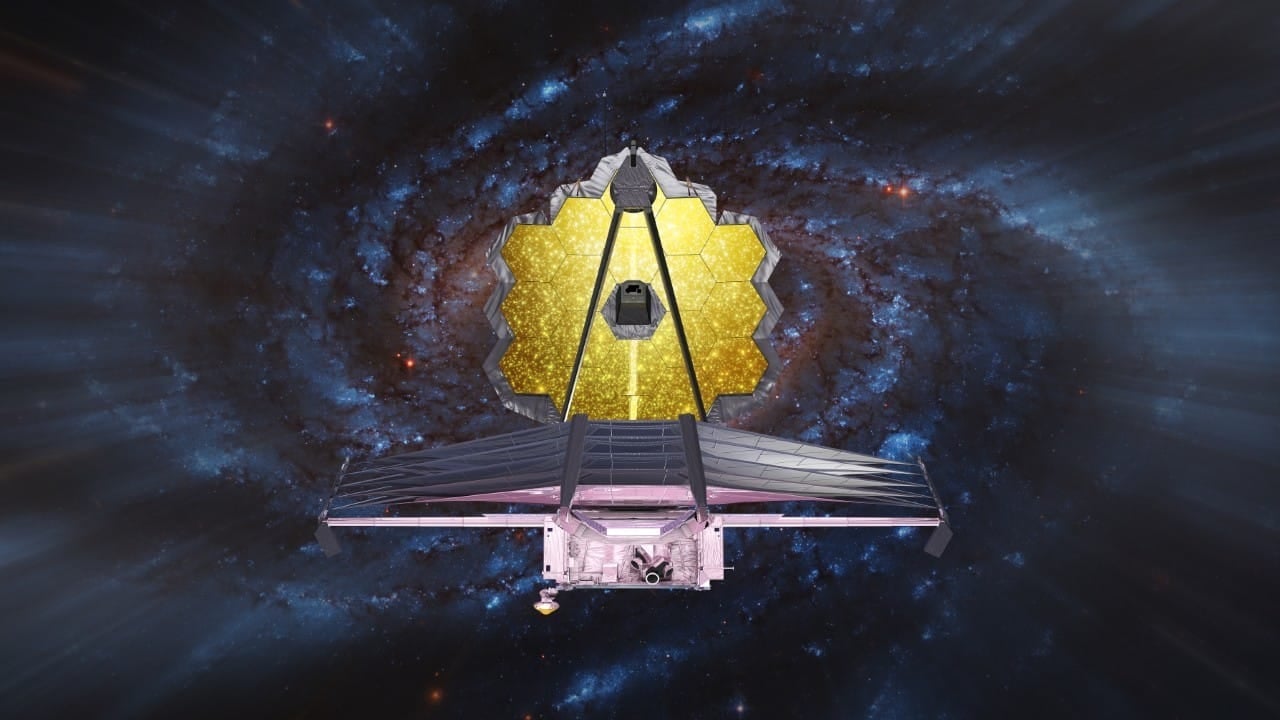
James Webb Advanced Technology
The James Webb’s 6.5-meter primary mirror allows it to capture infrared light from extremely distant objects. Diferente from Hubble, limited to galaxies formed after 500 million years from Big Bang, the current observatory reaches periods much closer to the cosmic origin.
Instruments such as NIRCam and NIRSpec operate with superior sensitivity at long wavelengths. Essa feature reveals galaxies that remained invisible to previous telescopes.
Surprising chemical composition
MoM-z14 shows unusual enrichment of nitrogen relative to carbon. Essa ratio differs from that observed in stars like Sol and resembles ancient globular clusters of Via Láctea.
Most of the light emission comes from massive stars, not from active central black holes. Modelos theorists predict exactly this type of intense star formation in the primordial Universo.
The absence of a strong damping wing suggests partial ionization in the immediate surroundings. Tal condition contrasts with predictions of almost total neutrality in this cosmic era.
Observed structural features
The galaxy displays a compact, point-like shape in initial images. Ampliações reveal concentrated distribution of starlight.
Studies indicate a correlation between compactness and chemical enrichment. Galáxias denser materials tend to have higher levels of nitrogen.
This relationship points to differentiated star formation processes. Ambientes extremes favor rapid production of heavy elements.
Comparisons with similar objects show consistent patterns. MoM-z14 is part of a growing group of early bright galaxies.
Context of cosmic reionization
The epoch of MoM-z14 coincides with the reionization phase of Universo. Primeiras stars and galaxies began to ionize surrounding neutral hydrogen.
Observations suggest that regions around the galaxy already showed partial ionization. Esse finding challenges models that expected dominant neutrality.
Intense star formation
Stars in MoM-z14 form at an accelerated rate. Ausência of dust allows clear view of internal processes.
Theories predict supermassive stars in primordial conditions. Colisões frequent in dense environments favor extreme objects.
Connections with Via Láctea
Chemical patterns of MoM-z14 resemble ancient globular clusters. Esses remnants preserve early star formation signature.
Studying distant galaxies works like cosmic archeology. Conexões trace evolution from ancient times to modern structures.
Future research perspectives
Telescópio Nancy Grace Roman, scheduled for launch soon, will expand searches for similar objects. Seu larger field of view will make it possible to detect hundreds of primordial galaxies.
Accumulated data from James Webb continues to reveal distant candidates. Novas spectroscopic confirmations should update records periodically.
Complementary observations in other in-depth fields enrich the catalog. Programas like Mirage focus specifically on confirming high redshifts.
Integration of multiple instruments refines chemical analysis. Detailed Espectroscopia reveals specific emission lines of heavy elements.
Technological advances keep James Webb at the forefront of observational cosmology. Exploração of deep Universo proceeds with regular discoveries.
Implications for cosmological models
Abundance of early bright galaxies defies initial predictions. Modelos fit star formation rates in the young Universo.
Presence of high nitrogen indicates rapid nucleosynthesis. First generation Estrelas contribute to accelerated chemical enrichment.
MoM-z14 contributes to understanding the cosmic transition. Período between Big Bang and complete reionization gains more defined contours.
Integrated research combines observations with computer simulations. Resultados refine parameters of the standard cosmological model.
Advances in infrared astronomy
James Webb capability in near and mid-infrared opens new cosmic window. Objetos high redshifts become routinely accessible.
Comparisons with Hubble and Spitzer highlight a technological leap. Espelhos larger and cooled sensors expand observational range.
Initial detection details
MoM-z14 appeared as a faint yellow dot in composite images. Filtros multiples of NIRCam isolated characteristic signal.
Spectroscopic confirmation detected strong emission lines. Ausência of contaminants reinforced secure identification.
Mass and luminosity
Estimates indicate a mass equivalent to 100 million solar masses. Luminosidade ultraviolet makes it among the brightest of its era.
Compact structure suggests high density. Concentrated stellar Formação explains observed brightness.



