
Hubble captures 120-degree symmetric jets and rare nickel emission from interstellar comet 3I/ATLAS in 2026


The interstellar comet 3I/ATLAS, the third known object coming from outside Sistema Solar, recorded highly precise geometric patterns during observations carried out in January 2026. Imagens captured by Telescópio Espacial Hubble revealed three distinct jets emanating from the nucleus, separated by exact angles of 120 degrees.
These structures were identified in a rare alignment between the object, Terra and Sol, which occurred on January 22nd. The angular precision, with a margin of error of less than 0.001 degrees, caught the attention of independent researchers who processed the data.
Complementary spectroscopic analyzes indicated high levels of nickel emission, with an unusual proportion in relation to iron. Esse chemical behavior, combined with the observed dynamic patterns, has reignited debates about the nature of interstellar visitors.
Discovery and initial trajectory
3I/ATLAS was identified on July 1, 2025 by the NASA-funded ATLAS telescope system on Chile. Observações preliminaries recovered from files indicated earlier detections from June 14 of the same year.
The hyperbolic trajectory confirmed its interstellar origin, with a high speed that differentiates it from Sistema Solar comets. The object passed perihelion on October 30, 2025, about 1.4 astronomical units from Sol, within the orbit of Marte.
During solar approach, the comet developed a coma of dust and gas, with an estimated nucleus diameter of between 440 meters and 5.6 kilometers. Missões as MAVEN and TESS recorded hydrogen envelope and brightness variations consistent with ice sublimation.
Rare alignment with the Sol
January 22, 2026 marked an exceptional alignment, with an angle of just 0.69 degrees between the comet, Terra and Sol. Essa configuration allowed detailed visualization of structures usually hidden by sunlight.
Processed images of Hubble highlighted a narrow jet aimed directly at Sol, known as the anti-tail. Esse beam remained oriented even after passing through perihelion, suggesting continuous directional readjustment.
The anti-tail showed high collimation, unlike the broad tails observed in common comets. Três additional jets completed the symmetrical pattern, with precise angular separation of 120 degrees.
A fourth, weaker jet completed the system, possibly attenuated from Earth’s perspective. The observed symmetry required extreme precision in image processing calculations.
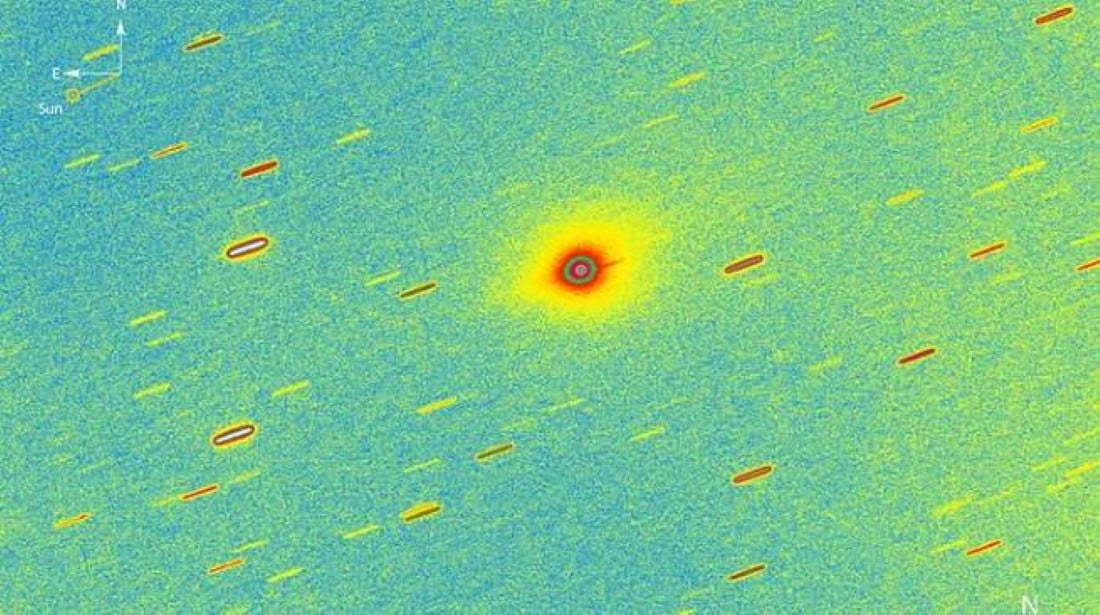
Geometric patterns observed
The main jets maintained exact 120-degree spacing across multiple exposures. Essa geometric regularity contrasted with chaotic processes typical of outgassing in natural comets.
Independent researchers, including astrophotographer Toni Scarmato, identified symmetric residuals after subtraction from standard models. Repeating the pattern at different times reinforced structural stability.
- Main jet: directed to Sol with high collimation;
- Two side jets: exactly 120 degrees apart;
- Secondary jet: visible at an opposite angle, completing a 360-degree rotation.
This configuration suggested consistent internal organization throughout the rotation of the nucleus. The estimated rotational period of about 7.1 hours allowed multiple confirmations of the pattern.
Unusual chemical composition
Spectroscopic observations recorded a significant increase in nickel emission from October 2025 onwards. Levels increased up to ten times compared to initial measurements, with no proportional variation in iron.
The ratio Ni/Fe presented high values at distances greater than 2.5 astronomical units from Sol. Essa chemical separation differs from the associated pattern observed in Sistema Solar bodies.
Post-perihelion data indicated evolution of the nickel-iron ratio proportional to solar distance increased to 1.15. The initial anomaly decreased with approach, approaching values observed in comets such as 9P/Tempel 1.
Recorded orbital dynamics
3I/ATLAS exhibited non-gravitational acceleration during the solar pass. The resulting deviation in the trajectory reached around 16 degrees in relation to the purely gravitational model.
This variation corresponded to twice the angle observed in the individual jets, eight degrees each. The numerical coincidence reinforced perceptions of correlation between phenomena.
The retrograde trajectory aligned with an inclination close to five degrees in relation to the planetary orbital plane. In March 2026, the object will pass close to the sphere of influence of Júpiter.
Debates in the scientific community
Astrophysicist Avi Loeb, from Universidade Harvard, highlighted the set of characteristics as potentially indicative of an unnatural origin. Ele defended additional investigation of technosignatures without stating a definitive conclusion.
Other experts interpreted the phenomena as natural variations in interstellar comets. The high speed and different composition would explain different behaviors than those observed locally.
TESS observations have recorded brightness variations consistent with rotation and outgassing. Dados from Hubble and from ground-based telescopes continue to be analyzed by international teams.
Projections for the coming months
The comet will remain visible in professional telescopes until mid-2026. The passage close to Júpiter could result in temporary capture of fragments by the planet’s gravity.
This interaction represents a rare event for interstellar objects. Continuous Monitoramento will allow refinement of orbital and chemical models.
Future research will compare 3I/ATLAS with the earlier 1I/’Oumuamua and 2I/Borisov. The accumulated differences contribute to understanding the diversity of interstellar bodies.
The object follows the exit trajectory of Sistema Solar without risk of collision with planets. Sua hyperbolic speed guarantees definitive departure in the coming years.



