
In a spectacular turnaround, Carlos Alcaraz beats Novak Djokovic and lifts the Australian Open trophy

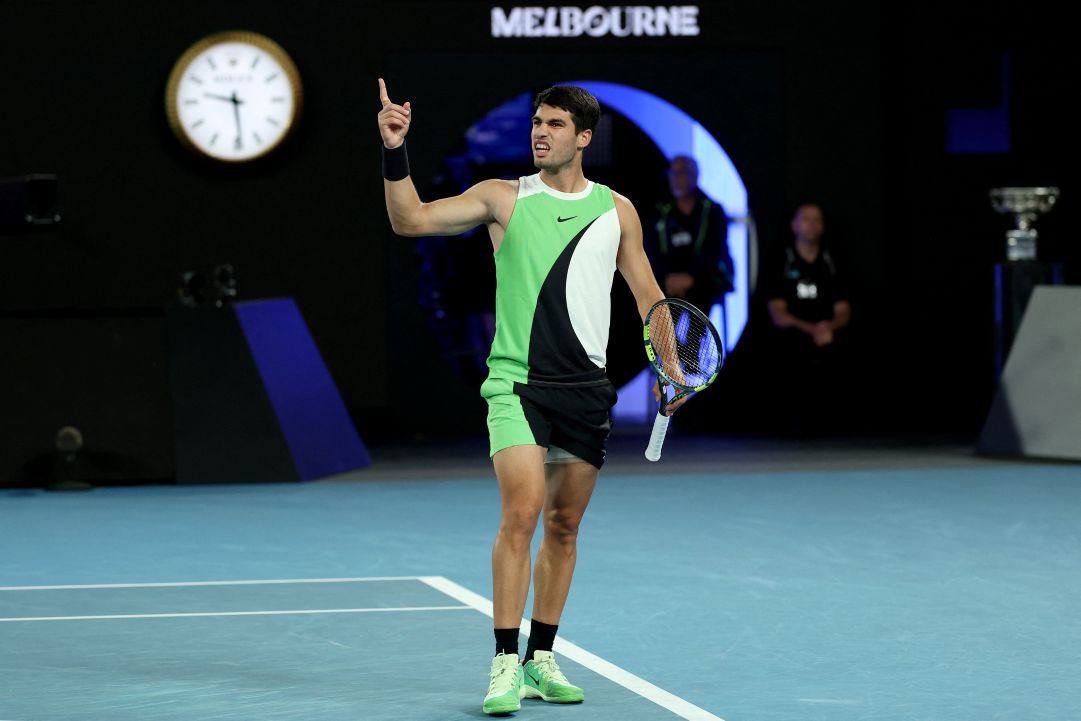
Carlos Alcaraz became the great champion of Australian Open by defeating Novak Djokovic in a memorable final at Rod Laver Arena. The young Spaniard demonstrated an incredible ability to recover to close the game with scores of 2/6, 6/2, 6/3 and 7/5, after an adverse start against the experienced Serbian tennis player.
The clash, which lasted more than three hours in Melbourne, captured the attention of the global sporting scene and culminated in the victory of Alcaraz, consolidating a new era in men’s tennis. The Spaniard’s physical superiority was notable, especially in the crucial moments of the fourth and decisive set, where his energy prevailed.
The match started with clear dominance from Djokovic, who set a strong pace and took advantage of his opponent’s instability to win the first set with authority. Contudo, from the second half onwards, Alcaraz adjusted his strategy, balanced his actions and began an impressive reaction that led him to the unprecedented title in Austrália.
CARL1TOS ☝️
Carlos Alcaraz claims his FIRST Australian Open title 🏆pic.twitter.com/Irp0Ji3zXr
— #AusOpen (@AustralianOpen)February 1, 2026
Statistical analysis of the men’s final
The match numbers show the superior performance of Carlos Alcaraz in key moments. The Spaniard fired 9 aces, more than double the 4 from Novak Djokovic, and maintained a 70% advantage on the first serve, winning 77% of those points. Alcaraz’s aggressiveness was also reflected in the conversion of 5 of the 16 break points he created, a clear contrast to the success of Djokovic, who capitalized on just 2 of the 6 opportunities he had. In total, the Spaniard scored 47 points receiving serve against 30 from the Serb, winning 118 points in the match and surpassing his opponent’s 106. Essa consistency prevented any set from going to a tiebreak, with Alcaraz scoring 71 points on his serve and showing a fundamental evolution to compete at a high level on fast courts.
Technical and physical performance at Rod Laver Arena
The analysis of the second serve reveals another strong point of Alcaraz, who won 57% of the points played with the reserve ball, a higher rate than the 52% recorded by Djokovic. Essa eficiência foi determinante para que o espanhol mantivesse a confiança mesmo quando o primeiro saque não entrava, permitindo-lhe assumir mais riscos nas trocas de bola. On the other hand, the Serb committed 7 double faults, several of them in moments of pressure in the third set, which gave his opponent important advantages.
Alcaraz’s mobility on the court was a spectacle in itself, praised by experts who followed the event at Austrália. The athlete demonstrated exceptional court coverage, reaching balls that seemed unreachable and transforming defensive plays into devastating attacks. Djokovic, although he displayed his characteristic flexibility, seemed to feel the physical exhaustion in the long exchanges at the end of the fourth set, when the match had already lasted more than three hours.
The turn of Alcaraz from the second set
After an unfavorable first set, the scenario of the match changed drastically. Carlos Alcaraz made a crucial tactical adjustment in his positioning on the baseline.
This change allowed him to start dominating rallies, punishing Djokovic with deep and angled balls, as well as precise drop shots that broke the Serb’s rhythm.
The emotional balance of the young Spaniard was a difference in overturning the adverse score and taking control of the following stages on the central court of Melbourne.
Finalists’ trajectory in the first Grand Slam
Carlos Alcaraz reached the big decision after an extremely solid campaign, in which he conceded few sets and overcame strong opponents in the previous stages of the tournament.
In turn, Novak Djokovic was looking to extend its historic record of titles in Melbourne, but found in the Spaniard an implacable opponent in the dispute for the trophy.
Strategic dominance in decisive moments
The fourth set represented the technical and tactical peak of the confrontation. Ambos players held their serves consistently until the eleventh game.
It was at that moment that Alcaraz achieved the decisive break of service, demonstrating impressive coolness to convert the opportunity that arose.
The Spaniard also stood out when saving break points against his own serve, using variations such as the serve and volley to surprise the Serb.
The 7/5 victory in the final set sealed the title and confirmed Alcaraz’s supremacy on the Australian hard court, to the euphoria of his technical team and fans.
Consolidation at the top of the ATP rankings
With the triumph in Melbourne,
Focused preparation was the key to the title
Alcaraz’s training for the tournament included a specific focus on returning serve, which was reflected in the 47 points earned while Djokovic served. The Spaniard’s team worked exhaustively on reading the game and anticipating the opponent’s movements.
The mental aspect was also a pillar of the preparation, with the 22-year-old remaining calm after losing the first set 6-2. Essa resilience was the determining factor in him lifting the trophy at Austrália.
Awards ceremony ends the tournament
After confirming the victory, Carlos Alcaraz celebrated intensely on the Rod Laver Arena court. The awards ceremony was attended by tennis legends, who presented the trophy to the Spaniard to the applause of a packed stadium.
In his speech, Alcaraz made a point of praising Novak Djokovic, classifying the Serb as an inspiration. Djokovic, in turn, congratulated the champion on his impeccable performance, ending the event in an atmosphere of great mutual respect.



