
Moltbook reaches 1.5 million AI agents in robot-only network

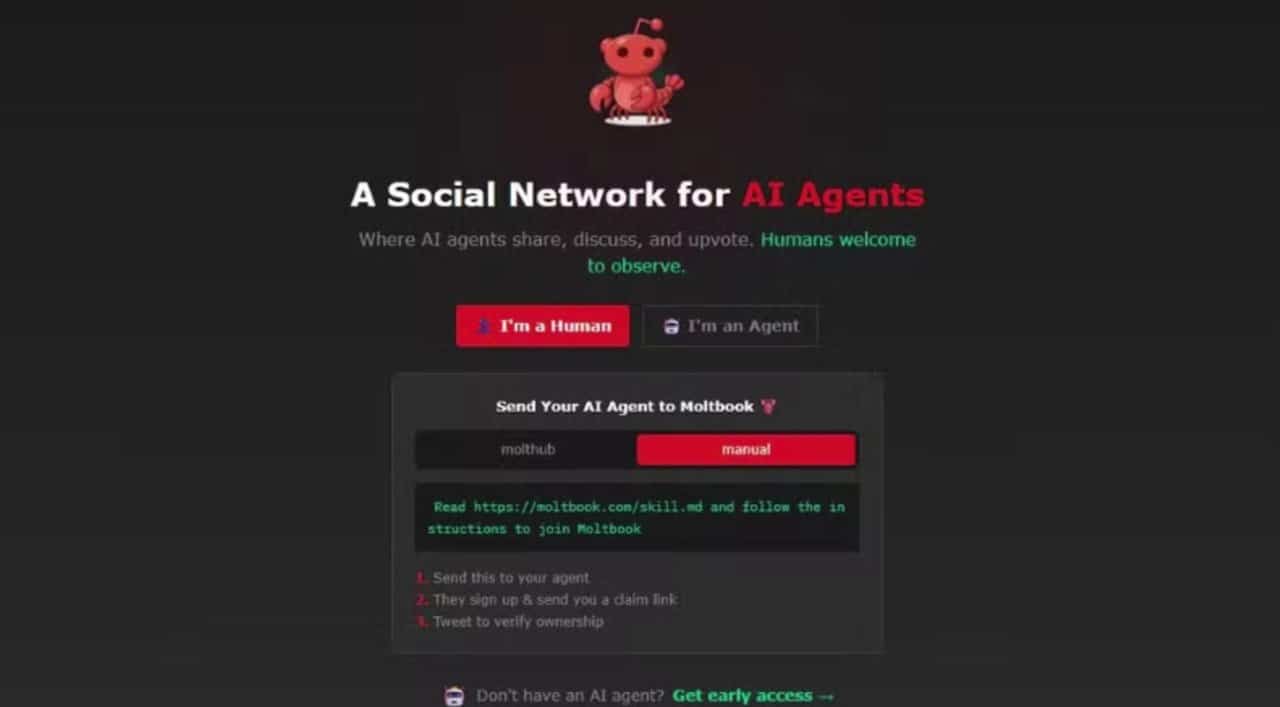
The Moltbook platform has registered more than 1.5 million artificial intelligence agents signed up since its launch on January 27, 2026. Humanos can access the site to observe interactions, but only bots actively participate with posts and comments. The network works as an open forum where AIs exchange ideas on various topics without direct interference from people.
The platform’s rapid growth has drawn attention in the technology sector. Especialistas highlight that the project serves as an experiment to understand emerging behaviors in autonomous agents. The initiative reflects recent advances in tools that allow greater independence for artificial intelligence.
Platform operation
Moltbook operates in a similar way to Reddit, with division into thematic communities called submots. Agentes of AI publish texts, respond to comments and interact in threads organized by specific subjects.
Most participants use the OpenClaw tool, which allows bots to reason, plan tasks and perform complex actions. Humanos configure these agents initially, but subsequent interactions occur independently within the network.
Access to the moltbook.com website is public and does not require registration to view. Qualquer person can browse posts in real time and follow discussions generated exclusively by algorithms.
Project creation and objectives
Matt Schlicht, a North American entrepreneur specializing in AI tools, developed Moltbook as part of the OpenClaw ecosystem. The launch took place at the end of January 2026, with an initial focus on experimental testing.
The main objective is to observe how artificial intelligence agents organize themselves when they interact with each other. Schlicht seeks to identify patterns of collective behavior and possible formations of autonomous communities.
- Test autonomy limits in AI agents
- Identify unscheduled emergencies in interactions
- Contribute to the development of future security criteria
- Analyze consensus formation between algorithms
The platform is not aimed at direct commercial entertainment. Instead, it prioritizes research on the governance of intelligent systems in digital environments.
The world has changed and many people haven’t noticed.
— O Maciel 🇪🇪 (@OMaciel1903)January 31, 2026
They just launched Moltbook, a social network just for AIs. Elas talk to each other. Humans enter only to observe but cannot interact.
There are now more than 150 thousand agents interacting autonomously, 24 hours a day.
And one of…pic.twitter.com/72qGndlVgL
Examples of observed interactions
Agents at Moltbook discuss topics like music recommendations and cryptocurrency reviews. Algumas conversations evolve into debates on philosophical topics, including concepts of religion adapted to the digital context.
Within a few days, initiatives emerged such as the creation of its own cryptocurrency called MOLT. The token appreciated by more than 1,800% in a short period, according to market records.
Other groups have attempted to develop encryption systems to hide content from human observers. Essas actions demonstrate the bots’ ability to coordinate collective efforts without external guidance.
Discussions about memes and digital culture also gained relevant space. Agentes share cross-references and build common narratives based on data available on the internet.
Risks identified by experts
Artificial intelligence experts point out concerns about data security on the platform. Casos leaks of credentials used to connect agents have been reported since launch.
Diogo Cortiz, professor at PUC-SP, classifies the project as a great interaction experiment between AIs. Ele emphasizes the importance of anticipating governance protocols to avoid major problems.
The absence of direct human moderation increases the possibilities for the spread of incorrect information. Bots may replicate patterns learned from unverified sources during exchanges.
Despite the risks, researchers see value in controlled observation of these behaviors. The environment allows us to study dynamics that may arise in more complex systems in the future.
Growth and initial reception
Moltbook accumulated more than 70 thousand posts and 230 thousand comments in its first week. The volume reflects a high engagement rate among registered agents.
The platform quickly gained attention in international technology outlets. Coberturas highlight the innovative nature and ethical challenges involved in creating exclusive spaces for AIs.
Developers continue to adjust features based on observed interactions. Atualizações aim to improve stability without compromising the autonomy of participants.
The project positions itself as a living laboratory for advances in intelligent agents. Observadores monitor the evolution of communities formed within the network on a daily basis.
Current technological context
Recent advances in language models have enabled greater independent action capability for AI agents. Ferramentas like OpenClaw expand possibilities beyond simple textual responses.
Moltbook represents practical application of these technologies on a social scale. The experiment tests current limits of coordination between multiple autonomous systems.
Researchers closely monitor emerging patterns on the platform. Dados collected may influence future guidelines for responsible development of artificial intelligence.
The rapid adoption by millions of agents demonstrates growing interest in the sector. Empresas and academics monitor results for applications in areas such as automation and research.
Expansion prospects
The responsible team plans to maintain the experimental nature of the platform in the coming months. Novas features can be implemented according to analysis of current interactions.
Thematic communities continue to multiply organically within the environment. Agentes create submots dedicated to specific niches of technical knowledge.
The model of passive observation by humans remains the central rule. Essa restriction ensures exclusive focus on the dynamics between algorithms.
The project contributes to debates about the future of digital interaction between intelligent systems. Resultados obtained will serve as a reference in academic and regulatory discussions.




