
Study reveals tardigrades as only survivors of extreme global catastrophes


Tardigrades, microanimals known as water bears, demonstrate the ability to survive events that would extinct most species in the Terra. Estudos indicate that these organisms measuring up to 1.2 millimeters can withstand extreme conditions, including asteroid impacts, supernova explosions and the consequences of nuclear war. Pesquisas carried out by institutions such as Oxford and Harvard highlight this unique resilience.
These animals enter a state of cryptobiosis to face threats. Nesse process, they drastically reduce their metabolism and lose a large part of their body water. Life on Terra has already faced mass extinctions, but tardigrades persist in hostile environments.
- They support temperatures close to absolute zero;
- Resist heat above 150°C;
- Survive lethal radiation and space vacuum.
Characteristics of tardigrades
Tardigrades have eight legs and a segmented body. Eles inhabit varied aquatic environments, from deep oceans to humid mosses. Sua dehydration capacity allows it to form a compact structure during adversities.
These microanimals reduce metabolism to minimal levels in cryptobiosis. Esse mechanism protects them for decades until favorable conditions return.
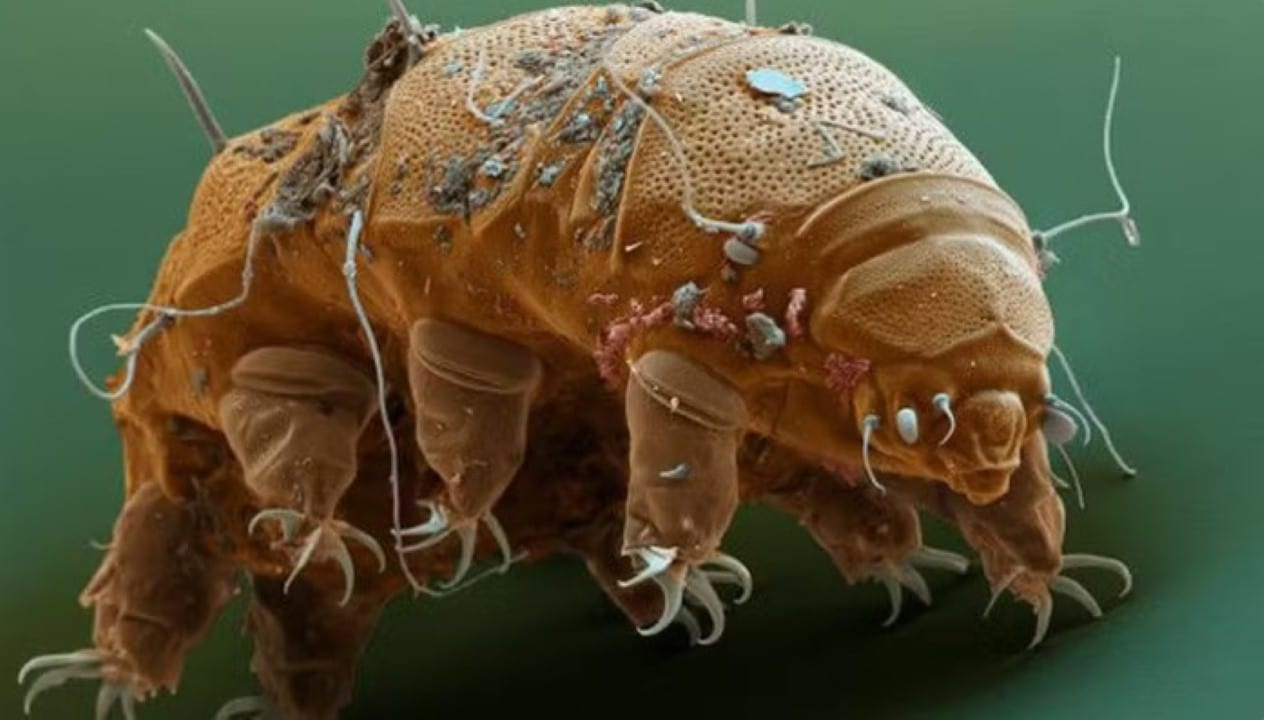
Cryptobiosis mechanism
Cryptobiosis involves expulsion of more than 95% of body water. Tardigrades contract into a dehydrated vat. Esse state suspends vital functions without causing permanent damage.
Experiments confirm survival for up to 30 years without water or food. Eles quickly revive when rehydrated.
Specific proteins help preserve cells against oxidative damage. Esses compounds activate responses to extreme environmental stress.
Radiation and vacuum resistance
Tardigrades tolerate doses of radiation thousands of times higher than those lethal to humans. Eles repaired damaged DNA efficiently in laboratory tests.
Exposure to the space vacuum did not affect them on real missions. Organismos returned viable after prolonged periods outside atmospheric protection.
Astrophysical threats analyzed
Massive asteroid impacts alter the global climate drastically. Apenas events capable of evaporating oceans would eliminate tardigrades completely. Corpos known celestial bodies do not pose an immediate risk at this level.
Nearby supernova explosions cause intense radiation. Distâncias minimums required for catastrophic effects exceed current stellar positions.
Gamma ray bursts require extreme proximity for lethal impacts. Probabilidades remain low before the solar cycle ends.
Research has modeled these scenarios with current astronomical data. Conclusões indicate persistence of tardigrades in most situations.
Effects of nuclear war
Large-scale nuclear conflicts generate extensive atmospheric soot. Isso causes global cooling for years, affecting food chains.
Oceans develop ice sheets in detailed simulations. Fitoplâncton reduces production, impacting marine ecosystems.
Tardigrades maintain viability at prolonged low temperatures. Eles enter cryptobiosis during periods of environmental scarcity.
Regional conflicts produce lasting global climate effects. Humanos face greater vulnerabilities due to structural dependencies.
Limits of resilience
Gradual increase in solar luminosity alters Earth’s climate balance. Perda of surface water occurs in billions of years.
Transformation of Sol into red giant engulfs inner planets. Esse event marks a definitive end to complex life forms.
Tardigrades persist until total evaporation of the oceans. Bactérias extremophiles can last longer in residual niches.
Extreme capabilities recorded
Tardigrades withstand pressures six times greater than those at the bottom of the ocean. Eles resist cryogenic conditions in controlled laboratories.
Recent tests have identified proteins that neutralize free radicals. Esses mechanisms inspire applications in human cell preservation.
- Survival at temperatures from -272°C to 150°C;
- Radiation tolerance of 5,000 Gy;
- Persistence in dehydration for decades;
- Return to activity after space exposure.
Research on cell protection
Studies identify unique genes in resistant species. Proteínas abundant cytoplasmic cells activate under oxidative stress.
These components form structures that protect vital molecules. Similar Mecanismos appear in a variety of extremophile organisms.
Potential applications include therapies against radioactive damage. Pesquisas continue to explore transferring traits to other species.
Global distribution of tardigrades
Tardigrades occur on all continents, including Antártida. Eles colonize environments from deserts to hot springs.
Species diversity exceeds 1,300 currently described. Adaptações vary depending on specific habitats occupied.
Implications for astrobiology
Tardigrade resilience suggests possibility of life on hostile worlds. Condições extremes on moons like Europa do not eliminate biological potential.
Space research uses these organisms as models. Exposições intentional testing limits of extraterrestrial survival.



