
Sun emits one of the biggest eruptions of 2026 class X8.1 with possible geomagnetic impact

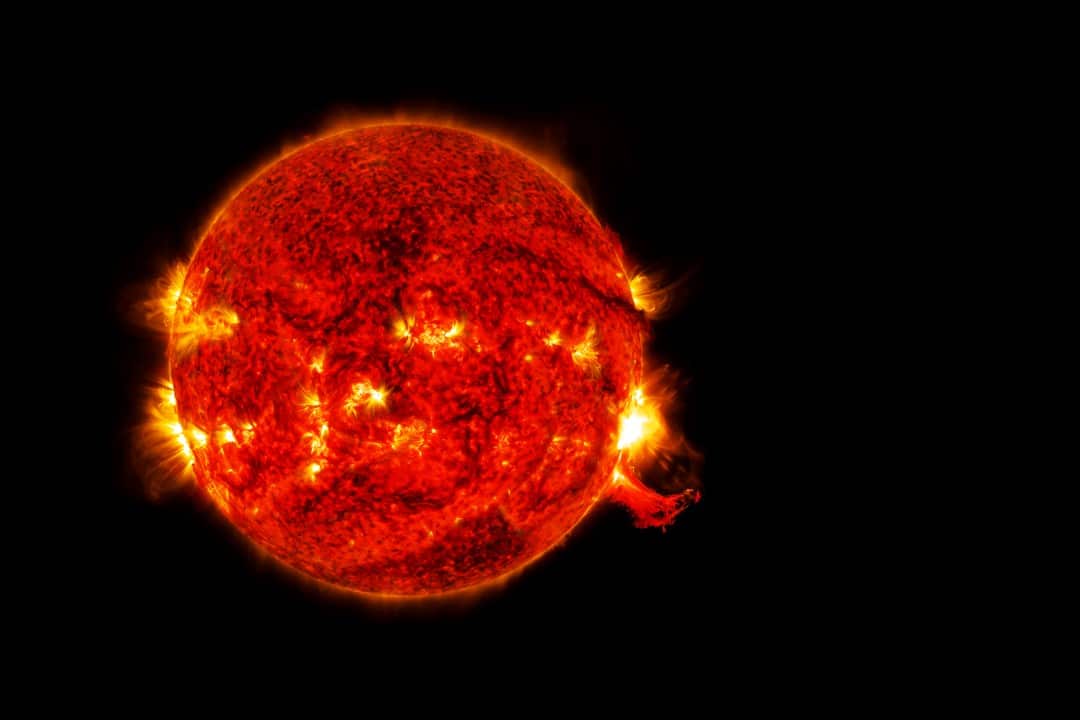
Sol recorded an X8.1 class solar flare on February 1, 2026, considered one of the most powerful of the year to date. The explosion occurred in active region 4366, which has high magnetic complexity and a size equivalent to about ten times that of Terra. An associated coronal mass ejection was detected, with models indicating that much of the material will pass to the north and east of the planet, potentially generating glancing influences from the end of February 5th.
Observations of Administração Nacional Oceânica and Atmosférica of Estados Unidos confirm the event as the peak of a sequence of intense flares. Entre February 1 and 2, the same region produced other significant explosions, including classes X1.0, X2.8, and X1.6. Essa activity reflects the expected increase in solar cycle 25, which reaches its maximum in 2026.
The X8.1 eruption released a large amount of radiation and charged particles, capable of ionizing the Earth’s upper atmosphere. Embora Although CME’s main impact is projected as glancing, experts monitor possible effects on high-frequency communications and navigation systems.
Classes of solar flares
Solar flares are classified according to their X-ray intensity. The Essa scale helps predict consequences in Terra and nearby space.
- Class X: more severe explosions, with potential for radio interruptions and increased radiation; Numbers from X1 to X9 indicate variation within the category.
- Class M: medium intensity, causing brief polar radio blackouts and moderate auroras.
- Class C: small, with minimal noticeable effects.
- Class B and A: even lower levels, with no relevant impacts on the planet.
The February 1 eruption reached X8.1, ranking among the strongest recorded in the current cycle. Active Regiõess like 4366 arise from complex magnetic fields on the solar surface.
NOW ☀️ Hace A few moments ago a solar flame of class X8.11 was recorded. It is evaluated if a coronal mass observation (CME) has been produced to analyze the consequences in the Tierra (auroras).
—Red Geocientífica from Chile (@RedGeoChile)February 2, 2026
More information ready.pic.twitter.com/Z21tG1iuic
Associated coronal mass ejection
NOAA models indicate that the CME linked to the X8.1 flare travels toward interplanetary space. Most of the material should pass to the north and east of Earth’s orbit, reducing the chance of a direct impact.
Forecasts point to the arrival of glancing influences at the end of February 5th. Esse type of passage can generate slight disturbances in the Earth’s magnetic field.
Experts highlight that complete CMEs cause more intense geomagnetic storms. In the current case, effects remain limited to minor fluctuations in GPS and high-frequency radio signals.
Recent activity in region 4366
Active region 4366 has grown rapidly in recent days and has become one of the most complex in the solar hemisphere. Sua magnetic structure favors reconnections that release accumulated energy.
On February 1st and 2nd, the site produced multiple high-intensity flares. Essa sequence demonstrates persistent instability in the area.
Observatories like NASA’s Solar Dynamics Observatory record detailed images of the process. Dados help refine spatial prediction models.
Possible effects on Terra
Geomagnetic storms result from the interaction between solar particles and the Earth’s magnetic field. In cases of glancing impact, as predicted, consequences are restricted to high latitudes.
Northern and southern lights can intensify in polar regions. Interferências in high frequency communications eventually occur on the illuminated side of the planet.
Electrical power systems and satellites face low risks in this configuration. Operadores maintains continuous monitoring for operational adjustments.
Current monitoring and forecasts
NOAA maintains alerts for radiation and possible radio disturbances. Previsões for February 3rd to 5th indicate high solar activity, with a chance of new flares.
Space forecasting centers update models based on real-time observations. Informações are publicly available for affected sectors.
The scientific community is following solar cycle 25, which presents more intense peaks than initially expected. Eventos like February contribute to understanding solar dynamics.
Context of solar cycle 25
The current solar cycle began in 2019 and reaches a maximum in 2026. Períodos of high activity increases the frequency of eruptions and ejections.
Class X flares become more common at this stage. Regiões complex assets, such as 4366, appear more regularly.
Studies indicate that the peak could bring more intense events in the coming months. Continuous Monitoramento remains essential for risk mitigation.



