
Avi Loeb receives artwork and publishes study on possible microbial life on the interstellar comet 3I/ATLAS


Astrophysicist Avi Loeb, professor at Universidade Harvard, received an original work of art from the artist The painting, titled “A História Aguarda”, was delivered to his home and will appear in the background of his future video interviews.
This episode occurred on a day marked by symbolic coincidences for the scientist. Loeb published the paper “Is there life in 3I/ATLAS?”, where he argues that dust particles expelled by the comet can carry microbes, providing the first evidence of interstellar panspermia. On the same day, he received a dedicated poem from Lance Mazmanian.
Comet 3I/ATLAS, the third confirmed object of origin outside of Sistema Solar, was discovered in July 2025 and has generated intense debate in the astronomical community. Suas unusual characteristics keep Loeb alert to the possibility of biological or even technological phenomena.
Work by Peter Tunney arrives at a symbolic moment
Peter Tunney personally delivered the work “A História Aguarda” to Avi Loeb a few minutes before a recording for his YouTube channel. The large painting incorporates elements from Pop Art with collages of newspapers, magazines and recycled materials. Tunney conveys positive messages through a variety of techniques, including paint, photography and discarded objects.
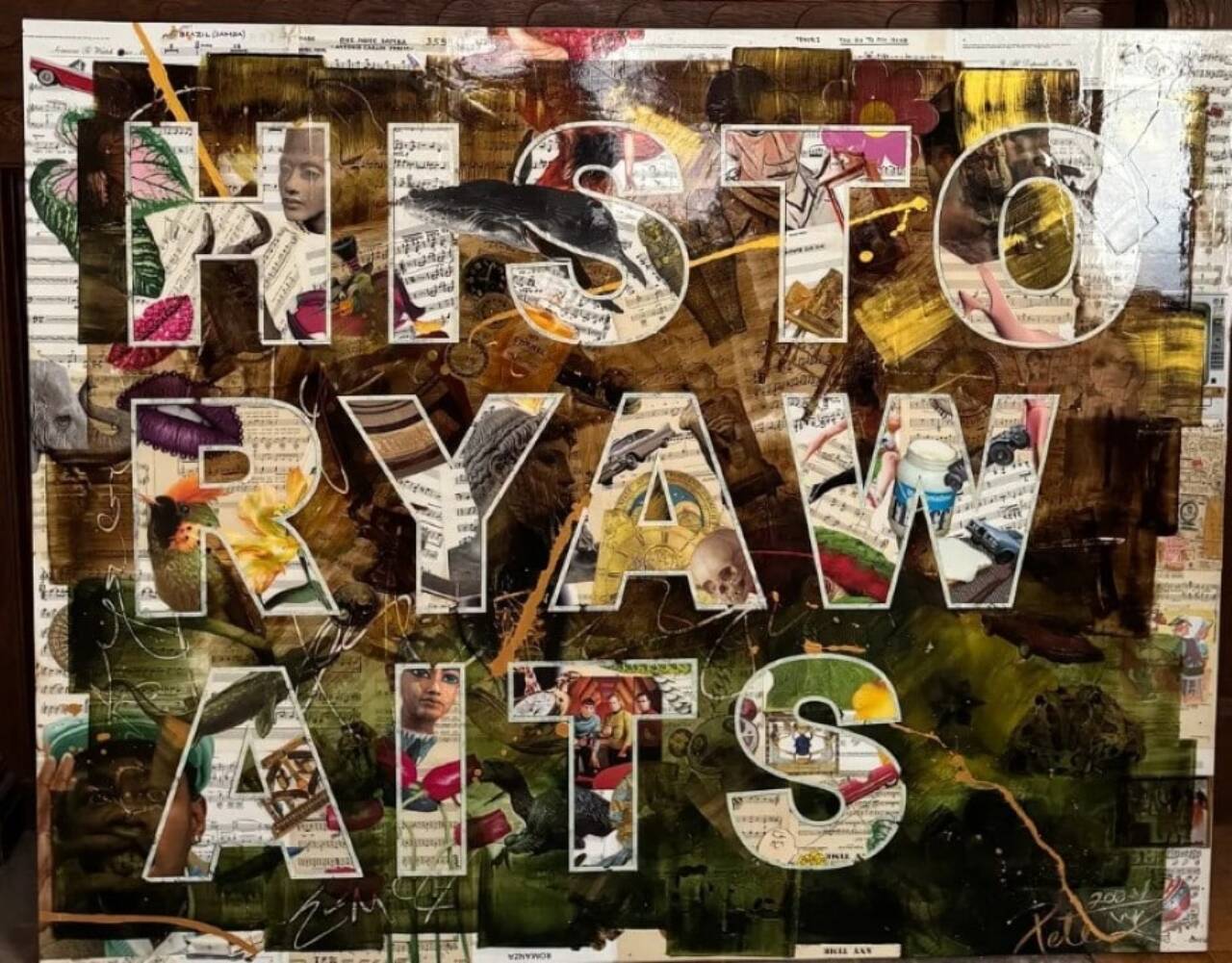
The arrival of the box surprised the scientist, who was barely able to transport it into the house. The piece will become part of the scene of his public appearances, reinforcing the idea that scientific discoveries are yet to come. Loeb highlighted the New York artist’s boundless creative energy.
This delivery coincided with the submission of the new scientific article. The title of the work directly reflects the expectation surrounding future data on the interstellar comet.
Paper explores panspermia in 3I/ATLAS particles
Avi Loeb submitted the article “Is there life on 3I/ATLAS?” hours after receiving the painting. The text concludes that large dust particles expelled by the comet could carry frozen microbes. Caso confirmed, this would represent the first concrete proof of interstellar panspermia, the process by which life spreads between stellar systems.
The scientist defends astrobiological tests with future data from the object. Ele argues that anomalous chemical compositions warrant detailed investigation. The paper reinforces Loeb’s previous positions on interstellar objects.
- Radial acceleration not explained by gravity alone;
- Gradual color change as you approach Sol;
- Continuous tail growth beyond expectations;
- Radio signals initially interpreted as natural.
These features distinguish 3I/ATLAS from common Sistema Solar comets. Observações continue as the object moves away.
Lance Mazmanian’s poem pays homage to Loeb’s trajectory
On the same day, the American writer Lance Mazmanian sent Avi Loeb the poem “The Avi Loeb Interstellar”. Mazmanian has experience in cinema, television and experimental poetry, having collaborated with figures such as Leonard Cohen. Ele praised the scientist’s mind and courage in exploring unconventional ideas.
The poetic text addresses the cold emptiness of space and places the name Loeb in the title. Mazmanian lamented the shortage of bold thinkers in several areas. The message reinforces the impact of the astrophysicist’s research beyond academic science.
This tribute adds to other cultural manifestations inspired by the work of Loeb. The scientist maintains an open dialogue with artists and writers interested in cosmic themes.
Trajectory of comet 3I/ATLAS at Sistema Solar
3I/ATLAS was identified on July 1, 2025 by the ATLAS telescope system. Sua hyperbolic orbit confirmed interstellar origin, making it the third such object after ‘Oumuamua and Borisov. Ele passed perihelion in November 2025 and approached Terra in December.
Astronomers recorded a progressive increase in the tail during the passage. The composition revealed unusual elements, such as variations in ice and dust particles. Observações from ground- and space-based telescopes track the object as it heads outward from Sistema Solar.
In March 2026, the comet will reach a minimum distance of Júpiter. Esse encounter may slightly alter your future trajectory. Dados collected at this stage will help clarify observed anomalies.
Observed anomalies spark scientific debates
3I/ATLAS showed a radial acceleration of approximately 1.1×10⁻⁶ astronomical units per day². Especialistas attribute part of this to the release of gases, but values exceed initial expectations. Mudanças of color suggest chemical transformations on the surface exposed to Sol.
The tail continued to grow even after perihelion, unlike common patterns. Sinais of radio detected were classified as natural after detailed analysis. Loeb maintains that such characteristics deserve open investigation.
Other researchers consider conventional explanations sufficient. The debate reinforces the importance of missions dedicated to interstellar objects. Projetos like Galileo, led by Loeb, seek systematic evidence.
Historical context of interstellar objects
The discovery of ‘Oumuamua in 2017 opened the modern era of interstellar objects. Sua’s elongated shape and non-gravitational acceleration generated varied hypotheses, including those of Avi Loeb about a possible technological origin. Borisov, identified in 2019, behaved like a typical comet with a visible tail.
3I/ATLAS combines elements from both predecessors. Sua entry velocity into Sistema Solar indicates origin in another star. Estimativas suggest that billions of similar objects cross the region annually.
New generation telescopes like the Rubin Observatory will increase detections in the coming years. Cada new case contributes to understanding the diversity of celestial bodies beyond Sol.
Avi Loeb’s career and contributions to astrophysics
Avi Loeb runs initiatives like Black Hole Initiative in Harvard. Ele has published hundreds of articles on black holes, cosmology, and interstellar objects. Seu book “Interstellar” details scientific evidence for the search for extraterrestrial life.
The scientist founded Galileo Project to study anomalous objects systematically. The open approach garnered criticism and support in the academic community. Loeb argues that science advances by considering all possibilities.
His ideas reach a wide audience through interviews, podcasts and social media. Colaborações with artists and writers expand the scope of scientific discussions.
Future perspectives for 3I/ATLAS studies
Data collected during the passage through Júpiter in 2026 will provide additional compositional information. Missões proposals include interception of future interstellar objects. Tecnologias of advanced propulsion make such ventures viable in the coming decades.
Analyzes of collected dust can directly test hypotheses of panspermia. Loeb emphasizes the importance of keeping instruments prepared for rare opportunities. The field of astrobiology gains momentum with each new object detected.
The combination of art, literature and science in the recent episode illustrates the cultural impact of astronomical discoveries. Pesquisadores continues to monitor 3I/ATLAS as it moves away definitively.
Cultural repercussion of Loeb’s research
Artists like Peter Tunney transform scientific concepts into accessible visual works. Lance Mazmanian’s poem demonstrates how cosmological ideas inspire literary creation. Essas interactions enrich the public debate about life in the universe.
Loeb receives regular messages from professionals in different areas. The painting “A História Aguarda” symbolizes shared expectation for future advancements. Exposições and publications expand interdisciplinary dialogue.
The integration between science and art strengthens social engagement with complex themes. Similar Iniciativas can encourage new generations of researchers.



