
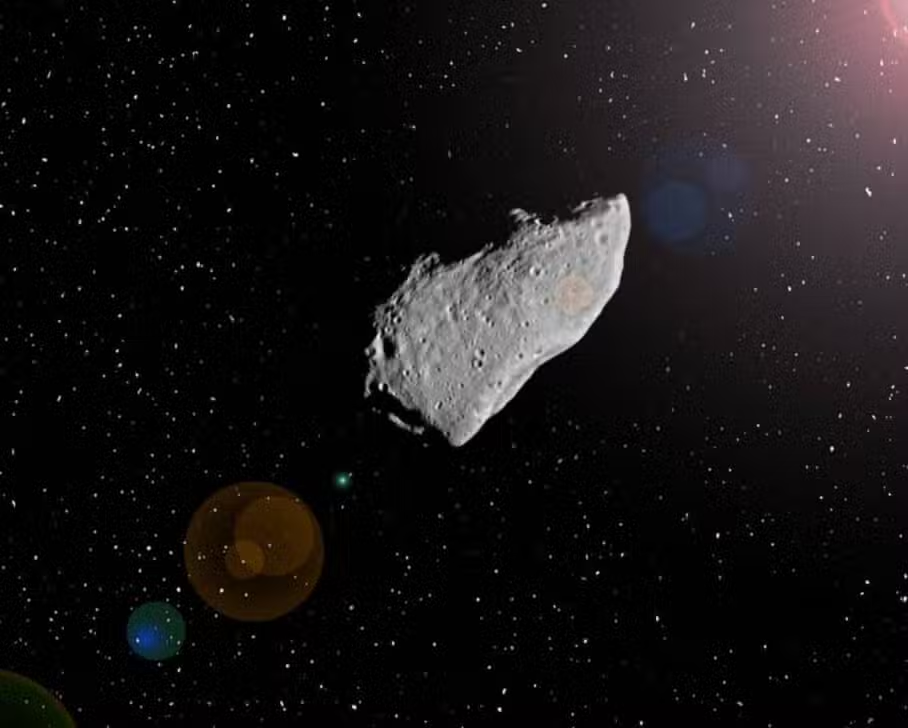
Asteroid 2024 YR4, with an estimated diameter of between 53 and 67 meters, has a 4.3% probability of colliding with Lua on December 22, 2032. More recent observations, including data from the James Webb telescope, have refined the trajectory and kept the lunar impact chance stable.
The collision, if it occurs, would release energy equivalent to 6.5 million tons of TNT. The event would create a crater approximately one kilometer in diameter on the lunar surface. Cientistas highlight that impacts of this scale are rare to be observed in real time with modern instruments.
This scenario offers a unique window into planetary studies. Telescópios Earth- and space-based bodies could record the initial flash and subsequent thermal glow.
Monitored trajectory of the asteroid
Asteroid 2024 YR4 follows an orbit that periodically brings it closer to the Terra-Moon system. Observações started in December 2024 initially identified a potential risk for Terra, which was discarded after refinements. The lunar probability has stabilized around 4.3% with infrared data from James Webb collected in 2025.
The relative speed of the object reaches about 13 kilometers per second at the time of approach. Essa speed determines the energy released in the impact and the extent of the crater formed.
Current probability and uncertainties
Calculations of Nasa and Agência Espacial Europeia indicate that 96% of simulations point to a safe passage. The remaining uncertainty arises from the difficulty of accurate observations in regions close to Sol. Novas measurements will only be possible from 2028, when the asteroid returns to visibility.
The trajectory passes close to the lunar orbit, but most models predict enough deviation to avoid collision. Atualizações regulars adjust these percentages based on new orbital data.

Opportunities for scientific research
A large-scale lunar impact has never been recorded with current technology. The event would make it possible to validate models of crater formation in bodies without an atmosphere. Pesquisadores could analyze heat emission and dispersion of ejected material.
The initial bright flash would be visible from telescopes at Terra. Esse thermal brightness would provide information about the surface composition of Lua.
Other aspects include the study of generated seismic waves. Dados collected would help refine the understanding of the lunar internal structure.
- Testing crater excavation theories
- Analysis of exposed underground material
- Measurement of released thermal energy
- Observation at multiple wavelengths
Expected seismic effects
The collision would generate seismic waves equivalent to a magnitude 5 earthquake at Terra. Essas vibrations, known as lunamotos, would propagate throughout the lunar body. Instrumentos installed on future missions could record signals with unprecedented precision.
Comparisons with records from the Apollo missions show that smaller artificial impacts produced detectable signals. A natural event of this magnitude would reveal details about the lunar core and mantle.
Lunamotos would last for hours due to the low energy dissipation in the Lua. Essa feature would allow mapping internal layers with higher resolution.
Formation of new lunar crater
The impact would excavate a crater about a kilometer in diameter and hundreds of meters deep. Most of the ejected material would fall back to the lunar surface. Simulações indicate that the morphology would follow patterns observed in ancient craters.
The absence of an atmosphere would prevent widespread dispersion of lunar dust. The crater would remain visible for centuries as a recent mark on the landscape.
Debris ejected from the impact
A small portion of the lunar material, between 0.02% and 0.2%, could reach escape velocities. Esses fragments would enter Earth orbit in a few days. The relative speed would reach 10 kilometers per second.
Satellites in low orbit would face increased risk of collisions. Danos in communications and navigation equipment would be possible.
Risks to orbital infrastructure
The debris cloud could temporarily raise the threat level in orbit. Operadores of satellites monitor objects larger than 10 centimeters. Smaller Partículas still cause significant damage at high speeds.
The phenomenon known as Kessler syndrome involves cascading collisions. A sudden increase in fragments would worsen the existing space debris problem.
Experts estimate that the risk would remain limited to months after the event. Medidas of maneuver would avoid most of the identified threats.
Continuous object monitoring
Space agencies maintain surveillance over 2024 YR4 until the next visibility period. Radares and optical telescopes will refine the orbit in 2028. Até There, computer models simulate thousands of possible scenarios.
The scientific community prepares instruments to capture data if the impact occurs. Missões lunar landings in planning include seismometers capable of recording the event.
Tracking demonstrates the current ability to track nearby objects. Avanços in space telescopes reduces uncertainty in future trajectories. The case of 2024 YR4 serves as an example of long-term monitoring in planetary defense.