
CIA’s evasive response reignites debate about 3I/ATLAS anomalies


Agência Central of Inteligência of Estados Unidos (CIA) responded to a request for access to information with the formula Essa stance, adopted in late 2025, contrasted with NASA’s public position, which classified the object as a natural body with no risk to Sistema Solar.
The request was submitted by an independent researcher via Lei of Liberdade of Informação (FOIA). The CIA response, dated December 31, 2025, used the legal mechanism that protects information sensitive to national security.
The 3I/ATLAS object was discovered on July 1, 2025 by the ATLAS system, at Chile. Trata is the third confirmed body of interstellar origin to cross Sistema Solar, after ‘Oumuamua and 2I/Borisov.
Discovery and trajectory of the object
Comet 3I/ATLAS follows a hyperbolic orbit, characteristic of bodies not gravitationally bound to Sol. Sua speed relative to Sistema Solar exceeds 68 km/s, which confirms its external origin.
The object reached perihelion in October 2025, about 1.4 astronomical units from Sol. In December of the same year, it passed the shortest distance from Terra, allowing detailed observations by terrestrial and space telescopes.
Recent data from Hubble and James Webb indicate that the core measures approximately 2.6 kilometers in diameter. Essa mass is about 40 times greater than that of comet 2I/Borisov, a previous interstellar visitor.
Observations continue as the comet moves away, with a predicted passage near Júpiter in March 2026.
The mechanism of the Glomar response
The Glomar response allows government agencies to avoid revealing whether or not they have certain records. Esse procedure is applied when mere confirmation could compromise national security interests.
In the context of 3I/ATLAS, the use of this instrument generated questions among astronomers and independent observers. NASA had stated, in a press conference in November 2025, that the object has characteristics consistent with a natural comet.
- Origin in the case of the ship Glomar Explorer, recovered by the CIA in the 1970s;
- Frequent use in intelligence and defense topics;
- Rare application in public astronomical objects.
The divergence between the positions of NASA and the CIA fueled discussions about the treatment given to the case.
Anomalies observed in behavior
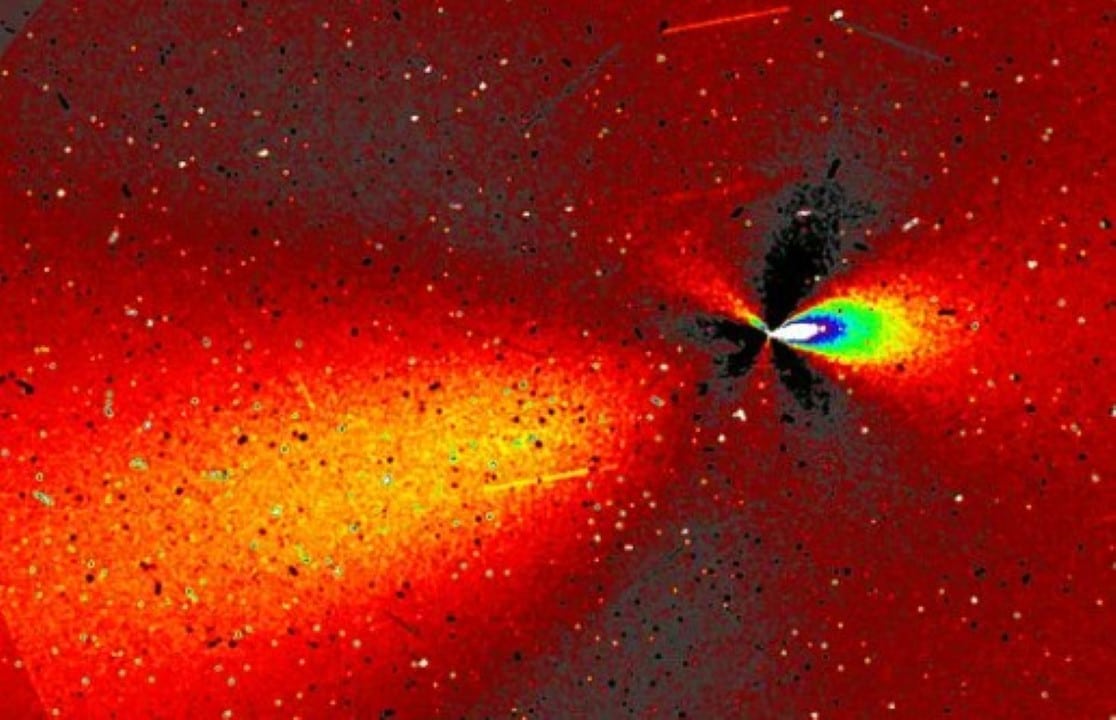
Researchers have identified several features of 3I/ATLAS that do not fit neatly into traditional comet models. Essas observations include jets and antitails with organized geometry, as well as regular angular emissions.
Morphological changes occurred after perihelion, with persistent activity even during separation from Sol. The chemical composition reveals an abundance of nickel and a low proportion of water, differing from known Sistema Solar comets.
Other points recorded include extreme polarization of reflected light and higher-than-expected brightness variations. The trajectory showed a subtle angular deviation after the gravitational interaction with Sol and proximity to Júpiter.
These characteristics are discussed as hypotheses, without definitive conclusions about artificial origin.
Counterpoint from the scientific community
Some astronomers attribute the apparent anomalies to known instrumental limitations and optical effects. Estudos indicate that the object may be a primitive chondrite rich in iron and nickel, with evidence of icy volcanism.
This interpretation keeps 3I/ATLAS within the parameters of conventional planetary science. Agências spaces reinforce that there is no evidence of an extraterrestrial threat or technology.
The debate remains open, with new observations expected in the coming months. Telescópios and James Webb continue to monitor the comet as it exits Sistema Solar.
Independent images and analysis
Amateur observers captured high-resolution images of 3I/ATLAS during its close pass to Terra. Esses records show morphological details superior to those initially released through official channels.
The difference in quality between institutional and independent images generated public discussions. Pesquisadores freelancers contributed extensive descriptions of the object’s behavior.
- Jets directed to Sol before and after perihelion;
- Precise alignment of the rotation axis with the solar direction;
- Orbital plane close to that of the Earth’s ecliptic.
These elements are analyzed in conjunction with spectroscopic data to understand the composition.
Institutional silence and perspectives
The lack of detailed explanations from some agencies encourages speculation in independent sectors. Para more cautious experts, the pace of science explains the reservation in hasty conclusions.
There is no official confirmation of the risk associated with 3I/ATLAS. The object follows its exit trajectory from Sistema Solar without changes that indicate a threat.
Future observations will focus on the comet’s residual activity. Dados collected contribute to the understanding of bodies formed in other stellar systems.
The case of 3I/ATLAS highlights the importance of continuous monitoring of interstellar visitors. Pesquisas ongoing efforts seek to refine models on the composition and dynamics of these rare objects.



