
Interstellar comet 3I/ATLAS records a 20-fold increase in gas emissions after passing the Sun

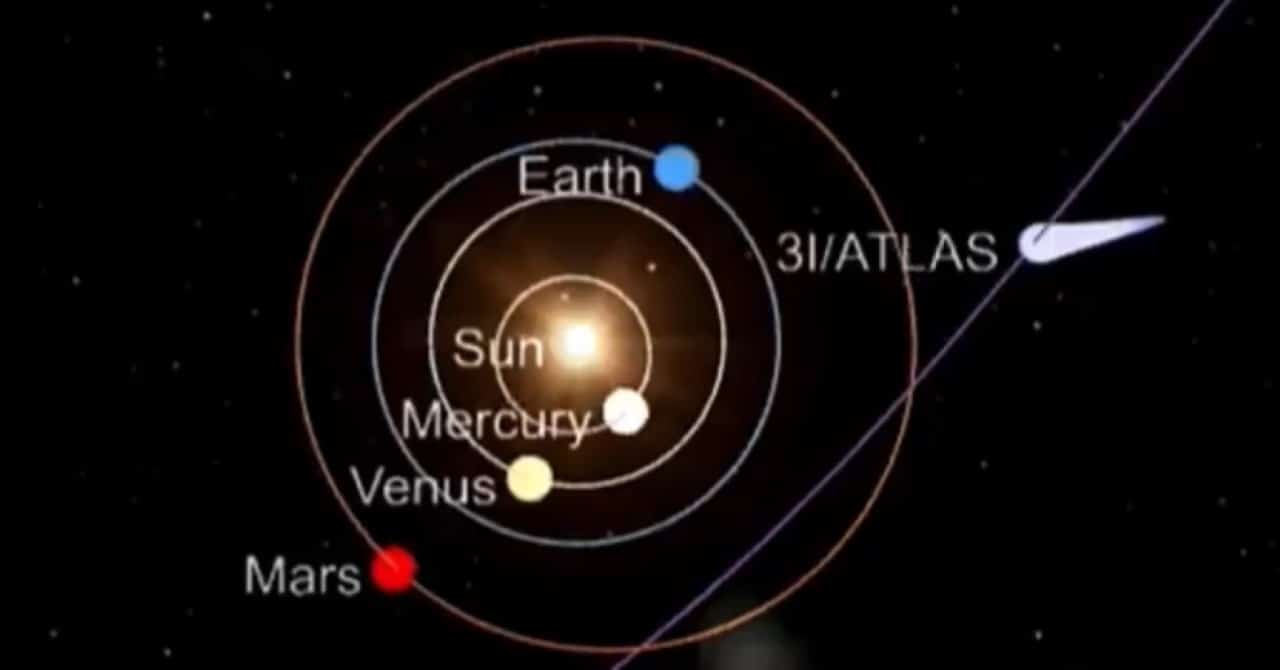
The interstellar comet 3I/ATLAS, the third confirmed object from another stellar system, recorded significant changes in its activity after the closest approach to Sol on October 30, 2025. Observações carried out by the SPHEREx space mission detected a significant increase in the release of gases and dust from November of that year. Essas changes indicated intense sublimation of previously inactive ices in the comet’s nucleus.
The observed transformation included an increase of around 20 times in water vapor emission compared to data from August 2025. The flow of carbon monoxide also increased at the same rate, activating previously dormant ice reservoirs. Pesquisadores identified the presence of complex organic compounds released by solar heating.
Images captured by Telescópio Óptico Nórdico on November 11, 2025 recorded variations in the comet’s visible structure. The dust cloud assumed an asymmetric shape, while the gaseous emissions maintained symmetry.

Trajectory and initial discovery
Comet 3I/ATLAS was identified in July 2025 by the ATLAS monitoring system, designed to detect objects close to Terra. Sua high speed, greater than 57 km/s, confirmed interstellar origin soon after discovery. The object follows a hyperbolic trajectory, with no permanent gravitational connection with the Sol.
Ground and space observatories followed its gradual approach to the inner Sistema Solar during the following months. Perihelion occurred in October 2025, when the comet reached its minimum distance from Sol. Essa passage generated a thermal wave that penetrated the outer layers of the core.
Increase in cometary activity
The SPHEREx mission recorded a dramatic increase in water vapor production starting in December 2025. The Esse increase indicated evaporation of water ice, previously undetected at significant levels. Activity went from low to full in a few weeks.
Carbon monoxide showed similar growth, suggesting activation of a deep reservoir in the core. Pesquisadores associated the phenomenon with the propagation of internal heat after perihelion. Carbon dioxide emissions also remained high.
Additional observations confirmed the continuity of intense sublimation until the beginning of 2026. The comet released large amounts of dust along with volatile gases.
Dust cloud changes
The 3I/ATLAS dust structure has evolved into a pear shape in recent images. The narrowest region was oriented towards Sol, a result of solar radiation pressure. Essa asymmetry contrasted with the previous symmetry of gaseous clouds.
The reflectance spectrum indicated a predominance of dark material with low albedo. Partículas revealed bluish light scattering, characteristic of specific compounds. The loss of the icy coating exposed inner layers rich in olivine and amorphous carbon.
Spectroscopic analyzes confirmed transition from ice domain to dust domain. The core lost some of its original surface coverage during the process.
Detection of organic compounds
Researchers identified strong cyanide emissions in the comet’s spectrum from November 2025. Outros organic compounds detected included methanol, formaldehyde, methane and ethane in relevant quantities.
- Methanol: present at levels compatible with Sistema Solar comets;
- Formaldehyde: released together with other complex volatiles;
- Methane: indicated sublimation of deep ice;
- Ethane: associated with internal thermal processes.
These molecules remained trapped under layers of ice before perihelion. Solar heating facilitated their release into space.
Observed chemical proportions
The relationships between carbon monoxide, carbon dioxide and water vapor approached patterns observed in inner comets of Sistema Solar. Essa similarity represented unexpected data for an interstellar object. Previous Proporções diverged significantly from local standards.
The combined flow of gases altered the dynamics of the comet’s coma. Pesquisadores recorded stabilization of emissions at high levels during January 2026.
Comparison with previous interstellar objects
3I/ATLAS differed from the first interstellar visitor, 1I/’Oumuamua, which showed little cometary activity. The second, 2I/Borisov, exhibited characteristics closer to traditional comets from the beginning. The transition observed in 3I/ATLAS highlighted unique variation among extrasolar objects.
Comparative studies use data from the three visitors to understand training in distant systems. Cada object provided distinct information about primordial composition.
Continuous imaging and monitoring
Telescópio Espacial Hubble captured detailed images of the comet as it passed inner Sistema Solar. Complementary Registros came from ground-based telescopes on different continents. Observações continue as the object gradually moves away.



