
Rare sequence of X-class solar flares detected by NASA with particles heading towards Earth


Solar activity of exceptional magnitude was observed by US space agency satellites in early February. In a span of less than 72 hours, a single region of Sol emitted at least five Class X eruptions, the most intense category. The explosions released clouds of charged particles, known as coronal mass ejections, which were projected on a direct trajectory with our planet.
The source of this intense activity is the sunspot designated AR 4366, a colossal structure with a diameter approximately ten times that of Terra. The magnetic complexity of this region makes it extremely unstable, favoring the occurrence of energetic events. Especialistas monitor the situation continuously, predicting that the first effects of the arrival of this solar material will begin to be felt in the Earth’s atmosphere between February 5th and 6th.
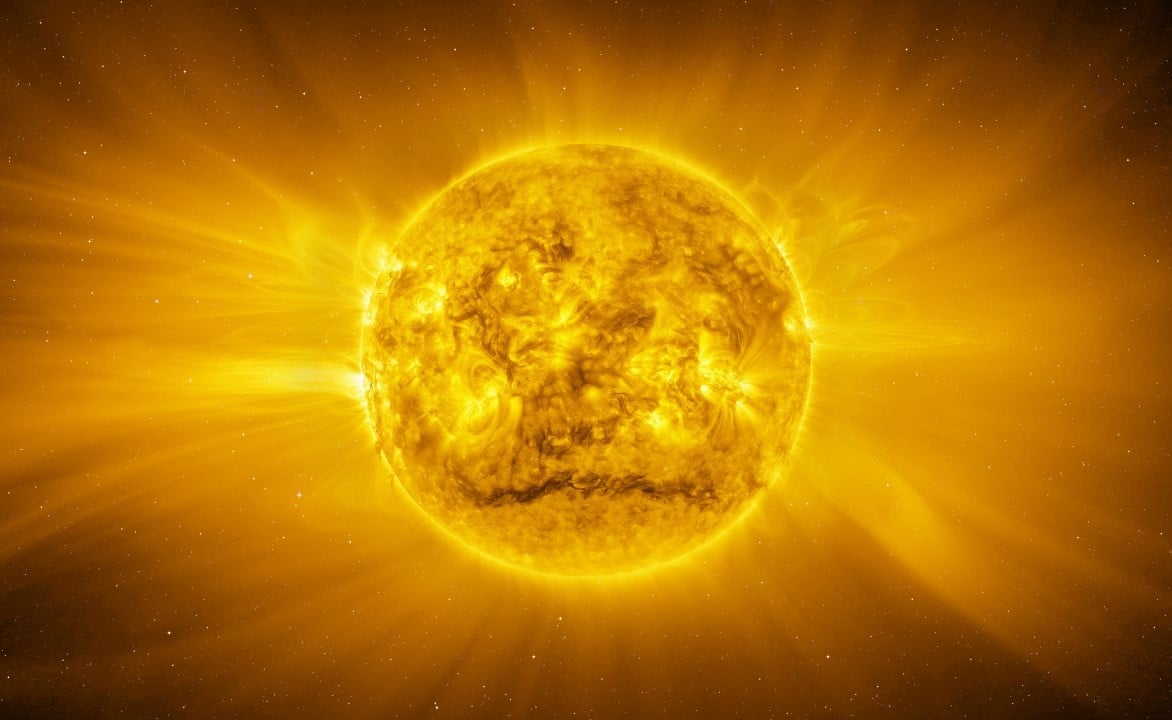
Although the sequence of events is considered rare due to its speed and intensity, initial projections from Administração Oceânica and Atmosférica Nacional from Estados Unidos (NOAA) indicate that the impacts should be mild to moderate. Não Significant risks are predicted for critical infrastructure on the ground, such as electrical grids, but the phenomenon has the potential to generate notable visual spectacles, such as northern lights and southern lights visible at lower latitudes than usual.
The origin of intense solar activity
Sunspot AR 4366, which has become the focus of all the attention of astronomers and space agencies, emerged in the visible solar disk of Terra in late January and rapidly evolved into a magnetically unstable complex. Sua structure, characterized by intertwined magnetic fields of opposite polarities, creates ideal conditions for the accumulation and sudden release of enormous amounts of energy. Desde its appearance, the region has already been responsible for dozens of lower-intensity eruptions, culminating in the recent series of class X explosions. Continuous observations, carried out mainly by Observatório of Dinâmica Solar (SDO) of Esse development raises the potential for significant new eruptions in the coming days as the region remains facing Terra in its approximately 27-day natural rotation.
Understanding the power of solar flares
Scientists classify solar flares based on the intensity of the X-ray radiation they emit, using an alphabetical scale. Categories A and B represent the weakest events, with energy so low that their effects are practically imperceptible on our planet. Next, class C designates moderate flares, which can cause small and brief interference with radio signals.
The scale progresses to class M, considered strong and capable of causing radio blackouts that mainly affect the polar regions of Terra. At the top of the scale is class X, which represents the most extreme and energetic events. An eruption of this magnitude has the potential to cause widespread radio blackouts, damage satellites in orbit and, in more severe cases, overload electrical grids on the ground. Dentro of each class, a numerical suffix indicates the relative strength; for example, an X8 blast is eight times more powerful than an X1.
Chronology of an unusual sequence of events
The recent series of eruptions began rapidly on February 1st, marking one of the periods of greatest activity in the current solar cycle. The first significant event was classified as X1.0.
Shortly afterwards, the same AR 4366 region released the most powerful explosion in the sequence, recorded with a magnitude that varies between X8.1 and X8.3 in different measurements, consolidating itself as the strongest of the current cycle.
The activity did not cease, being followed by another strong eruption, classified as X2.8, maintaining a state of alert among space weather forecasting centers.
In the following days, the sunspot continued to demonstrate its instability with two more class X explosions, one of magnitude X1.6 and the other of X4.2, characterizing the episode as notably rare due to the cadence and strength of the emissions.
Predicted effects on terrestrial and space infrastructure
Coronal mass ejections travel through space at speeds that can exceed millions of kilometers per hour. When they collide with the magnetic field of Terra, they generate so-called geomagnetic storms, which can have various technological effects.
One of the most immediate impacts is interference with high-frequency radio communications, used by sectors such as aviation and emergency operations. Sistemas Satellite navigation systems, such as GPS, may also experience temporary distortions, especially at higher latitudes.
Satellites in low orbit may experience increased atmospheric drag, requiring operators to perform trajectory correction maneuvers to avoid loss of altitude. Além In addition, energetic particles pose a risk to the electronic components of this equipment.
The peak activity of solar cycle 25
The Sol operates in activity cycles that last an average of 11 years, with periods of solar minimum and maximum. The current cycle, numbered 25, is approaching or has already reached its phase of maximum activity, which turned out to be more intense than initial forecasts indicated. Durante these peaks, the emergence of large and magnetically complex sunspots, such as AR 4366, becomes more frequent, increasing the probability of M and X class eruptions occurring. The number of extreme events recorded in this cycle already exceeds that of recent previous cycles, confirming the strength of this solar phase.
How aurora observation will be intensified
One of the most beautiful and visible effects of a geomagnetic storm is the intensification of the auroras. The interaction of solar particles with gases from Earth’s upper atmosphere creates colorful light shows in the night sky.
With the arrival of coronal mass ejections, the probability of observing northern lights (in the northern hemisphere) and southern lights (in the south) increases significantly. The phenomenon may be visible in places where it does not normally occur, such as in latitudes closer to the Equador line. Regiões of Canadá, Alasca, north of Europa and south of Argentina and
Constant surveillance by space agencies
Agencies such as Nasa and NOAA maintain around-the-clock surveillance of Sol through a fleet of specialized satellites. Observatório of Dinâmica Solar (SDO), for example, captures images of the star at different wavelengths in real time, allowing scientists to monitor sunspot development and detect flares as they occur.
This data feeds space weather forecasting models, which issue alerts to satellite operators, airlines and power grid managers. International collaboration is key to this process, with forecasting centers around the world sharing information to improve the accuracy of analyzes and mitigate potential technological harm.




