
Discovery in Scotland reveals that solar flares superheat ions to 60 million degrees Celsius

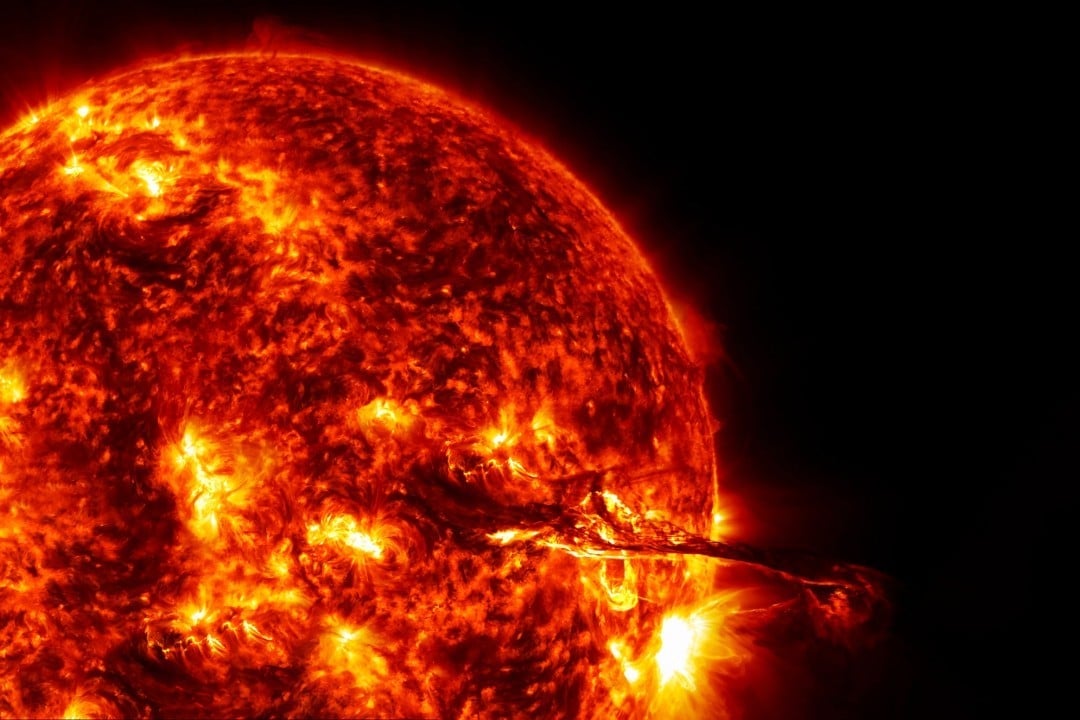
A new survey conducted by Universidade of St. Andrews, in Escócia, solved a five-decade-old mystery about the behavior of Sol. The study revealed that particles released during solar flares, specifically ions, reach temperatures exceeding 60 million degrees Celsius. Este value is approximately 6.5 times higher than previous estimates and redefines understanding of magnetic reconnection, the process that powers these colossal explosions in the solar atmosphere. The findings, detailed in the journal The Astrophysical Journal Letters, have direct implications for the ability to predict space weather and protect critical infrastructure both in Terra and in orbit.
Led by Professor Alexander Russell, the team of scientists used a combination of detailed observations and cutting-edge computer simulations. Essa approach made it possible to demonstrate that the ions present in the solar plasma are heated much more intensely than the electrons during the explosions. Esse uneven heating was a missing piece to explain certain anomalies observed in Sol’s spectral data, and the new research provides a cohesive and robust explanation for the phenomenon.

Advancement in knowledge about the real temperature of solar particles is fundamental, as these eruptions release an immense amount of radiation, such as X-rays, which travel through space and can interact with the Terra’s magnetic field. The research consolidates data from previous studies on the solar wind, creating a more complete view of the behavior of particles from their origin in Sol to their arrival in the vicinity of our planet. Este improved understanding is a crucial step toward developing more effective warning systems against potentially dangerous solar storms.
The mechanism behind extreme warming
The key to the discovery lies in the magnetic reconnection process. Durante a solar flare, Sol’s magnetic field lines bend, break and reconnect violently, releasing an extraordinary amount of energy in a short period. Este energetic event is the engine behind the explosions. The Scottish study demonstrated that this energy is not evenly distributed among the different particles that make up the solar plasma, which is a superheated gas of charged particles.
Ions, which are atoms that have lost electrons and therefore have a positive charge, absorb a much greater portion of this released energy compared to electrons, which are much lighter. Como result, the ions are accelerated and heated to extreme temperatures, much higher than the surrounding environment. Esse aquecimento preferencial dos íons explica por que as linhas espectrais, que são usadas pelos cientistas para medir a temperatura do plasma, apareciam muito mais largas do que os modelos teóricos previam, um enigma que intrigava os astrofísicos por mais de 50 anos.
Impacts on space technology and security
The consequences of solar flares go far beyond a distant astronomical phenomenon. The intense radiation and energetic particles released can cause significant interference with communications satellites and navigation systems, such as GPS, affecting everything from financial transactions to global logistics. In more severe cases, these storms can induce electrical currents in power grids in Terra, leading to overloads and widespread blackouts.
In addition to equipment, human safety in space is a central concern. Astronautas in orbit, especially during extravehicular activities (spacewalks), are exposed to dangerous levels of radiation. A more accurate prediction of the intensity of a solar flare allows space agencies to take preventative measures, such as postponing missions or directing astronauts to shelter in more protected areas of space stations, ensuring their safety.
Computer simulations validate the discovery
The robustness of the study of Universidade of St. Andrews lies in its interdisciplinary methodology, which combined observational data from solar telescopes with advanced computational models.
These simulations allowed the team to recreate the extreme physical conditions that occur at the heart of a solar flare, an environment impossible to replicate in terrestrial laboratories.
The models confirmed that magnetic reconnection was, in fact, the main mechanism responsible for the superheating of the ions, with the results of the simulations precisely matching the data collected by observational instruments.
Connection to solar wind and previous studies
The new discovery did not emerge in isolation, but rather as the culmination of years of research into the solar wind, a continuous stream of charged particles emanating from the Sol and filling the solar system.
Previous studies, based on data from satellites close to Terra, had already identified that magnetic reconnection could heat particles in interplanetary space, but the direct link with eruptions in the solar corona was not fully established.
The Scottish team was a pioneer in applying this concept directly to the source of the explosions, demonstrating that uneven heating occurs at the time of the eruption.
This established a fundamental link between the phenomena observed millions of kilometers away, at Sol, and the effects measured nearby our planet, unifying different areas of space physics.
Future Applications and Forecast Improvement
The most immediate application of this new knowledge is the improvement of space weather prediction models. With a more accurate understanding of the temperatures and energy levels involved in eruptions, scientists can more accurately predict the intensity of a solar storm and its potential impact on Terra. Isso allows satellite operators, airlines and power grid managers to take preventative measures earlier, such as putting satellites in safe mode or diverting flights from polar routes, which are more vulnerable to radiation. Além Furthermore, the detailed insights into plasma physics under extreme conditions could benefit other scientific fields, including research into controlled nuclear fusion, which seeks to replicate the energetic processes of Sol to generate a clean and sustainable energy source in Terra. The research also paves the way for the development of more rugged spacecraft and satellites designed to withstand the harsh environment of space.
The history of solar storms on Terra
The threat posed by solar storms is not just theoretical. One of the most striking examples occurred in March 1989, when a powerful solar storm induced electrical currents that overloaded the power grid in the province of Quebec, in the Canadá. The result was a blackout that lasted nine hours and affected millions of people, highlighting the vulnerability of our modern infrastructure.
Although events of this magnitude are relatively rare, they serve as an important reminder of the need for constant monitoring of solar activity. The data provided by the study of Universidade of St. Andrews are crucial for the development of more sophisticated early warning systems capable of minimizing risks and protecting society from future space storms.
The magnitude of solar flares
To put the scale of these events into context, a single large solar flare can release an amount of energy equivalent to the explosion of millions of nuclear bombs in a matter of minutes. Embora Terra’s magnetic field protects us from the worst effects, this energy is the driving force behind phenomena such as the northern lights and southern lights, at the same time as it represents a real threat to a world increasingly dependent on technology.



