
Interstellar comet 3I/Atlas reveals double jet structure in unprecedented images from the Hubble telescope


Telescópio Espacial Hubble made new observations of the interstellar comet 3I/Atlas, revealing complex and rarely seen behavior. The images, captured in December 2025, show a structure of double jets and a prominent “anti-tail” that points in the direction of Sol, defying conventional explanations for cometary activity.
The captures were taken on two different dates, December 12th and 27th, allowing astronomers to analyze the evolution of the comet’s activity as it moves away from Sistema Solar. The analysis indicates significant variations in the intensity of the jets, providing clues about the rotation and composition of their core. The object, which is confirmed to have originated in another star system, continues to be a target of great scientific interest.
The simultaneous presence of a jet directed towards Sol and another in the opposite direction suggests complex internal dynamics. Astrônomos around the world are poring over data to unravel the mechanisms that govern this cosmic visitor, whose hyperbolic trajectory will take him outside our planetary system permanently.
Detailed analysis of the new images
Using Câmera of Campo Largo 3 (WFC3) in its UVIS mode, Hubble recorded comet 3I/Atlas with 170-second exposures in each observation. Operando at a central wavelength of 0.5851 microns, the instrument was able to capture sharp details of the coma and dust jets. The December 12, 2025 image clearly shows the anti-tail as the dominant structure, extending hundreds of thousands of kilometers in the lower left corner of the image, toward Sol. The coma, a cloud of gas and dust around the nucleus, is also expansive, indicating strong ongoing activity.
In the capture made on December 27, the general structure is maintained, but with notable changes in the luminosity and collimation of the jets. The jet that forms the anti-tail remains narrowly focused, while the secondary jet, weaker and in the opposite direction, exhibits a different intensity than the previous observation. Essas temporal changes are crucial to scientists because they suggest a source of activity that is changing orientation or intensity over time, likely linked to the rotation period of the comet’s nucleus.
The unusual anti-tail structure
The most intriguing feature observed on comet 3I/Atlas is its anti-tail. Diferente of the tails of ions and dust that normally move away from the Sol due to radiation pressure and solar wind, an anti-tail is an optical illusion that occurs when the Terra crosses the orbital plane of a comet.
In this case, however, the structure appears to be a jet of larger, slower dust particles, which are less affected by solar radiation pressure and tend to follow the comet’s orbital trajectory. Como the jet is ejected from the nucleus, its oldest portion remaining behind in orbit, appearing to point toward Sol from our perspective.
What makes 3I/Atlas particularly special is the presence of a second, weaker jet in the opposite direction. Essa configuration of opposing double jets is rare and indicates that multiple active areas on the surface of the nucleus are releasing material simultaneously.
This duality in material ejection raises fundamental questions about the core’s internal structure, its composition, and how solar energy is distributed across its surface to activate these sources of gas and dust.
Theories that explain anomalous activity
One of the main hypotheses to explain the existence of the weaker jet, which points away from Sol, involves heat transfer. Solar energy absorbed on the day side of the comet nucleus could be conducted through the icy body, triggering the sublimation of volatile ices on the night side, which is colder and does not receive direct sunlight.
This release of gas on the night side would create the secondary jet. The variation in intensity between the two December observations could be explained by the way the comet’s rotation axis exposes different regions to sunlight and the darkness of space.
Another possibility is related to the composition of the ejected particles. The main jet, which forms the anti-tail, may be composed of larger, heavier dust grains that move more slowly. In contrast, the secondary jet could be made up of smaller, lighter particles that are quickly pushed by solar radiation pressure, aligning with the traditional dust tail.
The Interstellar Visitor’s Journey
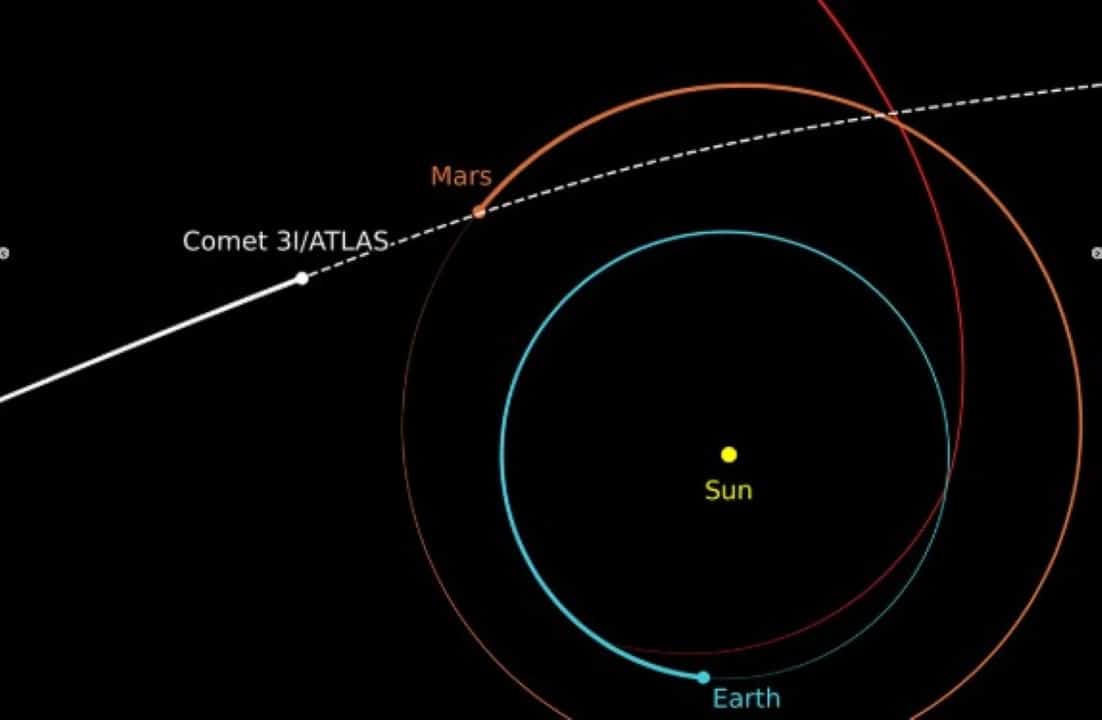
Comet 3I/Atlas was identified as an interstellar object due to its sharply hyperbolic trajectory, which means its speed is too high for it to be captured by Sol’s gravity. Ele made its closest approach to Sol, perihelion, on October 29, 2025, and has since been moving away, returning to interstellar space.
Even after perihelion, the comet maintains impressive activity. Analysis of the data shows that it continues to eject dust and gas at varying speeds. Partículas smaller ones can reach up to 22 meters per second, while the larger ones, which make up the anti-tail, move at around 2 meters per second. Essa persistent activity is an indicator of the large amount of volatile material present in its core.
Composition and origins of comet 3I/Atlas
Spectroscopic studies performed with Hubble and other ground-based observatories have provided valuable information about the comet’s composition. Analysis of the light reflected by its coma reveals a distinctly reddish color, a characteristic associated with the presence of complex organic compounds that have been irradiated over billions of years in interstellar space. Essa coloration is similar to that of other primitive objects, such as the D-type asteroids found in the outer part of the asteroid belt, and the first known interstellar comet, 2I/Borisov. Acredita 3I/Atlas is believed to have originated in the thick disk of Via Láctea, a region that is home to older stars, suggesting that the comet may be more than 7 billion years old. Estimates of the size of its core are still uncertain, varying widely between 440 meters and 5.6 kilometers in diameter, a range that reflects the difficulty of measuring a small, dark object surrounded by a bright coma.
Processing reveals rotation dynamics
To highlight the faint structures within the comet’s coma, astronomers applied advanced image processing, including the Larson-Sekanina filter, which accentuates brightness gradients. Essa technique made the jets and their variations even more evident, allowing a more precise analysis of their shape and behavior over time.
The changes in the appearance of the jets between December 12 and 27 are consistent with a core rotation period of approximately 16 hours. Essa oscillation in observed activity, which had already been noted in observations from July 2025, can be directly attributed to different active regions being exposed or hidden from view of Terra as the comet rotates on its axis.
The continuous ejection of material
3I/Atlas’ continued activity, even as it moves away from Sistema Solar’s main heat source, indicates that its core is rich in supervolatile ices. Calculations suggest that the mass lost through the ejection of dust and gas represents a significant percentage of the estimated minimum mass for the core, showing how these objects wear out when passing close to a star.



