
Interstellar visitor defies science by making exact approach to Jupiter in 2026

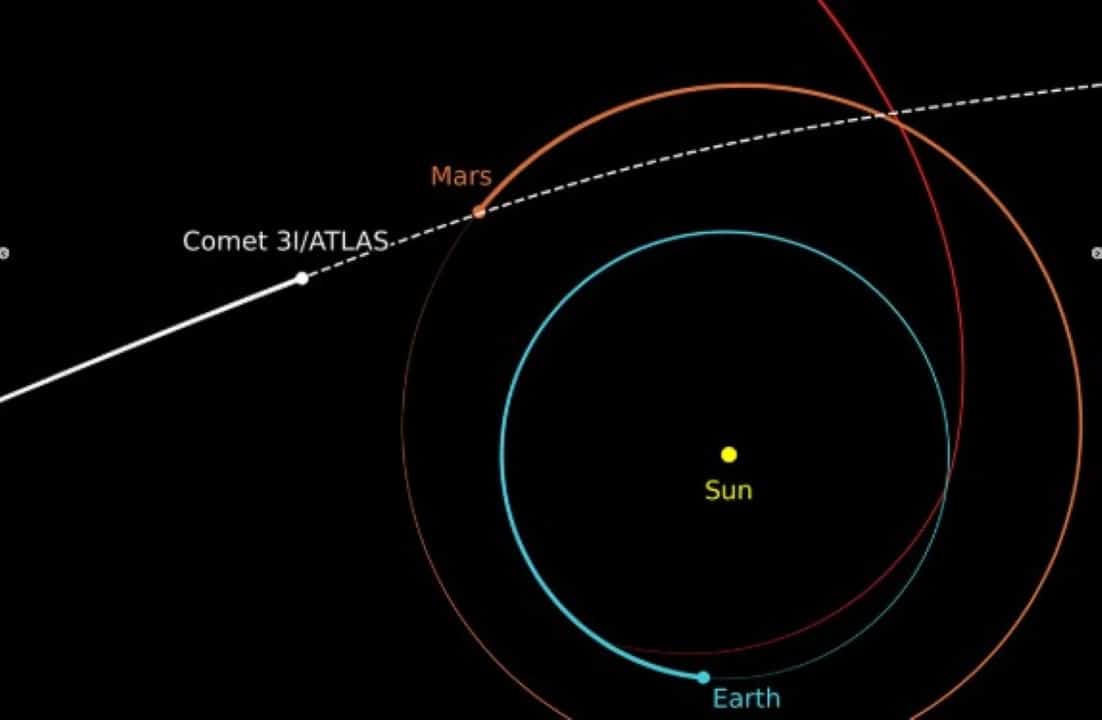
An object coming from outside our Sistema Solar is at the center of an intense scientific debate. Identificado in July 2025, the interstellar comet 3I/ATLAS follows a hyperbolic trajectory that will place it in a remarkably accurate approach to the planet Júpiter in March, an event that defies the odds and divides opinion among the field’s leading experts.
The controversy is fueled mainly by the anomalies observed in its behavior and composition. Enquanto Most of the scientific community, including NASA, classifies 3I/ATLAS as a natural comet with exotic characteristics due to its origin in another star system, a group of researchers, led by astrophysicist Avi Loeb, from Harvard, suggests that the evidence may point to something more complex.
Since its detection by the ATLAS system (Asteroid Terrestrial-impact Last Alert System), the third known interstellar visitor has been monitored by a global network of telescopes. The observations confirmed the presence of a coma and tail, but also revealed a series of peculiarities that continue to intrigue astronomers and drive new research into the nature of these cosmic travelers.
The orbit that defies statistics
The central point of the controversy lies in the non-gravitational acceleration detected while 3I/ATLAS approached Sol. Essa’s acceleration, attributed to the ejection of gases from its surface, subtly altered its route in a way that positioned it for an extremely close encounter with Júpiter, expected on March 16.
The projected minimum distance is 53.445 million kilometers, a value almost identical to the radius of Esfera of Hill of Júpiter, which is 53.502 million kilometers. Essa is the region of space where the gas giant’s gravitational pull overlaps that of Sol, and the probability of such a perfect alignment occurring by chance has been calculated by Loeb at one in 26,000.
Visitor’s unusual chemical composition
Analysis performed by Telescópio Espacial James Webb provided spectroscopic data that deepened the mystery. The composition of the comet’s coma revealed a predominance of carbon dioxide, corresponding to 96% of the material, while the presence of water is only 4%, a drastic inversion in relation to comets originating from our Sistema Solar, where water is the main component.
This atypical chemical composition suggests that 3I/ATLAS formed in a protoplanetary disk with characteristics very different from ours, possibly in a more carbon-rich environment around a star older than Sol. The high presence of nickel in the ejected gases reinforces the hypothesis of an origin in a different chemical environment.
Other notable features include highly collimated gas jets that maintain their direction over long distances and a strong negative polarization of reflected light. Essa polarization may indicate an extremely smooth surface or orderly aligned dust particles, features rarely seen in natural objects of this class.
The scientific community’s response to the debate
The list of anomalies compiled by Avi Loeb was not met without skepticism. Astrofísicos as well as Jason Wright, from Penn State University, argue that with a sample of just three interstellar objects studied to date (‘Oumuamua, Wright and other critics assert that the probabilities cited by Loeb may underestimate the uncertainties inherent in orbital and compositional measurements of such distant and fast-moving objects.
NASA, for its part, maintains an official stance that 3I/ATLAS exhibits behavior consistent with that of an active comet. In a statement, the space agency confirmed that searches for technological signatures, such as radio emissions, have not produced any evidence supporting hypotheses of artificial origin. The agency emphasizes that, so far, all data can be explained by natural phenomena, even if unusual.
An unprecedented observation campaign
To collect as much data as possible, NASA mobilized a fleet of 14 space missions and dozens of ground-based observatories. Instrumentos aboard Hubble, James Webb, probe Swift and Parker Solar Probe are dedicated to tracking the object. The Perseverance rover, in Marte, has already contributed images that increased the accuracy of orbital calculations tenfold. The Juno probe, which orbits Júpiter, will play a crucial role in March, closely monitoring the encounter to detect any gravitational disturbances. Essa international collaboration is part of the eighth planetary defense exercise coordinated by the UN and Rede Internacional of
Preparations for the meeting with Júpiter
The Europa Clipper probe, currently en route to Júpiter, has also adjusted its instruments to make timely observations during the comet’s approach. The expectation is that the data collected can reveal more about the object’s interaction with the gas giant’s magnetic and gravitational field.
Large ground-based telescopes, such as the Very Large Telescope (VLT) at Chile, have scheduled observing sessions to capture infrared emissions, which can help determine the surface temperature and composition of the comet’s nucleus.
Implications for future exploration
The 3I/ATLAS study already offers valuable lessons for the detection and characterization of future interstellar visitors. The object’s high speed, 65.9 km/s in relation to Júpiter, highlights the immense technological challenges for any mission that attempts to intercept, capture or deflect a celestial body with these characteristics.
Regardless of its origin, the comet functions as a time capsule, bringing with it material from another star system. Analysis of its composition offers a rare window into planet formation processes elsewhere in the galaxy, guiding future searches for exoplanets.
The event also strengthens global cooperation in astronomy and planetary defense, improving communication and data sharing protocols between space agencies and observatories around the world.
Continuous monitoring and expectations
As 3I/ATLAS approaches Júpiter, the scientific community remains on high alert. Cada new observation has the potential to confirm or refute existing theories, clarifying whether the anomalies are just peculiarities of an exotic comet or signs of something more extraordinary.



