
James Webb reveals unprecedented detection of methyl radical as precursor to life in nearby galaxy

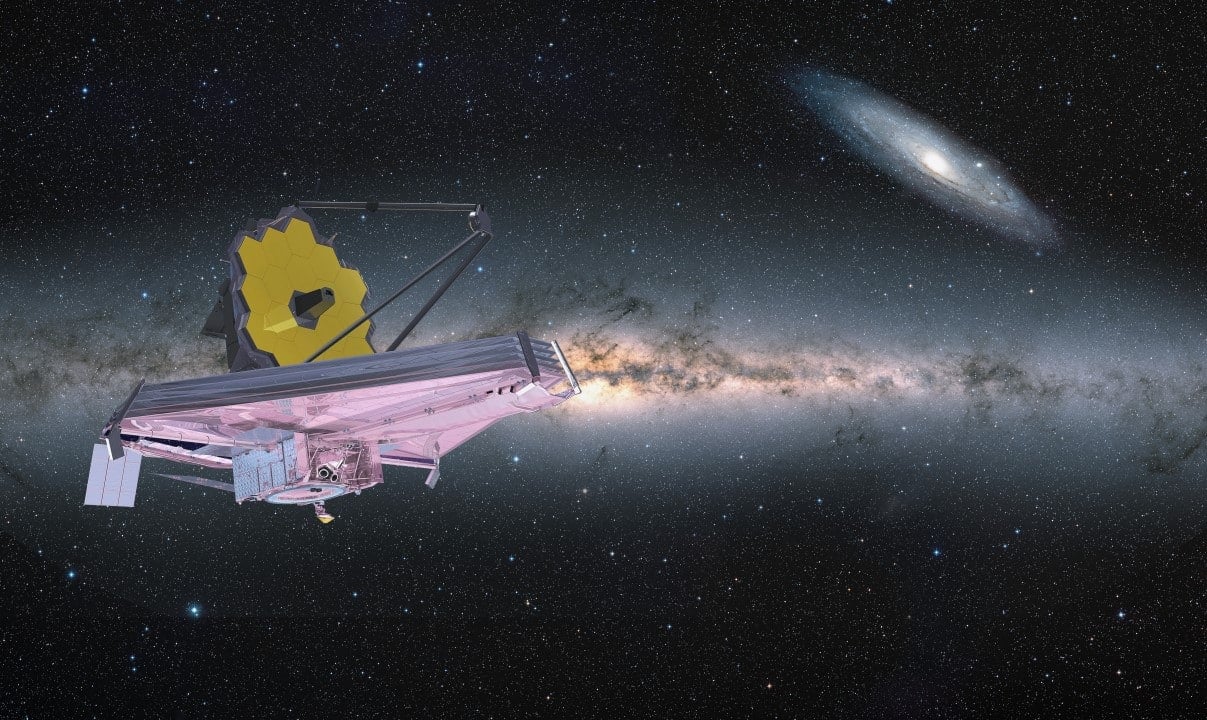
Telescópio Espacial James Webb recorded the presence of complex organic molecules in a relatively nearby galaxy. The observation took place in the obscured core of the galaxy IRAS 07251-0248, classified as ultraluminous in the infrared.
These molecules include carbon-based compounds that act as initial steps in prebiotic chemistry. The detection highlights the methyl radical for the first time outside of Via Láctea.
The telescope’s instruments picked up signals at infrared wavelengths. Essa ability allows it to penetrate dense clouds of dust that block visible light.
The discovery reveals a rich chemical environment in extreme regions of the universe. The data indicate continuous production of organic materials in active galactic nuclei.

Identified organic molecules
Astronomers have confirmed the presence of several molecules in the spectrum of the galaxy IRAS 07251-0248. Essas substances appear in quantities greater than those predicted by previous models.
The methyl radical stands out for its high reactivity and role in complex chemical reactions. Sua extragalactic detection represents a milestone in interstellar observation.
Other compounds include polycyclic aromatic hydrocarbons in solid grain form. Esses materials contribute to the formation of larger carbonaceous structures.
- Benzene
- Methane
- Acetylene
- Diacetylene
- Triacetylene
- Water ice associated with carbides
These molecules arise under high-energy conditions typical of galactic nuclei. Raios cosmic fragments fragment larger compounds and release smaller, detectable versions.
The simultaneous presence suggests active chemical cycles. Pequenas molecules serve as the basis for amino acids in suitable environments.
james webb instruments in capture
Telescópio James Webb used two main instruments for this observation. NIRSpec operated in the near-infrared and identified precise spectral signatures.
MIRI complemented the data in the mid-infrared. Essa combination revealed details hidden by thick dust in the galaxy’s core.
The obtained spectra show clear emission lines of hydrocarbons. The resolution surpasses previous observations from ground-based or space-based telescopes.
The galaxy IRAS 07251-0248 shows an intense infrared glow due to central activity. The telescope penetrated the dust veil and exposed the chemical composition inside.
Characteristics of the observed galaxy
IRAS 07251-0248 is classified as an ultraluminous infrared galaxy. Esses objects emit intense radiation due to star formation processes or black hole activity.
The distance allows for detailed observations with current technology. The nucleus remains obscured in visible light but accessible in infrared.
Extreme environments host complex carbon-based chemistry. The presence of carbon-rich grains indicates continuous sources of organic material.
Galactic cores like this function as natural cosmic laboratories. Eles reproduce conditions that favor the synthesis of prebiotic molecules.
Molecule formation process
Complex organic molecules form in regions of high density and radiation. Raios cosmics act as catalysts by breaking bonds in larger compounds.
Resulting fragments recombine into smaller, more stable versions. Esse mechanism explains the observed abundance beyond theoretical predictions.
Carbon-rich interstellar dust protects newly formed molecules. Camadas solids incorporate hydrocarbons and gradually release them.
The continuous cycle maintains high levels of organic compounds. Pequenas molecules accumulate and participate in subsequent reactions.
Detection technical details
Infrared spectroscopy revealed specific absorption and emission peaks. Cada molecule presents a unique signature at certain wavelengths.
The methyl radical appears in lines previously observed only in Via Láctea. Sua extragalactic identification expands knowledge about cosmic distribution.
Combined data from NIRSpec and MIRI provides broad spectrum coverage. Cross-analysis confirms the presence of multiple compounds simultaneously.
Amounts detected exceed expectations from standard chemical models. Isso suggests additional production mechanisms in active cores.
Relevance to prebiotic chemistry
Small organic molecules represent initial steps in forming the building blocks of life. Elas include precursors of amino acids and nitrogenous bases.
Detection in distant galaxies indicates that similar chemical processes occur throughout the universe. Carbono is widely distributed since the early stages of the cosmos.
Environments such as IRAS 07251-0248 demonstrate efficient production of organic materials. Esses locations contribute to the cosmic inventory of essential elements.
The presence of associated water ice reinforces the potential for aqueous reactions. Combinações favor the synthesis of more complex compounds.
Mid-infrared observations
The MIRI instrument captured emissions from carbon-rich solid grains. Essas structures emit characteristic radiation at longer wavelengths.
Polycyclic aromatic hydrocarbons appear as main components of dust. Eles absorb ultraviolet light and re-emit it in the infrared.
The spatial resolution allows mapping distribution within the nucleus. Regiões plants concentrate a higher density of organic materials.
Data complement near-infrared observations. The integrated view reveals the galaxy’s complete chemical dynamics.
Comparison with milky way
Regions of Via Láctea present similar molecules in molecular clouds. Porém, detection of the methyl radical was limited to our galactic system.
Ultraluminous galaxies exhibit more extreme radiation and density conditions. Isso accelerates molecular formation and destruction processes.
Greater abundance suggests superior efficiency in carbon production. Núcleos active ingredients work like intense factories of organic compounds.
Differences highlight variety of chemical environments in the universe. Processos commons distribute life ingredients widely.
Advances in cosmic astrobiology
The discovery reinforces the ubiquitous distribution of complex organic chemistry. Moléculas precursors appear in diverse galactic contexts.
Telescópio James Webb continues to map obscured regions. Future Observações will explore similar galaxies at different evolutionary stages.
Accumulated data contributes to understanding chemical origins of life. Blocos fundamentals form naturally under varied cosmic conditions.
Integrated research combines spectroscopy with theoretical modeling. Resultados refine understanding of the chemical evolution of the universe.



