
Strongest solar explosion of the current cycle launches particles towards Earth and generates warning from NASA


A coronal mass ejection was launched towards our planet after the most intense solar flare recorded in the current cycle. The phenomenon, classified as X8.1, originated from the massive sunspot AR4366 on February 3 and is under intense monitoring by space agencies. The arrival of the material expelled by Sol to the magnetic field of Terra is expected to occur between the 5th and 6th of February.
Experts at NOAA’s Centro of Previsão of Clima Espacial (Administration Nacional Oceânica and Atmosférica) project that the resulting geomagnetic storm will reach the G1 level. Esta classification is considered lower on the intensity scale, which goes up to G5. Consequentemente, expected impacts are limited, but the event provides an opportunity to observe aurora borealis at higher latitudes than usual.
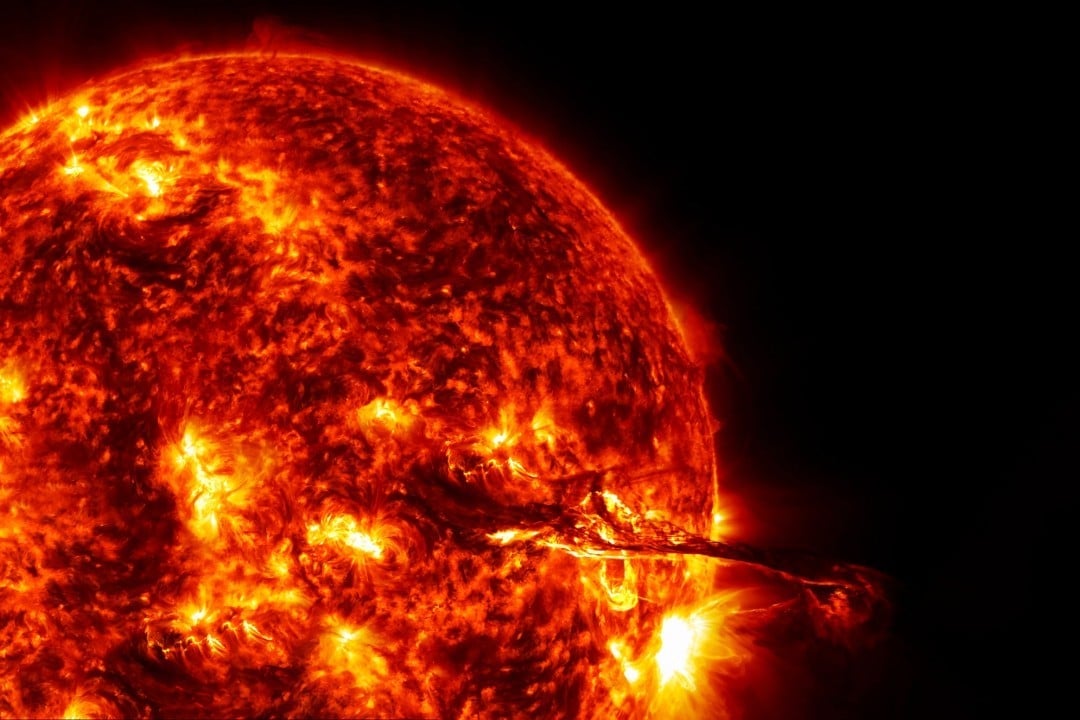
Sunspot AR4366, responsible for the flare, has demonstrated exceptionally high activity since late January. The active region on the surface of Sol is remarkably large, with a diameter approximately ten times larger than that of Terra, which creates conditions for the formation of complex and unstable magnetic fields, conducive to eruptive events of great magnitude. Surveillance over this sunspot remains constant, as new explosions may occur while it is facing our planet.
Sunspot AR4366 Activity Details
The AR4366 region has been a prolific source of solar activity in recent weeks. Entre the end of January and the beginning of February, the spot generated dozens of eruptions of different intensities, keeping observatories on alert.
Data collected indicates that, in addition to the main X8.1 class explosion, the same region produced four other class X eruptions, the strongest level. Essas secondary explosions reached magnitudes of X1.0, X2.8, X1.6 and X1.5, demonstrating the magnetic instability of the area.
The trajectory of solar particles
The February 3 eruption released a cloud of plasma and charged particles, known as a coronal mass ejection (CME). Modelos computational tools developed by space agencies were used to predict the trajectory and speed of this particle cloud.
The forecast indicates that the CME shock front will reach the Earth’s magnetosphere between February 5th and 6th. The interaction of these particles with our planet’s magnetic field is what triggers the geomagnetic storm.
The intensity of the storm, classified as G1, suggests that the effects will be mostly felt at high latitudes. One of the main visible phenomena will be the intensification of the auroras, which can be observed in places such as Canadá, Escandinávia and north of Estados Unidos.
The colors of the auroras depend on the altitude and atmospheric gases involved in the collision. Oxygen is responsible for the green and red tones, while nitrogen can produce blue and purple lights, creating a natural spectacle for observers in places with clear skies.
Expected impacts on communication systems
Geomagnetic storms, even low-intensity ones like G1, can cause disruption to technologies that rely on electromagnetic signals. High frequency (HF) radio communications, used primarily by aviation and amateur radio operators in polar regions, are the most susceptible to temporary interference. The ionosphere, the layer of the atmosphere that reflects these signals, is directly affected by the arrival of solar particles, which can lead to signal degradation or loss for short periods. However, modern communications systems are designed with redundancies to mitigate these effects, and recovery to normalcy is often quick after the peak of the storm passes.
Satellites in low orbit may also be affected. The energy deposited in the upper atmosphere during a solar storm causes it to expand, increasing aerodynamic drag on satellites. Isso can subtly alter its trajectories, requiring course corrections by operators to maintain accurate orbital position and avoid collisions with other objects. Para a G1 event, these corrections are generally small and managed by routine protocols of space agencies and satellite companies, and do not pose a significant risk to the operation of services such as GPS or data transmission.
Continuous Space Weather Monitoring
Surveillance of Sol and the space environment is a continuous and global operation, essential to predict and mitigate the effects of events like this. The Nasa plays a key role in this effort with instruments such as the Observatório of Dinâmica Solar (SDO), which capture very high-resolution images of the Sol at different wavelengths. Esses data allows scientists to analyze the evolution of sunspots and identify the occurrence of flares in near real time, providing crucial information about the intensity and direction of flares. The ability to observe the dynamics of the solar corona helps determine whether a coronal mass ejection is aimed at Terra. In parallel, NOAA, through its Centro of Previsão of Clima Espacial (SWPC), uses this data and information from its own satellites, such as the GOES series, to issue warnings and forecasts about geomagnetic conditions. International collaboration is vital, with agencies around the world sharing data to improve model accuracy and ensure operators of critical infrastructure, such as power grids and satellite fleets, receive early warning needed to take preventative action.
Context of solar cycle 25
The increased frequency and intensity of solar flares is in line with the current phase of solar cycle 25. The Este cycle, which began in December 2019, is approaching its peak of activity, known as solar maximum. During this period, which occurs approximately every 11 years, the magnetic field of Sol becomes more complex and unstable, resulting in a greater number of sunspots and, consequently, explosions and coronal mass ejections.
Forecasts for the next few days
Current models confirm the arrival of the particle cloud between February 5th and 6th, with the forecast of a G1 level storm maintained. Space agencies will continue to monitor the AR4366 spot, which will remain on the side of Sol facing Terra for a few more days. Novas eruptions, if they occur, could change the scenario and intensity of geomagnetic effects. Updates are continuously released on the official Nasa and NOAA portals, allowing the public and affected sectors to follow the event’s evolution in real time.




