
Flat sheet of dark matter explains why Andromeda advances towards the Milky Way in recent study

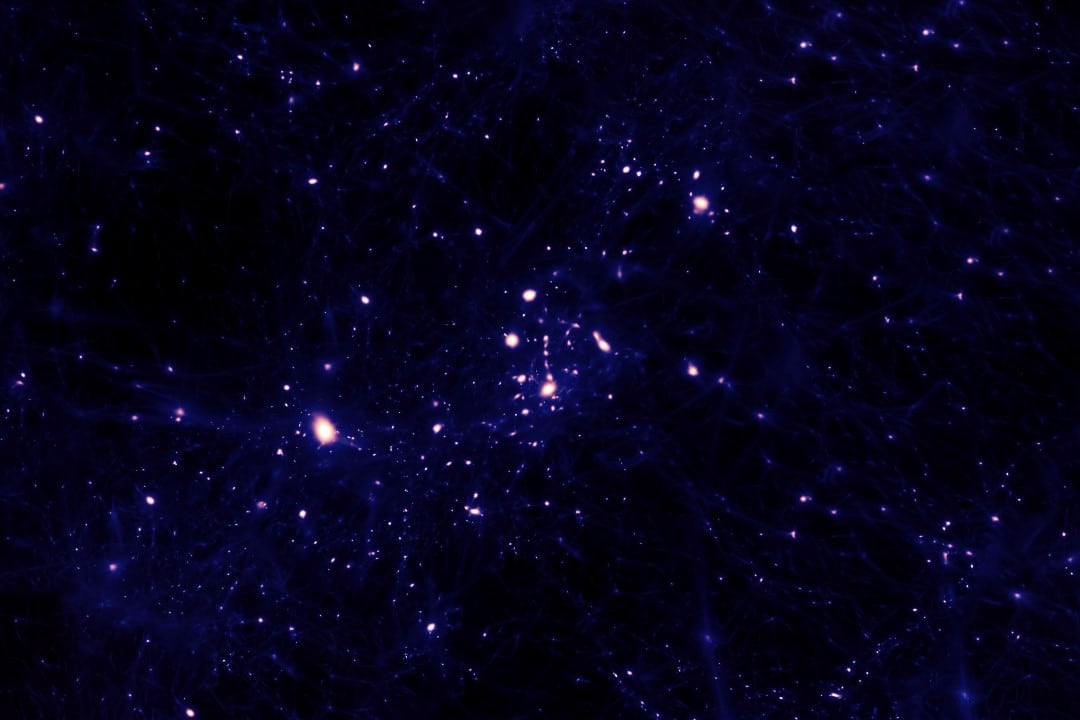
Astronomers have identified a vast flat structure of dark matter that surrounds Grupo Local of galaxies, including Via Láctea and Andrômeda. Essa configuration explains why Andrômeda moves toward our galaxy at about 70 miles per second, while other nearby galaxies move away faster than predicted by the expansion of the universe.
The study, published in the journal Nature Astronomy in January 2026, used computer simulations to model the distribution of mass in the cosmic neighborhood. Pesquisadores from institutions such as Universidade from Groningen and Instituto Max Planck from
This discovery resolves an anomaly observed for decades in the application of Lei from Hubble to Grupo Local. The law predicts that distant galaxies move away in proportion to their distance, but local exceptions required an additional explanation for the observed movements.
Flat structure of dark matter
Simulations indicate that the dark matter around Grupo Local is not distributed spherically, as traditional models assumed. Instead, it is concentrated in a flat sheet, with large cosmic voids above and below this structure.
This geometry changes the relationship between speed and distance of nearby galaxies. The gravitational pull of the distant mass in the sheet counterbalances the pull of Grupo Local, accelerating the retreat of external galaxies while allowing Andrômeda to approach.
Researchers tested several computational scenarios to reproduce the measured speeds. Apenas the model with a flat distribution accurately reproduced the observations of 31 galaxies neighboring Grupo Local.
The Andromeda Galaxy in ultraviolet captured by GALEXpic.twitter.com/sKV1g6pnbF
—Astropics (@astropics)January 30, 2026
Anomalous movement of Andrômeda
Andromeda, the largest neighboring galaxy to Via Láctea, is approaching at a speed that contradicts the general expansion of the universe. Essa trajectory points to a future merger between the two galaxies, expected to occur in billions of years.
The sheet of dark matter exerts a gravitational influence that directs Andrômeda into Grupo Local. Galáxias further away experience opposite pull from the external mass on the flat structure, resulting in faster than expected recession.
Historical observations, beginning in the 1950s, already indicated invisible mass between the two galaxies. The new model refines these estimates by incorporating the flattened shape of the matter distribution.
- Approach speed: about 110 km/s
- Current distance: approximately 2.5 million light years
- Estimated combined mass: equivalent to trillions of suns, mostly dark matter
Role of cosmic voids
Cosmic voids represent low-density regions that expand faster than the universe average. Essa expansion concentrates matter in the walls that separate these voids, forming structures like the identified sheet.
Cosmic walls accumulate galaxies and dark matter over time. In the case of Grupo Local, this concentration creates the gravitational environment observed in the simulations.
The presence of voids above and below the sheet reinforces the flattening effect. Regiões of lower density push matter towards the walls, shaping the local dynamics of galaxies.
Simulations and model validation
International teams ran systematic numerical experiments to test mass distributions. Spherical Modelos failed to explain the measured velocities of nearby galaxies.
The flat configuration emerged as the only one capable of reconciling observations with the estimated total mass of Grupo Local. Dados from space and ground-based telescopes validated the model’s predictions.
Co-authors highlight that the structure extends to scales larger than Grupo Local itself. Essa extension influences movements over tens of millions of light years.
Mass distribution in the local universe
Dark matter makes up about 85% of the total mass of the universe. Sua indirect detection occurs through gravitational effects in galaxies and clusters.
In Grupo Local, the joint mass of Via Láctea and Andrômeda dominates the internal dynamics. The outer sheet adds a component that explains deviations of Lei from Hubble at close scales.
Observations of 31 galaxies outside of Grupo Local confirm the pattern. Pontos cyans in simulations represent these galaxies, aligned with the flat structure.
Implications for cosmological models
The flattening of the distribution challenges assumptions of spherical symmetry at local scales. Futuras observations could test the prevalence of similar structures in other groups of galaxies.
Refinements to the model incorporate data from new telescopes. Esses advances promise greater accuracy in predictions of galactic movements.
The discovery reinforces the dominant role of dark matter in cosmic evolution. Large-scale Estruturas continues to shape the observable universe.
Detailed gravitational dynamics
The sheet’s gravity partially counteracts Grupo Local’s internal attraction to distant galaxies. Andrômeda, closer, escapes this effect and maintains an approaching trajectory.
Simulations show that galaxies less than 8 million light years away recede more slowly. Além this distance, the recession accelerates due to the external mass on the sheet.
This geometry-dependent variation resolves previous inconsistencies. Modelos traditional models overestimated or underestimated speeds in different ranges.
Additional observations
Data from satellites like Gaia provide precise measurements of stellar movements. Essas information helps calibrate simulations on galactic scales.
Ground-based telescopes monitor radial velocities of neighboring galaxies. Combining multiple sources validates the consistency of the flat model.
Future research will explore similar structures in distant regions. The distribution of dark matter remains central to modern cosmology.
Features of the cosmic sheet
The extension of the structure reaches tens of millions of light years. Vazios flank the leaf, creating density contrast that defines its shape.
Grupo Local galaxies appear as bright spots in the center of the simulation. The lateral view reveals the pronounced flattening of the distribution.
This configuration emerges naturally from cosmic evolution. Expansão void differential concentrates matter in the intermediate walls.
The study represents a significant advance in understanding the cosmic neighborhood. Movimentos observed gain an explanation consistent with established gravitational principles.



