
NASA’s Juno probe reveals that Jupiter is smaller and flatter than ancient measurements indicated

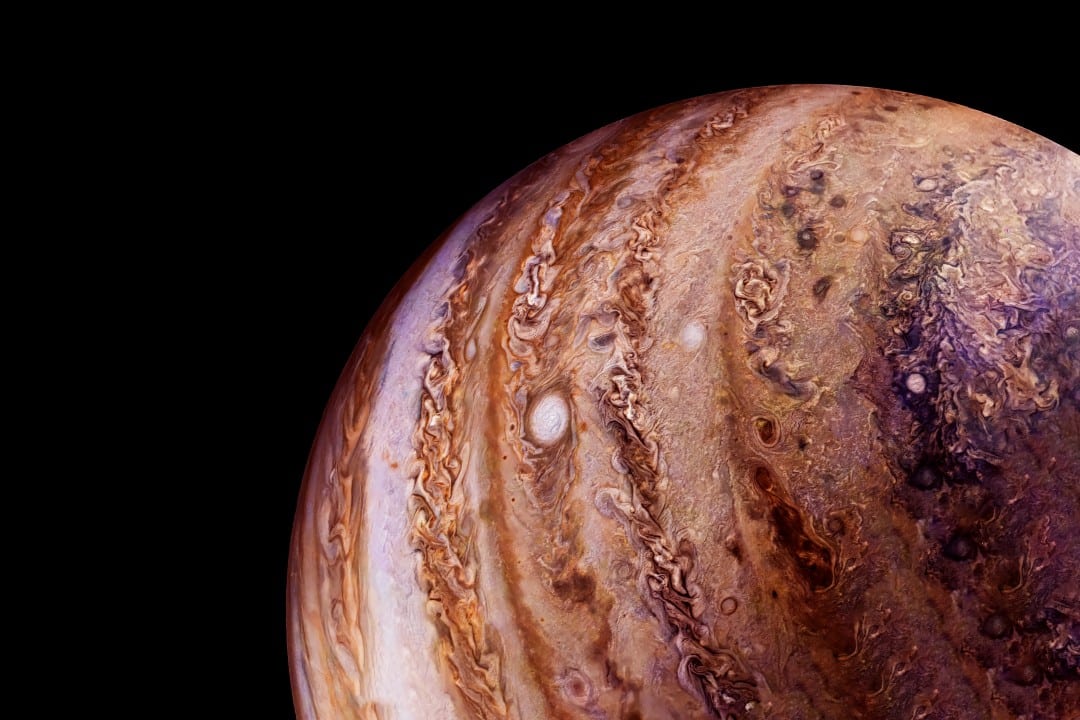
NASA’s Juno probe collected data that allowed more precise measurements of the size and shape of Júpiter, the largest planet in Sistema Solar. The new observations show that the planet’s equatorial diameter is 142,976 kilometers, about 8 kilometers smaller than previously estimated. Já the polar diameter registers 133,684 kilometers, a reduction of approximately 24 kilometers compared to previous measurements.
These updates result from detailed analyzes carried out during the probe’s passes behind the planet, from a terrestrial perspective. Scientists adjusted the calculations considering factors such as zonal winds and atmospheric composition. The flattening of Júpiter is now estimated at around 7%, a value higher than that of Terra, which presents only a 0.33% difference between the equator and the poles.
The information refines the understanding of the structure of the gas giant and serves as a basis for more accurate models of its interior. The Juno mission, in orbit since 2016, continues to provide valuable data to the scientific community.
Mission Juno and its contribution to astronomy
The Juno probe was launched in 2011 and entered orbit around Júpiter in 2016. Sua extension, approved in 2021, allowed additional observations that were not initially planned.
Juno’s instruments capture radio signals that pass through the planet’s atmosphere during occultations. Esses signals undergo changes due to atmospheric density and temperature, allowing accurate size calculations.
Radio occultation measurement method
The process involves passing the probe behind Júpiter, as seen from Terra. The radio signal from Juno travels through the atmosphere before reaching terrestrial receivers.
Changes in the signal reveal details about the planet’s atmospheric composition and gravity. Cientistas analyzed 26 such occasions to refine the measurements.
Zonal winds, which reach high speeds, influence the shape of the planet. Including these effects in the models increased accuracy to about 400 meters in each direction.
This technique overcomes the limitations of measurements from the Voyager and Pioneer probes, carried out in the 1970s. Naquela time, only six similar passages were available.

Comparison with previous measurements
Old estimates were based mainly on data from missions Voyager 1 and 2, in addition to Pioneer. Essas probes have provided the first detailed images of the gas giant.
The new measurements reduce the equatorial radius by about 4 kilometers. At the pole, the reduction reaches 12 kilometers in terms of radius.
- Anterior equatorial diameter: approximately 142,984 km
- Current equatorial diameter: 142,976 km
- Previous polar diameter: about 133,708 km
- Current polar diameter: 133,684 km
These differences, although small, impact computational models of the planetary interior. Júpiter remains the largest planet, capable of containing over 1,300 Terras in its volume.
Importance for models of the interior of Júpiter
The precise radius serves as a fundamental reference in simulations of the planet’s internal structure. Júpiter has a possibly dilute core, surrounded by metallic hydrogen.
Size adjustments change calculations about pressure and temperature in deep layers. Isso affects the understanding of the intense magnetic field generated by the planet.
The composition rich in hydrogen and helium reflects primitive conditions of the Sistema Solar. Mudanças in parameters refine hypotheses about planetary formation.
General characteristics of the gas giant
Jupiter is the fifth planet from Sol and dominates the mass of Sistema Solar, except for the central star. Sua atmosphere presents colored bands formed by winds of up to 600 km/h.
Storms like Grande Mancha Vermelha persist for centuries. The Juno probe revealed details about auroras and cyclones at the poles.
The planet has no solid surface, consisting mainly of gases. The transition to liquid state occurs at high depths.
Role of Júpiter in the formation of Sistema Solar
Jupiter formed early in the history of Sistema Solar and influenced the distribution of material. Sua Gravity attracted or ejected objects, shaping the orbits of other planets.
Volatile substances transported by the giant contributed to the composition of Terra. Elementos how water and ammonia reached the internal system through impacts.
The study of the interior of Júpiter sheds light on planetary accretion processes. Updated Modelos helps understand similar exoplanets detected in other systems.
Scientific advances provided by Juno
The mission collected data on the gravitational and magnetic field of Júpiter. Observações revealed asymmetries in the interior, challenging uniform models.
High-resolution images show complex clouds and atmospheric structures. The probe identified ammonia and water in unexpected quantities.
The extension of the mission allows for continuous monitoring of seasonal changes. Juno also studies the Galilean moons, including possible subsurface oceans.
Implications for future space missions
Precise measurements guide the planning of future probes to the gas giant. Projetos and mission Europa Clipper benefit from data from Juno.
Size refinement improves trajectory calculations in flyby missions. Agências spaces use these parameters in navigation simulations.
International collaboration involves institutions from several countries in data analysis. Resultados published in specialized journals expands access to knowledge.
The precision achieved demonstrates the technological advancement in space instruments. Similar Técnicas can be applied to other gaseous planets, such as Saturno.
Details about the oblate shape of planets
Rapidly rotating planets tend to flatten at the poles due to centrifugal force. Júpiter exhibits this effect pronouncedly by its rotation of about 10 o’clock.
The 7% difference between the equator and poles reflects the planet’s low average density. Corpos rocks like Terra show minimal flattening.
Factors such as internal mass distribution influence the degree of oblatism. Em Júpiter, deep winds contribute to dynamic variations.
Comparative studies with Saturno show differences in flattening. Urano and Netuno, further away, have inclined rotations that complicate measurements.
Contributions of the study to planetary science
The work led by Israeli researchers analyzed data from multiple passages. The inclusion of atmospheric effects increased the precision of the estimates.
Results update official astronomical databases. Materiais educational and textbooks require revision with the new values.
The methodology serves as a reference for measurements on exoplanets. Telescópios Futures may apply similar techniques to distant systems.
The continued refinement of knowledge about Júpiter demonstrates the importance of long-duration missions. Prolonged Observações reveal details impossible in fast flybys.



