
What is comet 3I/ATLAS made of? New NASA images reveal organic molecules and late eruption

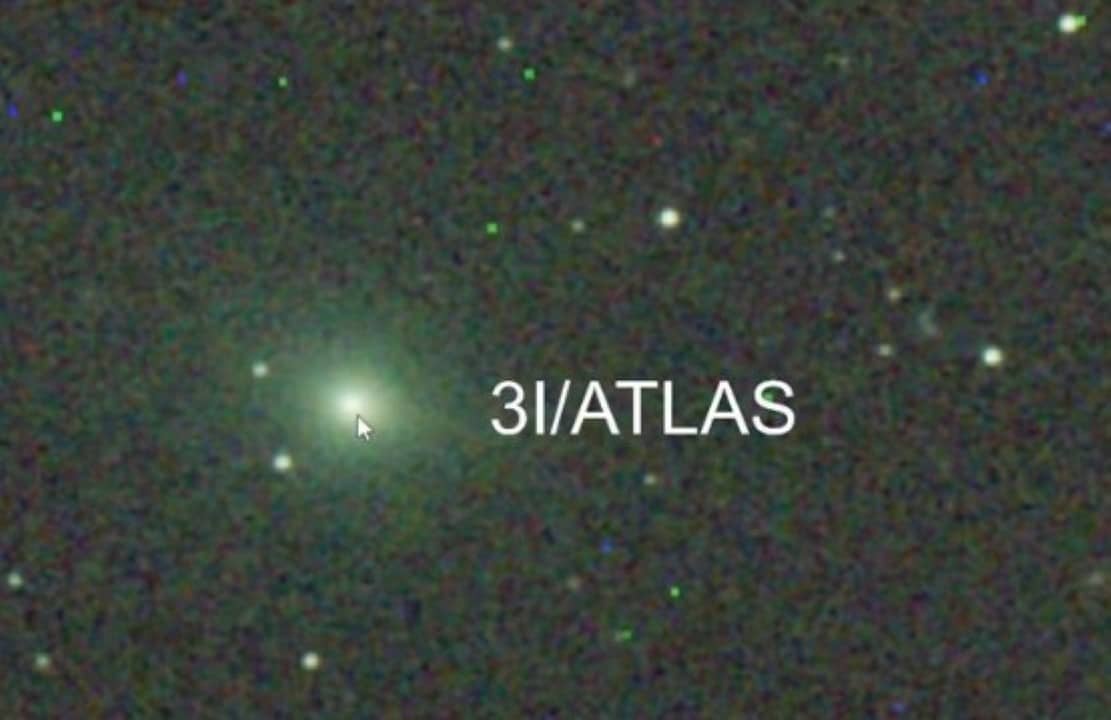
The Nasa space telescope SPHEREx captured infrared images of the interstellar comet 3I/ATLAS in December 2025, two months after its perihelion. The records revealed intense activity, with significant release of gases, dust and complex organic molecules, even far from Sol. Essa unexpected eruption allowed the most detailed chemical analysis ever performed on an object formed outside of Sistema Solar. The data indicates that the comet developed a bright coma and a pear-shaped dust tail.
Observations show the presence of water vapor, carbon dioxide, methane, methanol and cyanide in the cloud surrounding the core. Esses compounds are considered basic ingredients for the formation of planets in stellar systems.
- The comet’s brightness increased noticeably after its closest pass to Sol.
- Water ice quickly sublimated into interplanetary space.
- Rock particles were ejected, forming the observed structure.
3I/ATLAS was discovered in July 2025 by the ATLAS system and confirmed as the third interstellar object to visit Sistema Solar.
Discovery and trajectory of the object
Comet 3I/ATLAS follows a hyperbolic orbit, confirming its origin external to Sistema Solar. Ele passed perihelion in October 2025, about 1.4 astronomical units from Sol. Após this approach, the object continued its exit route, without posing a risk of impact with planets.
Scientists monitored its trajectory with several instruments on Nasa, including Hubble and James Webb. The minimum distance from Terra occurred in December 2025, at approximately 170 million kilometers.
🚨 NASA has found ingredients for life on an interstellar comet.☄️🛸
— 3I/ATLAS updates (@Defence12543)February 7, 2026
⚠️SPHEREx observations reveal that interstellar comet 3I/ATLAS is releasing methanol, methane, cyanide & CO₂ — organic molecules essential to life as we know it.😳
🔭 Detected after the comet’s solar close…pic.twitter.com/mMLiTKwQkp
Observed chemical activity
SPHEREx identified an extensive carbon dioxide-rich coma stretching hundreds of thousands of kilometers. Essa gaseous structure resulted from the sublimation of ancient ices inside the comet. Sunlight penetrated surface layers, releasing materials trapped for billions of years.
The late eruption differed from the typical behavior of comets, which activate mainly near perihelion. The data suggests that cosmic radiation altered the composition over time.
Detailed composition revealed
Infrared images highlighted the presence of complex organic molecules in the 3I/ATLAS coma. Essas substances include carbon chains associated with prebiotic processes in space environments.
The telescope detected specific emissions of methanol and cyanide, as well as methane in significant quantities. The ejected dust formed a distinct tail, visible in multiple wavelength ranges.
The records confirmed water ice undergoing gaseous transformation, even at considerable distances from the Sol. Essa characteristic indicates robust internal reserves of volatiles.
Comparison with previous visitors
3I/ATLAS differs from 1I/’Oumuamua, which exhibited no detectable coma or tail in 2017. Aquele object exhibited rocky behavior, without significant outgassing.
2I/Borisov, observed in 2019, showed cometary activity, but with a less diverse composition. 3I/ATLAS has a greater abundance of organic compounds.
This chemical variety offers comparative data on the formation of bodies in different regions of Via Láctea. The materials detected are common in protoplanetary disks observed by Nasa.
Importance of infrared observations
SPHEREx operates in 102 infrared bands, enabling precise separation of molecular emissions. Essa ability distinguished contributions from dust, water and gases in the coma.
The December 2025 observations captured the comet in the phase of maximum post-perihelion eruption. Scientists processed the data to map spatial distributions of each component.
Contributions to planetary studies
The composition of 3I/ATLAS includes elements considered building blocks of rocky planets. The simultaneous presence of water and organics reinforces hypotheses about the universal distribution of these materials.
Laboratory research simulates transformations in cometary ices exposed to radiation. Esses experiments validate changes observed in the interstellar object.
SPHEREx data complements records from other missions, forming a broad set of information about the visitor. The comet will remain observable until spring 2026 in amateur telescopes.
Technical monitoring details
The ATLAS system, funded by Nasa, initially detected the comet in images from July 2025. The hyperbolic trajectory was confirmed days later by international coordination centers.
Multiple spacecraft, including Parker Solar Probe and Europa Clipper, have recorded the object in previous passes. Esses records have provided varying perspectives of its evolution.
Continuous monitoring allowed us to track the increase in brightness in real time throughout December. Combined infrared and visible analysis revealed internal dynamics of the core.



