
Eruption of interstellar comet 3I/ATLAS as it exits the solar system reveals unique secrets


A cosmic event of rare beauty and scientific complexity surprised the astronomical community. The interstellar comet 3I/ATLAS, a visitor from outside our stellar neighborhood, displayed an unexpected eruption of gas and dust as it moved away from Sol, defying researchers’ expectations.
This atypical activity, detected through infrared observations, provided an unprecedented window into the internal composition of a celestial body formed in another star system. The data collected is revolutionizing understanding of planetary formation and the ubiquity of components essential to life in the universe.
Unraveling the mystery of the late eruption
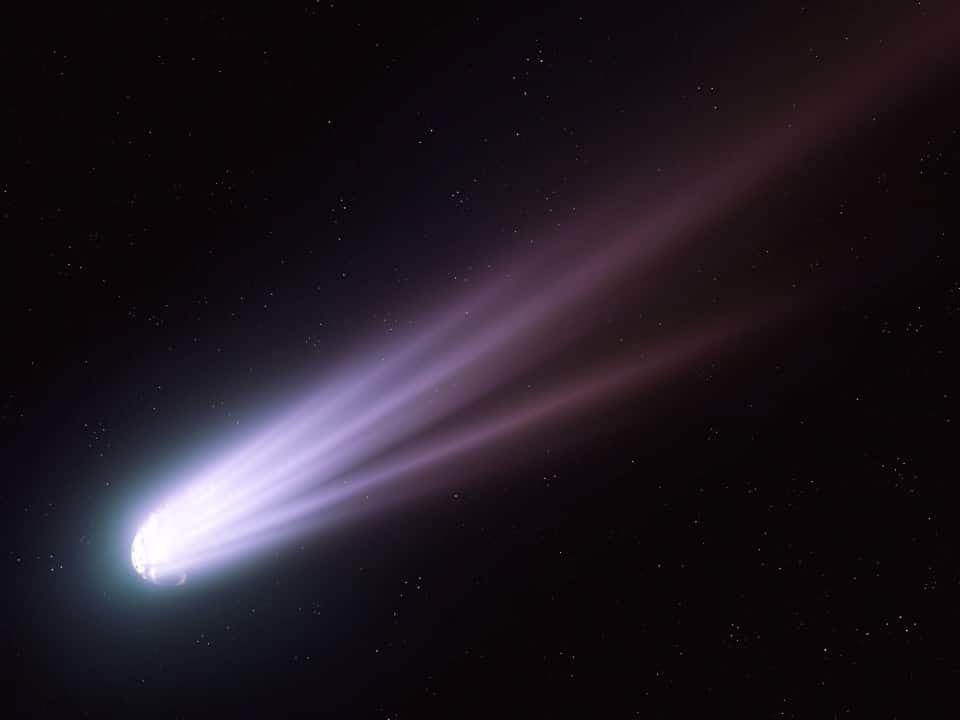
Comet 3I/ATLAS showed intriguing behavior, erupting weeks after perihelion, the point of closest proximity to Sol. Geralmente, comets exhibit greater activity when they approach our star, due to direct heating that sublimates their surface ices. The eruption of 3I/ATLAS in its withdrawal phase indicates more complex internal geophysical processes than initially predicted for an interstellar object.
Scientists suggest that solar energy, over time, slowly penetrated the comet’s deeper layers. Essa gradual irradiation warmed primitive ices that were protected by a dense outer crust, modified by billions of years of exposure to cosmic rays. As heat reached these intact regions, a sudden and intense release of volatile material occurred, resulting in the formation of an extremely bright coma and a remarkably asymmetrical dust tail.
Chemical composition and the search for life
Detailed analysis of the material ejected by comet 3I/ATLAS revealed extraordinary chemical richness. The telescopes identified large amounts of water vapor (H₂O), carbon dioxide (CO₂), as well as methane, methanol, cyanide and a series of other complex organic compounds. The presence of these elements, together with carbon-rich rocky dust, is of paramount importance for astrobiology.
These molecules are considered the fundamental “building blocks” for the formation of planets and, under the right environmental conditions, are essential precursors for the emergence of life. The detection of such a vast diversity of organic compounds in an object of interstellar origin amplifies the hypothesis that the basic ingredients for life may be widely distributed throughout the galaxy.
The technology behind the groundbreaking discovery
The precise identification of the chemical components of 3I/ATLAS was only possible thanks to the capabilities of the SPHEREx space telescope, which specializes in infrared observations. Diferente of visible light, infrared radiation allows scientists to detect specific molecular signatures. Cada type of molecule absorbs and emits light at unique infrared wavelengths, like a type of chemical “fingerprint.”
This technique proved indispensable for mapping not only the presence of dust, but also the comet’s intricate chemical diversity with unprecedented precision. Infrared technology has enabled in-depth analysis of the comet’s coma and tail, offering data that would be inaccessible through other observation methods, solidifying the critical role of advanced instruments in space exploration.
Messengers from distant star systems
Comet 3I/ATLAS is only the third confirmed interstellar object ever observed to cross our Sistema Solar, underscoring the extreme rarity of these cosmic encounters. Sua’s unmistakable hyperbolic trajectory confirmed its origin in a stellar environment completely different from our Sol, coming from a distant star in Via Láctea.
This means that 3I/ATLAS is not an original member of our planetary system, but rather a traveler offering us a direct, virgin glimpse of another star system. Sua arrival, and especially its eruption, serve as a unique opportunity for astronomers to study conditions and materials present in other regions of our galaxy, without the need to send complex space missions to these remote locations.
Universal ingredients for life
Comparing the chemical elements found in 3I/ATLAS with those observed in comets native to our Sistema Solar is crucial to answer one of the central questions of astrobiology: are the ingredients for the formation of planets and the emergence of life universal processes? Este comet, arriving from another stellar nursery, acts as a walking laboratory for this investigation.
Recent studies, which included analyzes published in the journal Research Notes of the AAS, indicate that, despite its external origin, 3I/ATLAS has a molecular composition remarkably similar to that of the comets orbiting Sol. Essa similarity suggests that the fundamental chemical processes that generate these building blocks of life may be common and repetitive throughout Via Láctea, increasing the likelihood of life elsewhere in the cosmos.
3I/ATLAS: a cosmic time capsule
In essence, comet 3I/ATLAS functions as a true cosmic time capsule. Ele preserved chemical material that formed in another region of the galaxy, untouched for billions of years. Sua late eruption offered scientists a unique opportunity to observe substances that have remained isolated since their creation, significantly expanding our understanding of the diversity and recurrence of processes that shape planetary systems throughout the universe.
Crucial observations and future learnings
Observation of the 3I/ATLAS flare highlighted the importance of monitoring interstellar objects, even as they move away from Sol. Key highlights of the event include the detection of molecules directly associated with planet formation and the genesis of life, the delayed release of deep ices gradually heated by solar radiation, and the formation of a glowing coma and irregular dust tail, all mapped with unparalleled precision using infrared technology.
These revelations not only deepen knowledge about cometary chemistry, but also open new avenues for research into the distribution of organic materials in space. Data obtained with 3I/ATLAS will continue to be analyzed for years, providing insights into the chemical and physical diversity of celestial bodies formed in conditions different from those in our own solar system, driving the search for other forms of life.
Analysis and detection methods
The complexity of analyzing such distant objects and the speed with which they traverse our system require a sophisticated combination of methods. Além of SPHEREx’s infrared observations, spectroscopy techniques in other wavelengths, such as visible and ultraviolet, complement data collection, allowing the identification of atomic elements and other molecules that may have different spectral signatures. Triangulating data from multiple terrestrial and space-based instruments and observatories is essential to building a complete profile of these visitors. Computational modeling also plays a vital role, helping scientists simulate the conditions that could lead to a late flare, such as the penetration of heat into the comet’s subsurface layers, as well as the evolution of its coma and tail, providing a deeper understanding of the observed phenomena.
The role of comets in the distribution of materials
Comets are often considered the “postmen” of the universe, playing a crucial role in distributing water and organic compounds throughout space. Durante the formation of planetary systems, these icy bodies collide with protoplanets, delivering these essential materials. In our Sistema Solar, it is believed that comets and asteroids were responsible for much of the water and organic compounds that eventually formed the oceans and Earth’s atmosphere, being crucial for the emergence of life.
The discovery of similar organic compounds in an interstellar comet like 3I/ATLAS suggests that this material delivery mechanism is not unique to our stellar system. Isso implies that other planets in different systems may have received these vital building blocks, increasing the likelihood that life could flourish on a multitude of worlds beyond our own. The continuous study of these objects is fundamental to mapping this cosmic distribution network.
Next steps in the search for interstellar objects
The 3I/ATLAS observation reinforces the need to develop new strategies and technologies to detect and study future interstellar objects. With each new discovery, scientists refine models of stellar and planetary formation and evolution, seeking to better understand the characteristics of these cosmic travelers. Advances in survey astronomy and the next generation of telescopes could reveal even more secrets about these messengers from other worlds, expanding our view of Via Láctea.



