
Hubble details structure of double jets and inverted tail in comet of interstellar origin


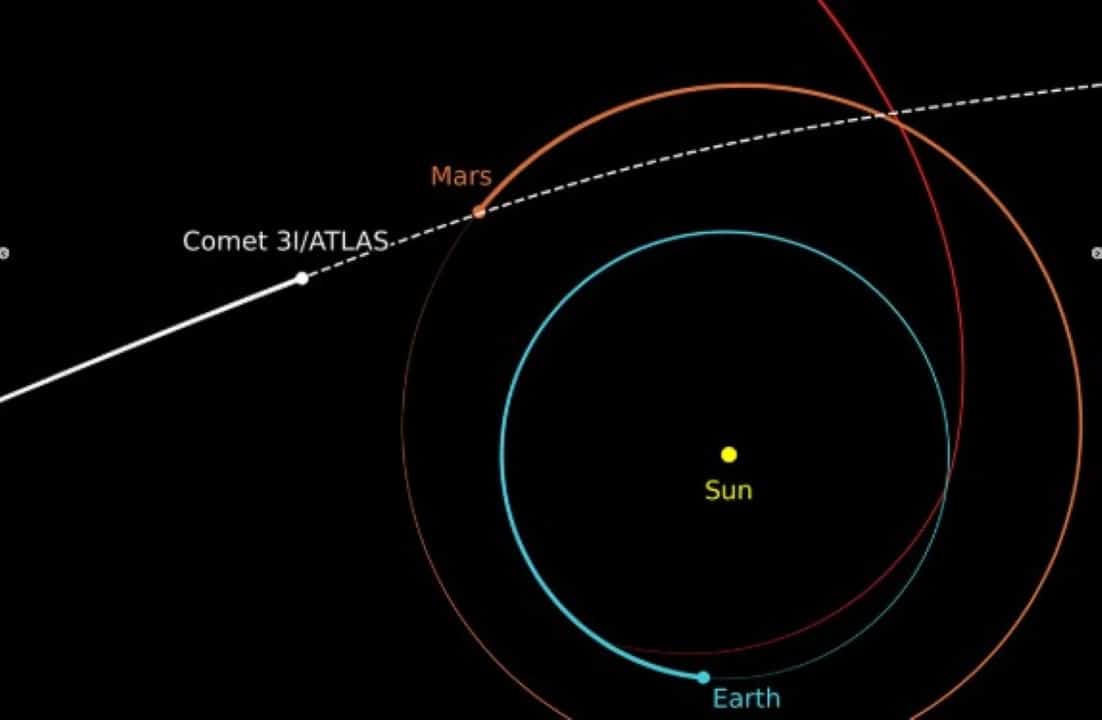
Records captured by Telescópio Espacial Hubble have revealed complex, dynamic behavior in a cosmic visitor who recently crossed Sistema Solar. The images, taken in December 2025, show an unusual configuration of double jets on comet 3I/Atlas, including an “anti-tail” that challenges traditional visualization of these celestial bodies. The object, which had its closest passage to Sol in October of the same year, remains active as it follows its trajectory out of deep space.
Analysis of the data, processed by astronomy teams in early 2026, highlights the presence of a dominant jet pointed towards Sol and another weaker flow in the opposite direction. Essa peculiar structure suggests intense internal processes in the comet’s nucleus, possibly linked to its rotation and the way in which solar energy was absorbed and redistributed by the object’s surface during perihelion.
Using the WFC3 UVIS instrument with 170-second exposures, Hubble was able to accurately detail the morphology of the coma and jets. The persistence of activity even after Sol moves away offers scientists a rare opportunity to study the composition and mechanics of bodies originating from other stellar systems.
Jet dynamics and rotation
Observations carried out on different dates, specifically on December 12th and 27th, allowed astronomers to identify significant variations in the intensity of the jets. Image processing indicates that the structure is not static, but rather evolutionary, which raises hypotheses about the nucleus’ rotation period. Estima oscillations in luminosity are expected to be compatible with a rotational cycle of approximately 16 hours.
The observed configuration differs substantially from the pattern seen in native Sistema Solar comets, where the tail generally extends just in the opposite direction to Sol, pushed by the solar wind. In the case of 3I/Atlas, the simultaneous presence of flows in opposite directions suggests that the nucleus may be ejecting material from different poles or that the particle dynamics have unique characteristics.
- Primary jet: forms the so-called anti-tail, visible and extended towards the Sol.
- Secondary flow: has lower intensity and alignment opposite the main jet.
- Temporal variation: changes in brightness and shape detected between the two photo sessions.
- Collimation: the jets remain narrow, indicating localized emission sources.
These elements point to a possible transfer of thermal energy to the night side of the comet, activating the release of gases and dust in regions that were no longer under direct illumination.
Particle characteristics and ejection
The formation of the prominent anti-tail is attributed, in part, to the physics of particles ejected by the nucleus. Grãos of larger dust, less susceptible to the pressure of solar radiation, tend to remain in the comet’s orbital path, creating the visual illusion of a tail pointed towards the star. In contrast, smaller particles are quickly pushed away, forming the conventional tail.
Ejection velocity measurements reinforce this theory. Enquanto Smaller, lighter particles reach escape velocities of around 22 meters per second, larger, heavier grains move at about 2 meters per second. Essa difference in speed results in the spatial separation of materials, allowing Hubble to distinguish the different structures in the object’s coma.
The extent of the observed coma reaches hundreds of thousands of kilometers, an impressive scale for a nucleus whose size estimates vary between 440 meters and 5.6 kilometers. The continued mass loss suggests that the object is rich in volatiles that sublime vigorously even at increasing distances from the heat source.
Galactic origin and trajectory
The hyperbolic orbit of 3I/Atlas confirmed its interstellar nature, classifying it as an object that did not form in our system’s primordial cloud. Estudos spectroscopic and trajectory data indicate that this celestial body may have originated in the thick disk of Via Láctea, with an estimated age greater than 7 billion years. Sua composition, rich in irradiated organic compounds, has a reddish color similar to that of type D asteroids.
The passage through the inner Sistema Solar caused only a slight orbital curvature of 16 degrees due to solar gravity, preserving the fundamental characteristics of its pre-perihelion rotation. Essa stability allows astronomers to consider current observations as representative of the natural state of the object on its journey through the galaxy.
As the comet recedes, ground- and space-based telescopes, including James Webb (JWST), continue to monitor its behavior. Cada new data collected helps refine models about the formation of planetary systems and the distribution of organic matter in the universe.
SEO Keywords:Cometa interstellar 3I/Atlas, Imagens Hubble 2025, Jatos double comet, Anti-solar tail, Astronomia space.



