
Object from another star system surprises astronomers with X-ray halo and rare composition


Space telescopes recorded unprecedented behavior on the celestial body identified as 3I/ATLAS, consolidating its importance as the third confirmed interstellar visitor in history. The detection of a diffuse halo of X-rays around the nucleus marks the first time such a phenomenon has been observed in an object with origins outside our planetary system, offering crucial data on the interaction of exotic materials with the solar wind.
The object is now heading towards the most distant regions of the cosmos, after reaching its closest approach to Terra last December. Sua hyperbolic trajectory confirms that it is not trapped by Sol’s gravity and will never return, which has made the observation window extremely valuable to the international scientific community.
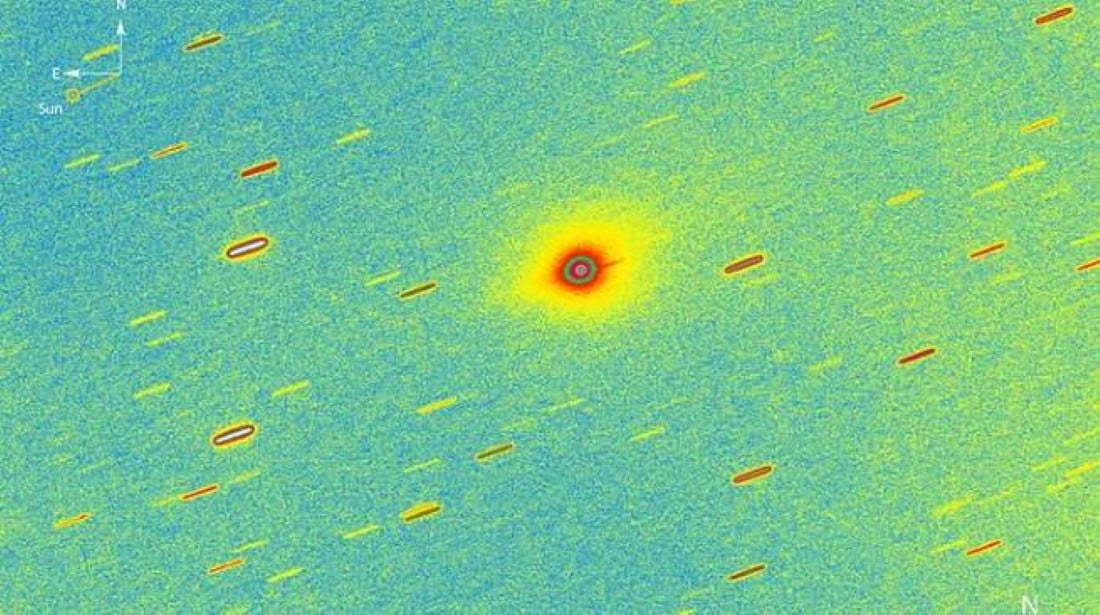
Data collected by observatories such as XMM-Newton and Hubble revealed unique characteristics that differentiate this body from local comets:
- X-ray emission resulting from collisions between solar particles and gases released by the nucleus.
- Extreme speed that reached over 240 thousand km/h during perihelion.
- A chemical composition that suggests formation in a dry and distant environment.
The passage of this cosmic traveler allows researchers to test planetary formation models from other star systems. The information obtained indicates that the comet was probably ejected from its original system billions of years ago, wandering through space until it crossed the neighborhood of Terra.
Peculiar chemical signature
Spectroscopic analyzes pointed to an unusual proportion of elements in the 3I/ATLAS structure. Diferente of the comets formed in our Sistema Solar, which generally have large amounts of water, this object has a high concentration of carbon dioxide. Essa characteristic suggests that its sublimation occurs at greater distances from a host star.
Another highlight was the detection of high levels of nickel compared to iron, in addition to the presence of methanol. The coma, a cloud of gas and dust that surrounds the nucleus, evolved showing a reddish color and larger than usual dust grains, reinforcing the thesis of a distinct origin and unique formation processes.
Dynamics and speed
The object’s orbit was accurately calculated, revealing that it entered the system from the direction of the constellation Sagitário. The gravitational influence of Sol altered its route by just 16 degrees, a minimal deviation given the high escape velocity that the celestial body maintains.
Currently, the comet crosses the orbit of Júpiter as it accelerates toward interstellar space. Embora its brightness is decreasing as it moves away, professional telescopes continue to monitor its magnitude, located between 13 and 15, to extract the last possible data before it becomes invisible to even the most powerful equipment.
Observations carried out at the end of 2025 also identified an “anti-tail” of dust pointed towards Sol, a geometric perspective effect, in addition to double jets of ejecta linked to the rotation of the nucleus.
Distinct luminous phenomena
The greenish glow observed in the coma of 3I/ATLAS has caught the attention of astronomers since November. Essa specific coloration is the result of the excitation of diatomic carbon and cyanide molecules by ultraviolet radiation, a process that intensified rapidly after passing through the closest point to Sol.
The emission of X-rays, detected in early December, comes from the exchange of charges between the solar wind and neutral atoms around the comet. Analysis of these emissions revealed the release of gases such as oxygen and carbon, providing a “fingerprint” of the matter that makes up this primordial artifact from another star system.
Keywords: comet 3I/ATLAS, space X-rays, interstellar object, chemical composition of comets.
Long-tail keywords: discovery of X-ray halo in interstellar comet.



