
Observers can observe a reduction in lunar luminosity this Saturday before the last quarter phase

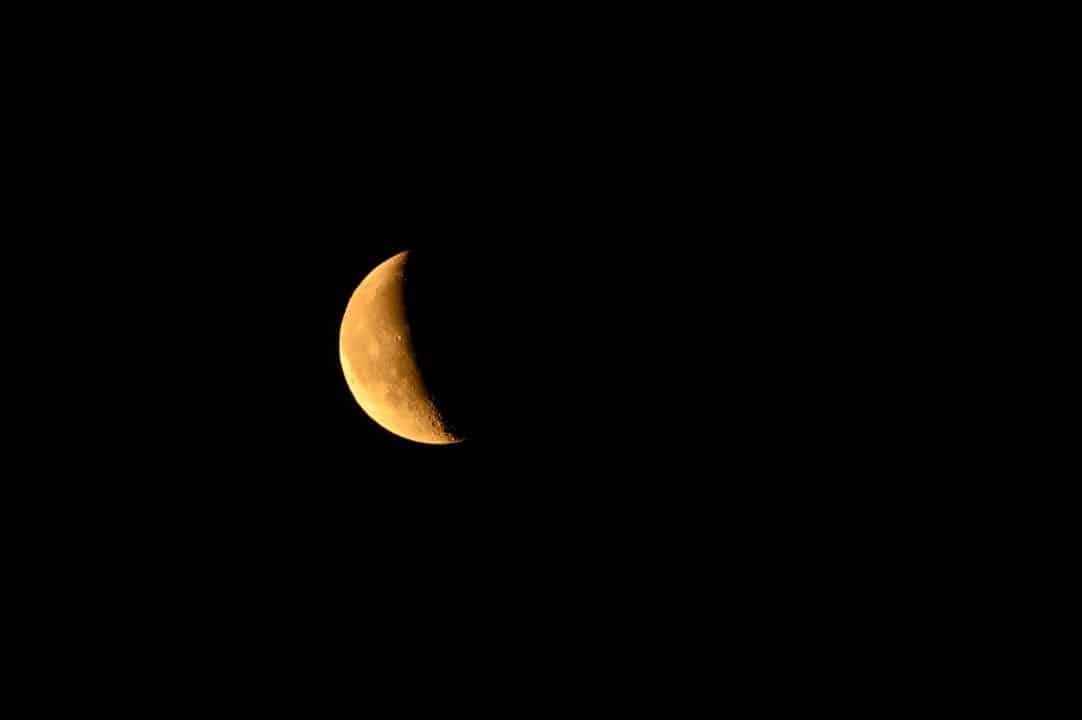
The night sky this Saturday, February 7th, offers a specific configuration for astronomy enthusiasts and casual observers. The natural satellite of Terra is in the phase known technically as gibbous waning, with 72% of its illuminated surface visible. Este stage marks the period of gradual transition between the full moon, which occurred at the beginning of the month, and the waning quarter phase, expected for the next few days.
The main characteristic of this moment in the lunar cycle is the progressive reduction in luminosity. Diferente of the full phase, where the disk appears complete, the gibbous configuration displays a convex shape, with a dark portion already noticeable on the right edge of the star, considering the perspective of the southern hemisphere. The phenomenon occurs due to the orbital movement of the satellite around the planet, changing the angle of incidence of reflected sunlight.

Astronomers and meteorologists indicate that Saturday night is suitable for identifying lunar craters and seas, especially on the line that divides the illuminated part from the dark part, called the terminator. The shadow cast in this region highlights the relief of the lunar surface, making it easier to see geological details even with basic optical equipment, such as binoculars or telescopes.
The current positioning precedes the official entry into the last quarter phase, which will occur in approximately 48 hours. Durante this interval, the lighting rate will drop rapidly until it reaches 50%, at which point the cycle enters its final stretch towards the new moon. Observation depends directly on local weather conditions, with areas of clear skies providing greater clarity.
February astronomical timeline
The lunar calendar follows a rigorous pattern determined by celestial mechanics, completing a synodic cycle every 29.5 days. Para the current month, the dates were calculated based on the time zone of Brasília, serving as a reference for observers throughout the national territory. The month started with maximum luminosity and continues to decrease.
The main phase transitions occur at exact times, marking the changes in geometry between Sol, Terra and Lua. Monitoring these dates helps in planning activities that depend on night light, such as fishing, agriculture and astrophotography itself.
- Full moon: Ocorreu on February 1, at 7:10 pm.
- Waning moon: Prevista for February 9, at 9:44 am.
- New moon: Acontecerá on February 17, at 9:03 am.
- Waxing moon: Fechando cycle on February 24, at 9:28 am.
This schedule highlights that the second half of February will be marked by progressively darker nights until the 17th. Após the new moon, the satellite appears again in the afternoon sky, starting the process of increasing the illuminated area.
Celestial mechanics and lighting
Understanding the lunar phases requires understanding the relative position of the stars in the solar system. The waning gibbous phase, the current stage, occurs when the Lua has already surpassed the opposition to the Sol (full moon) and moves towards the quadrature (waning quarter). At the Neste point, more than half of the disk still receives visible direct sunlight from the Terra, but the angle is closing.
The term “gibbous” refers to the rounded, but not circular, shape that the star assumes. The transition is continuous and does not occur in jumps; the definition of the main phases at specific times serves only as an astronomical landmark for the exact moment of geometric alignment. In practice, the visual change is perceived night after night by the reduction of the illuminated slice.
During the waning phase, the satellite tends to rise later and later on the eastern horizon. Enquanto the full moon appears at sunset, the waning gibbous appears a few hours after dark and remains visible during the early morning hours of the following day, on the western horizon.
Regional visibility conditions
The experience of observing the phenomenon varies significantly according to geographic location and prevailing atmospheric conditions. No Brasil, the vast territorial extension causes differences in the stability of the sky. Regiões with lower levels of light pollution and low relative humidity tend to offer sharper and more contrasted images.
At Sul and Sudeste, cold fronts or areas of high pressure can clear the atmosphere, creating ideal windows for amateur astronomy. Já in regions Norte and Nordeste, the cloudiness typical of this time of year can interfere with visibility, requiring observers to take advantage of brief cloud-free intervals.
Coastal areas have the advantage of a clear horizon over the ocean, which favors the observation of the sunrise or sunset of the Lua. However, salt spray and atmospheric turbulence at sea level can slightly distort the image when the star is close to the horizon.
Impacts on tides and environment
The presence of Lua exerts a direct influence on ocean tides through gravitational force. Embora the full moon phase causes the most intense tides, known as spring tides, the gibbous waning phase maintains a considerable gravitational attraction. The movement of water follows the movement of the satellite, affecting ports and coastal areas.
The distance between Terra and Lua, which orbits on average at 384 thousand kilometers, also suffers small variations due to the elliptical orbit. Quando phase coincides with perigee (closest point), tidal effects can be amplified. Monitorar the lunar cycle is essential for navigation and for communities that depend on coastal dynamics.
The current cycle is moving towards the new moon phase, when the tides return to greater amplitudes due to the alignment between Sol and Lua, adding their gravitational forces. Até there, the tidal range tends to gradually decrease during the last quarter.
Tools and registration
Modern technology has made it easier to track celestial cycles. Aplicativos astronomy and specialized websites provide real-time data on the azimuth and elevation of Lua for any location. Essas tools allow you to know exactly where and when the satellite will appear on the horizon, optimizing observation time.
Astronomy clubs and observatories often hold public sessions on these dates. The use of telescopes makes it possible to view lunar mountain ranges and the contrast of light and shadow in craters, details that go unnoticed with the naked eye. Photographic recording is also favored at this stage, as the brightness is not as intense as during a full moon, allowing captures with better exposure balance.
Keywords: gibbous moon today, lunar calendar February, observational astronomy, moon phases 2026.
Long-tail keywords: Visibility of the gibbous gibbous moon in February 2026.
Sources researched:
https://www.inmet.gov.br/portal/
https://www.on.br/
https://www.timeanddate.com/moon/phases/




