
SPHEREx telescope reveals building blocks of life on interstellar comet 3I/ATLAS from another system

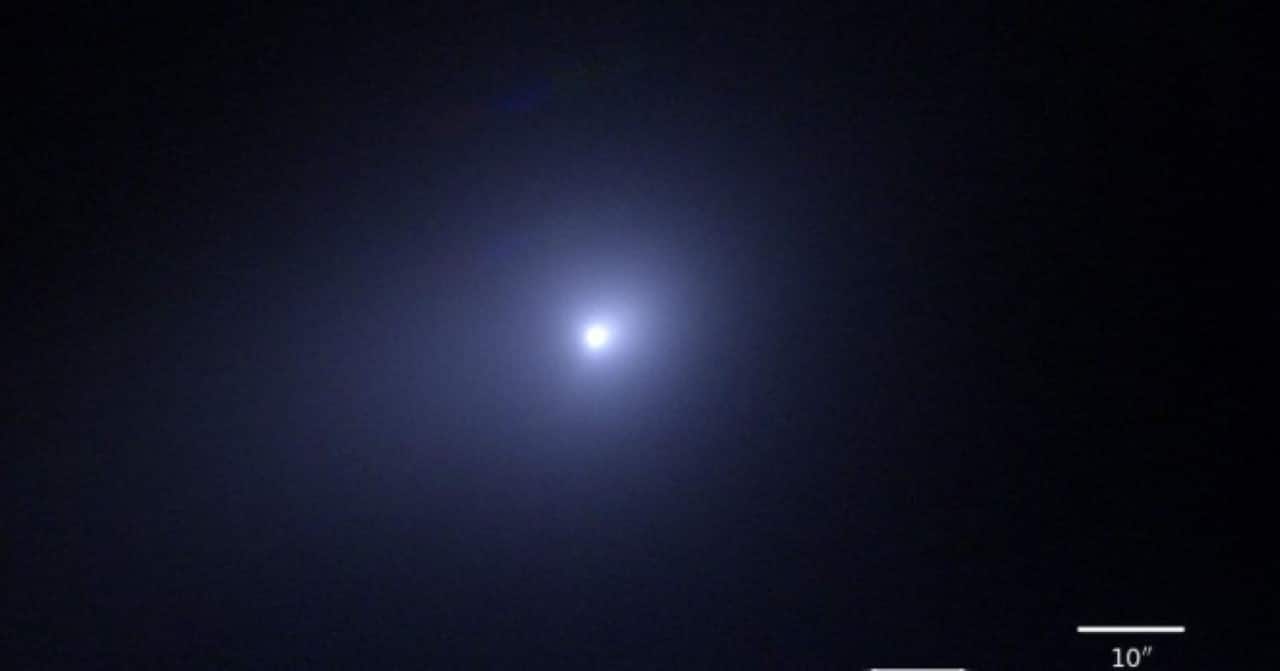
NASA’s SPHEREx space telescope recorded unprecedented details about the interstellar comet 3I/ATLAS in December 2025. The observations showed the presence of complex organic molecules, considered essential components for the formation of life.
The comet, discovered in July 2025 by the ATLAS system in Chile, passed through perihelion in October and showed a significant increase in brightness two months later. Esse phenomenon allowed the detection of substances preserved for billions of years.
The data indicates that the object carries primordial materials from another star system. The analysis reinforces the understanding of the distribution of chemical compounds in the universe.
Discovery and trajectory of the comet
Comet 3I/ATLAS was initially identified as an object in hyperbolic motion. Observações confirmed her origin outside of Sistema Solar, making her the third recorded interstellar visitor.
The ATLAS system, responsible for detection, operates telescopes at Chile and other locations. Ele constantly monitors threats near Terra and distant objects.
After confirmation, astronomers monitored its approach to Sol. Perihelion occurred in October 2025, when solar heat began to activate inner layers of the core.
🚨NASA’s SPHEREx Mission Tracks Brightening of Interstellar Comet ☄️✨
— 3I/ATLAS updates (@Defence12543)February 4, 2026
😱For only the third time ever, astronomers are closely studying an object that originated beyond our solar system—and this one is putting on a spectacular show 🌌.
⚠️NASA’s SPHEREx space telescope 🔭 has…pic.twitter.com/BcO7o1tmLg
Unexpected increase in brightness
The comet’s brightness grew noticeably in December 2025. Esse flare happened about two months after Sol’s closest pass.
The phenomenon resulted from the gradual penetration of solar heat through the outer crust. Camadas deep ice began to sublimate, releasing accumulated gases and dust.
Researchers recorded the formation of an extensive coma around the nucleus. Essa temporary atmosphere included water vapor, carbon dioxide, and solid particles.
The process revealed materials that had remained intact for billions of years. The surface crust protected the interior against cosmic radiation during interstellar travel.
Chemical composition revealed
SPHEREx captured emissions in multiple infrared bands. The data showed the presence of several organic molecules in the comet’s coma.
Among the compounds identified are:
- Methanol, common in terrestrial biochemical processes;
- Methane, a simple but relevant gas for prebiotic chemistry;
- Hydrocyanic compounds, amino acid precursors;
- Water vapor, basis for complex chemical reactions.
About a third of the object’s mass consists of water ice. When sublimating, this ice releases carbon-rich particles and dark dust.
These materials carry information about the conditions of the star where the comet formed. Preservation occurred thanks to the protective crust developed in interstellar space.
Unique capabilities of SPHEREx
The SPHEREx telescope operates in 102 infrared spectral bands simultaneously. Essa capability allows mapping chemical compositions with high precision.
During December observations, the instrument recorded emissions of dust, ice and gases. The images showed the coma stretching hundreds of thousands of kilometers.
Scientists highlight that the timing of the observations was ideal. The burst of activity coincided with the telescope’s monitoring window.
The SPHEREx mission was originally designed to map the universe on a large scale. However, its flexibility allowed it to direct attention to transient objects like this comet.
Context of interstellar comets
Interstellar comets offer rare views of distant planetary systems. Até At the moment, only three confirmed objects have visited Sistema Solar.
The first was 1I/’Oumuamua, detected in 2017. The second, 2I/Borisov, appeared in 2019 and showed clear cometary features.
3I/ATLAS follows a similar hyperbolic trajectory. Sua speed and composition reinforce the origin external to our system.
- Hyperbolic trajectory indicates speed greater than solar escape;
- Composition rich in volatiles differentiates it from local asteroids;
- Presence of coma and tail confirms cometary activity;
- Molecules detected resemble comets from Sistema Solar.
Preservation of primordial materials
The long journey through interstellar space exposed the comet to cosmic radiation. Essa exposure formed a hard crust on the surface.
Under this protection, inner layers remained unchanged. Recent solar heat has activated the sublimation of these deep ices.
Scientists estimate that the released compounds date back to the object’s original formation. Eles represent chemical conditions of a distant star billions of years ago.
The gradual release of material allowed detailed observations. The collected data contributes to public astronomical research databases.
Implications for astrobiology
The presence of complex organic molecules reinforces hypotheses about chemical panspermia. Esses compounds are basic building blocks found in terrestrial organisms.
Although it does not indicate extraterrestrial life, the discovery shows a wide distribution of these elements. Sistemas varying stellars can produce similar prebiotic chemistry.
Future research will analyze SPHEREx data in conjunction with other missions. The goal includes better understanding the formation of planets and molecules in the universe.
Comet 3I/ATLAS continues to move away from Sistema Solar. Sua speed prevents return, but records remain available for extended studies.
Technical details of the observations
The observations took place between December 2025 and early 2026. SPHEREx captured images in ranges from 0.75 to 5.0 microns.
The carbon dioxide coma stretched for at least 348,000 kilometers. Essa dimension surpasses many previously observed comets.
Additional records from other telescopes confirmed the findings. The combination of infrared and optical data enriches chemical analysis.
Scientists highlight the rarity of capturing an interstellar object in full activity. The post-perihelion outbreak provided a unique window for detailed study.
Comparison with previous objects
Unlike ‘Oumuamua, which showed no visible coma, 3I/ATLAS displayed clear activity. Essa feature facilitated the detection of volatiles.
In relation to Borisov, the new comet has a greater amount of carbon dioxide. The proportions of ice and dust also vary.
These differences reveal chemical diversity between stellar systems. Cada interstellar visitor brings unique signature of its origin.
The preservation of organics at 3I/ATLAS exceeds initial expectations. The protective crust has maintained materials in a primordial state for cosmic eons.
Advances in space monitoring
The case of 3I/ATLAS demonstrates the evolution of detection systems. Redes like ATLAS identify distant objects with greater efficiency.
Space telescopes like SPHEREx complement ground-based observations. Infrared coverage reveals details invisible in optical light.
Future missions plan continuous monitoring of interstellar visitors. The goal includes capturing more data on composition and behavior.
The integration of multiple instruments expands astronomical knowledge. Cada new object contributes to mapping galactic chemistry.



